I said, “You must do what your heart tells you to.”
The Guardsman lifted his goggles and looked at me with warm, not angry, eyes and said, “Yes.”
And that’s the last thing I remember.
© 2025
Church of the Open Road Press
I said, “You must do what your heart tells you to.”
The Guardsman lifted his goggles and looked at me with warm, not angry, eyes and said, “Yes.”
And that’s the last thing I remember.
© 2025
Church of the Open Road Press
…a Memorial Day Tradition…
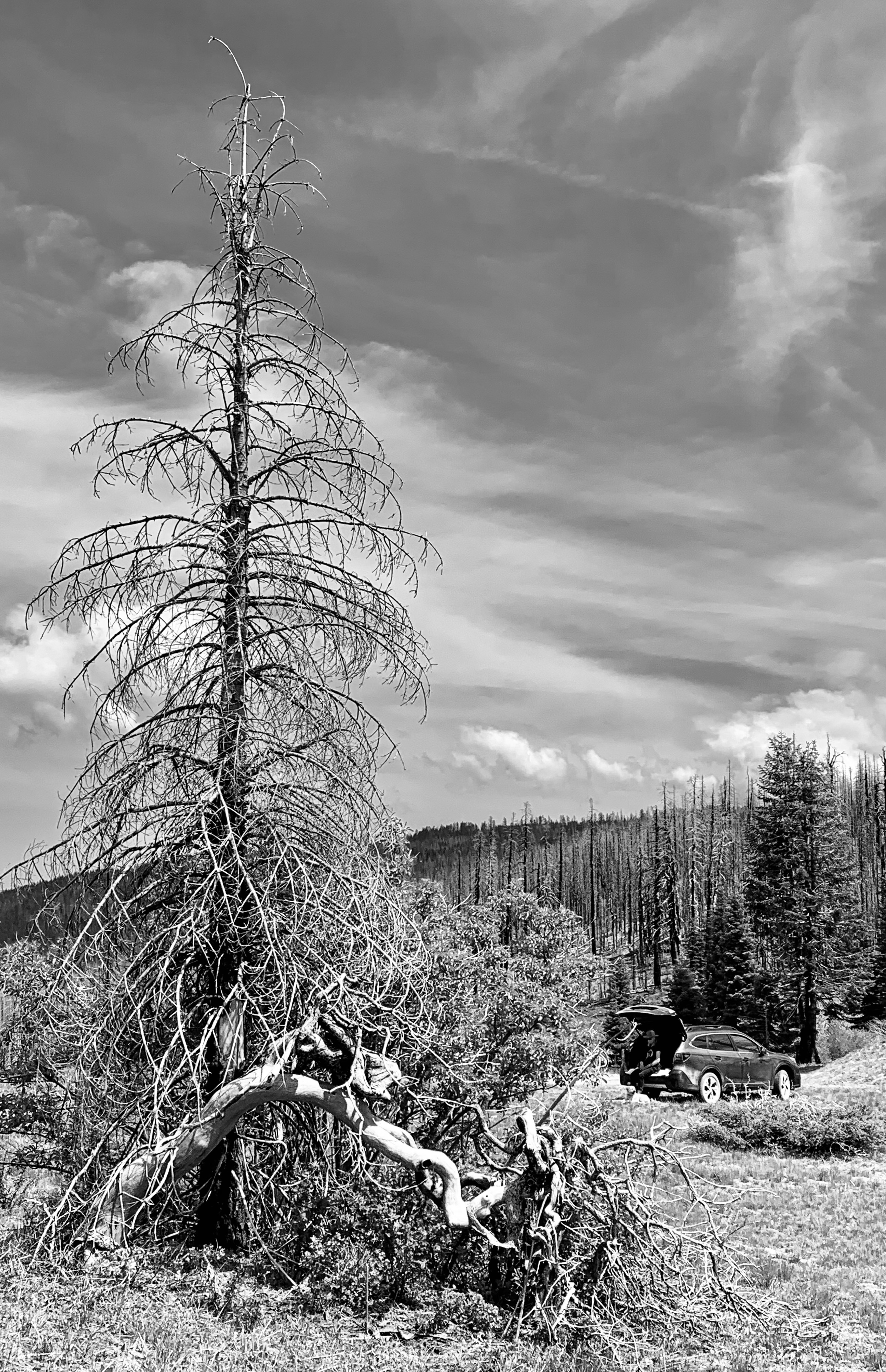
On or about Memorial Day in good years, I’ll make the trek up to Simpson Camp (western edge Glenn County near Mendocino Pass) with a loved one or a few to reminisce about 1960s-era visits to that old sheep camp with the sheepherder who worked the area forty years before. [Details are recounted in “Eden Indeed: Tales Truths and Fabrications of a Small Town Boy” pages 186-203] Our family reveled and relaxed in the beauty and solitude of the cool evergreen forests, velvet soft glades and clear starry nights.
In 2020, we fulfilled one of Mom’s final wishes and held a memorial for her at Simpson Camp, leaving her beloved shillelagh tucked beneath a fallen timber. Within months, the devastating August Complex fire roared through searing the trees, wiping out any sign of the camp, and leaving only a trace of white ash where Mom’s stick had lain.
Back in the sixties, a small cluster of oak trees grew at the top of the ridge, visible from camp. Dad said it looked like a Greek Chorus, whatever that was. On a clear day, standing near to those oaks, looking west, one could see the fogbank of the Pacific shore; looking east, Lassen Peak: the whole of my northern California growings-up. As we lunched after Mom’s memorial, I called a granddaughter and a nephew to visit that stand where they watched as I drove a wooden stake in the ground, observing the knowing nods of those from the next generation.
This recent visit found the old camp regenerating. Amid the blackened spires of standing deadwood, thickets of gooseberry and chemise were taking hold. The meadow was back and foresters were awork downing some of the standing deadwood and yarding it into piles for later care; all under the ever watchful gazes of a couple of circling red tails.
Curiously, that copse of tiny oaks had somehow survived the great fire. My stake in the ground was still my stake in the ground, confirming that, at some time-point in the future, I’ll witness ~ and be one with ~ the rebirth of Simpson Camp.
Photo Album 2025


Life returns to the meadow.

Someone has replaced the Zibe’s sign lost in the fire. (I had hoped to do this.)


Final view of the road winding down the hill.

My stake in the ground.
© 2025
Church of the Open Road Press
In praise of a good reference book…
…and a little kismet
For reasons I cannot recall, about a half century ago, I picked up a copy of Erwin Gudde’s California Place Names, the hardbound edition, at the used bookstore on Broadway in Chico…

…Maybe because new it was listed at $15.95 but this one was marked down to $13.50…

I’d probably picked it off the shelf and looked up Chico [page 62]…

…then Paradise [page 238], then Butte Creek [page 44] and learning useful trivia about the origins of the names of the places near which I’d grown up.

The wisdom of that purchase was confirmed a few years later when I served as a Fourth Grade teacher in Durham [page 96]…

…and kept it on hand in the back of my classroom. At the conclusion of my reading Scott O’Dell’s classic Island of the Blue Dolphins to the class, one of my students asked if the island was real and what was it really called. Pulling Place Names from the back counter, the kids learned about San Nicolas Island…

…and the Santa Barbara islands and a bunch of other one-thing-led-to-another- type stuff found in such a volume. After lunch recess, we always engaged in ten-minutes of silent reading. A little boy pulled the reference book from the back counter. He wanted to find out about the town where his grandparents lived. The next day another one picked it up.
Two or three years into my tenure as a fourth grade teacher, someone donated an aquarium to the class. (There’s a lesson here.) I gladly accepted it, and one Friday afternoon, set it up and filled it with water thinking that over the weekend the water would warm enough to be suitable for a goldfish or a guppy. Monday, I discovered not an aquarium filled with warm water, but a countertop backed with water-logged books. Including Place Names…

…Tossing out some, having to pay for others, I kept Gudde’s volume knowing it was still serviceable once all the pages dried out. Yet, over the intervening fifty years, I’ve felt a pang of disappointment every time I leave through its crackly pages. So much so that I was always on the lookout for a replacement. I even purchased the 40th Anniversary edition (2004) in paper, but that fell short of relieving my angst.
During those Durham days, I was a regular attendee of the Bidwell [John Bidwell, page 28 (entry) and 376 (glossary)] Presbyterian Church in Chico. I even served on their Session ~ the elective body that oversees policy for the congregation. The session was comprised of long-time members, many upstanding members of the Chico community: doctors, lawyers, university types, educators. Not sure how I qualified.
John Nopel, decades my senior, was one of ‘em. He and his wife always sat a few pews in front of me and the family I’d married into during my first attempt at matrimony. In reviewing his lovingly prepared obituary, it became clear that Mr. Nopel garnered many claims to fame beyond being an elder in the Presbyterian Church. A life-long member of Scouting, in 1934, he worked on the construction crew building Camp Lassen, the Boy Scout Camp where 54 years later, I wed [See Eden Indeed: Tales, Truths and Fabrications of a Small Town Boy pages 210-15]. As a school principal, Mr. Nopel opened Chico’s Hooker Oak School in 1948 and later served as an associate superintendent for the school district before moving to the county office. Career coincidence found me a member of Chico’s Phi Delta Kappa educational fraternity with him, later employed opening two new schools (elsewhere) myself. But, perhaps, most significant, he was the heartbeat of the Butte County Historical Society maintaining files and photos of the earliest years of my old stompin’ grounds. His library of historic texts and references must have been exhaustive.
Why might I think this? A couple of weeks back, I engaged in another of those searches for a copy of my long-damaged book. To my surprise, AbeBooks so called ‘sellers of books, fine art and collectables’ had one listed. In excellent condition. Priced at thirty-five bucks! (AbeBooks, it turns out, serves as a means for individuals to market their wares to an online audience. Note: I normally avoid shopping for books online.) Confirmation of my purchase came with a bit of information about the seller. Enough to tell me to whom this copy might have once belonged. The Chico address rang a bell.
The book arrived. The cover, sheathed in plastic perfect. The pages pristine. Side-by-side, it was an exact match for my waterlogged copy. I can’t say my throat didn’t constrict a bit.

That evening, I settled into a favorite chair with a thimbleful of favored scotch and began to thumb through. All the listings I’d referenced before were there as, of course, were entries about the new places I’ve explored…

…and before I knew it, an hour-and-a-half and fifty years magically dissolved.

Mr. John Nopel (1914 – 2006): Perhaps your greatest calling was that of teacher. Know that even now in 2025, you’re still in the business.
© 2025
Church of the Open Road Press
Ode to the Joys of First-Car Ownership
Commuting on a Honda Trail 90 wasn’t gonna get it anymore. Feeling like an adult at nineteen, I needed a car. I was drawn to British roadsters likely because one of my most memorable toys was the red Hubley MGTD Santa left when I was about four. My ninth grade English teacher, Mr. Reed, drove a baby blue Triumph TR3; the county sheriff’s kid, a year or two my senior, had an Austin Healy 3000. But I liked MGs: Midget or B. Either one. British Racing Green if possible.
Life, I was continually discovering, is nothing if not a series of compromises. One day, motoring south on Park Avenue past Arnie’s Kwality Kars on my Honda 90, I spied a yellow Triumph Spitfire parked at the corner of the front row. Pasted on the windshield was the bargain price: $1299. I rode around the block and puttered by again. Working half time at the wholesale house and making about two-and-a-quarter an hour, I somehow amassed most of that, so on day two, I stopped in for a closer look.

The sales guy was as nice as could be although his breath smelled like an ashtray that no measure of Hai Karate cologne could obscure. I wheeled down Park Avenue on a test drive with him. Although it was far from an MGB and yellow certainly wasn’t BRG, I was feeling a bit obligated because the sales professional ~ it may have been Arnie himself ~ told me he could make a good deal if I acted today. My experiential file in this regard contained only blank index cards and in less than an hour, $1200 lighter in savings, the ’67 Triumph Spitfire Mk3 was mine. So pleased was I with my coming-of-age purchase that the little cough or two it gave up leaving the lot would be of no concern.
My plan had been to park the Trail 90 and use it only on weekends up in the national forest, but plans have a way of not going as planned. After the Spitty stalled out multiple times at stop lights and Mr. Cigarette Breath said, “Gee, son, that’s too bad,” I found a foreign car service that would give my baby a good once over. The ensuing tune-up wasn’t too expensive but more than I wanted to pay and the mechanic said he’d had “a hell of a time” trying to sync the carbs, but I nodded and paid and drove away. Two days later, I was back and the kind mechanic said he’d give the carbs another shot “free gratis.”
Ultimately, I figured that a bit of sputtering must be the spit part of owning a Spitfire, so I decided I’d enjoy the ride in this sleek British marvel even if the ride wasn’t always so enjoyable.
A couple of months into ownership, I hooked up with Brother Beebo who was home on leave from the Army. Beebo knew more about cars than I did, which arguably still wasn’t much. “You just need to blow the carbon out,” he said.
“Blow the carbon out?”
“Yeah. Let’s hop in and take it out to Seven Mile Lane and just get ‘er going and blow the carbon out of the system.”
“Ummm… Okay.”
Seven Mile Lane is (or was) a straight stretch of country road bordered by acres and acres of corn. Rural, it proved a mecca for hot rodders on Friday or Saturday nights engaging in “run it for pink slips.” I never quite knew what that meant but it didn’t matter because this was a Thursday or a Wednesday afternoon.
Top down on the little roadster, we turned off Dayton Road on to Seven Mile and Beebo said, “Hit it!”
So I did. Within about 20 seconds we were going a good sixty miles an hour. Then sixty-five. Then seventy! Seventy-five! The little four cylinder topped out at 82. I checked the rearview mirror to, indeed, see a cloud of black smoke gushing from the tailpipe.
Over the roar of the engine, Beebo yelled, “Let’s find out what the brakes will do!” So I crammed on the pedal.
God or someone who’d engineered Seven Mile Lane made sure the shoulders of the road were wide. There must have been a good fifty feet between the pavement and the concrete irrigation ditches that lay parallel on either side. Across that expanse, gravel would give way to dirt then to weeds then to that water.
As it would turn out this day, half of the brakes worked just as commanded. I think they were on the passenger side of the car because as soon as I crushed the pedal, my little Spitfire’s ass end swung around in front of me, off the far side of the road, spit up some gravel and dough-nutted in a cloud of dust that took a good two or three minutes to clear. In those initial moments, I wasn’t sure how I hadn’t flipped the damned thing and, as Mom would often aver about young people who died doing stupid things, “Become a statistic.”
I killed the engine, waited for my pulse to subside and crawled out to tiptoe along the edge of the irrigation ditch and assess what, if any, damage, might have occurred to my Spitty. Beebo, by this time, was at the back of the car, sort of laughing. He had endured this near-death experience from the passenger seat. Although perhaps thinking active duty was somehow safer, he was gracious enough to drive the thing back home for me.
North Valley Volkswagen was at the north end of town. A week after the ‘incident,’ I dropped by. In 1971, VW had just come out with the Super Beetle, a marginally larger version of the car that so many Americans had grown to love. An orange one had just rolled off the transport truck, and after accepting $300 as a trade in, I found myself comfortably tooling around in a vehicle that was much more my style.
A week into ownership, I cruised down Park Avenue, and sitting at the prime corner position at Arnie’s Kwality Kars was a yellow Triumph Spitfire Mk3. Attached to the windshield was the bargain price: $1299.
© 2025
Church of the Open Road Press
…Hooked by my Himalayan…
From the outside looking in, a cult seems to embody some sort of collective allegiance to a concept, product or a leader that is patently false. History is full of cults. Contemporary societies, too. Examples?
1. False Products: Fizzies (remember those?), Beanie Babies, Coors Light.
2. False Leadership: [fill in the blank]
3. False Prophets: Jim Jones, David Koresh and others.
Typically, I’m thinking, cult membership is a response to a need for comfort, answers to tough questions or maybe simply a desire to belong. Sadly, the result of cult membership can often to lead to lost dreams, lost potential, lost savings and sometimes, loss of life itself. (See item 3, above)
But not always.

Membership in the cult to which I belong began innocuously enough. The plan was to accompany a buddy on his first motorcycle trip over the vaunted Beartooth Pass between Montana and Wyoming.

However, the one-week timeframe I’d set aside for the round trip wouldn’t allow for the 2400 mile round trip on my Yamaha Super Tenere. Perhaps I could find an alternative. A little internet search and I found a gentleman outside of Red Lodge who owned a small fleet of Royal Enfield Himalayan dual sport single cylinder machines. He rented them out to folks who, like me, wanted to explore the impressive Absarokas, but lacked the time to ride to and from. Rugged looking thumpers, stats showed they pumped – well, squeezed – out 22 horsepower, about a fifth of my big Yamaha’s grunt. I wondered if the little machine could haul my ample rear end up and around the winding Beartooth Highway to 11,000+ feet in elevation.
My first motorcycle was actually referred to as a “motor-driven cycle.” Purchased new from the Honda shop a half mile from my home in Chico, the Trail 90 banged out seven horses, requiring me to ride on the shoulder of any state highway that might lead me to a Lassen or Plumas National Forest road.

But the thing got 100 miles to the gallon and with that 1.1 gallon tank, I could go… well… about a hundred miles on 26 cents worth of gas. I bought the little Honda after obtaining a loan from Laurentide Finance and, for a while it being my only vehicle, put ten thousand miles on it in less than three years. The adventures on that yellow step-through remain a half-century later. Cheap transportation, Cheap explorations. Cheap adventures. Cheap fun. (And no, Mom, I wasn’t likely to kill myself on the damned thing; or even get too banged up.)
My view of the Himalayan was that it was a throwback to my Trail 90.

Cheap, rugged, light and it would take great effort for me to kill myself on one. The only question was, as stated above, would it haul my 220+ pound carcass up the Beartooth Highway from Red Lodge to Cooke City without holding up my buddy on his big Triumph? The posted speed limit of 35 for the bulk of the 68-mile trek would help and, the day before the big adventure, I test-ran the bike and found it could cart me around at 60-plus miles per hour so long as those miles weren’t particularly uphill.
After orienting myself to the quirks of the little 411cc powerplant, I was ready to join my pal and head up and over Beartooth.

He, on his Triumph Triple, soon left me with nothing but his fading exhaust note.
Everybody else in the world who enjoyed two wheels must have been on the Beartooth Highway that day. Nobody was traveling too fast. The scenery was simply too spectacular to race through. Wide spots and scenic viewpoints dotted the route and I found myself stopping at damned-near every one, along with hordes of others that day, including the boys on the big bad American Iron. Pulling into one, I parked next to a beautiful blue bagger just as the rider and his mate were about to saddle up.

“What the hell is that thing?” he asked stepping forward for a look.
“Royal Enfield,” I said. “Comes from India, of all places.”
“Sounds British.”
“It once was,” I said and I related a little bit of history I’d learned while researching the brand and model.
A couple of other riders joined in. “How long you had it?”
“Three days.”
“New?”
“Nope. A rental. I’m on a bit of a short timeframe. I live in California and left my FLNCH (I guessed at the Harley designation) home,” I lied. (Forgive me, Lord.) “A guy rents ‘em out of Red Lodge.”
We chatted a bit and soon the big boys were off. But it wouldn’t be our last conversation of the day. With almost every viewpoint would come the question, “What do you think of it now?”
What I thought about it was this: The Himi could accomplish highway-esque speeds, but I didn’t think that was the point. Roomy for my 34-inch inseam, upright seating that meant taking the wind head on, light and flickable even with the semi-knobby tires, it hadn’t taken me long to begin to enjoy the alpine environs and not think about the little burro that was hauling me along. Primarily, it reminded me of the simple pleasures I’d enjoyed on that Honda 90 so many years before.

The day’s journey was more than fine; and I had something to compare it to. Years before, returning from South Dakota on a BMW GSA, I took a wrong turn while searching for the road to Cody and found myself on the Beartooth Highway. That day, too, was spectacular, but this day was its equal. And I think this was when I got sucked into the cult.
Over the years since that second ride on the Beartooth Highway, I’ve traded one bike for another, finding myself more than enamored with Italy’s Moto Guzzi marque. Established a year before BMW and still manufactured in the same factory on Lake Como, Guzzi may be another two-wheeled cult to which I belong. I’m on my third sample.

As fate would have it, my current Guzzi, under warranty, somehow developed a crack in the fuel bladder and the part had to be shipped from Europe. There was a new model just like mine on the showroom floor, and had the shop been an enthusiast’s shop they’da pulled the bladder out of the floor model and sent me on my way. But unlike A&S in Roseville or Dave Richardson’s shop in the Seattle area or AF-1 in Austin, this was not an enthusiast’s shop. It was simply a dealership. One that carries, Guzzi, Aprilia, BMW, Zero (electric), Vespa and… wait for it… Royal Enfields. An unsold, year old Himi with a striking red and black tank was drawing me near.
I was eyeballing it and about to swing a leg over to try out the seat when: “Do you want to kill some time and take it for a spin?” the sales guy asked.
A wiser me would have said, “No thanks.”
The Guzzi and the Himi live side-by-side in my garage. The former great for 150-mile packed-side-case runs to Chico to see family or multi-day tours into Oregon or across the Sierra or down the coast. Powerful. Comfortable. Head turning Italian flair. Sweet!

The Himalayan is utilitarian, suited for simpler tasks. Basically I use for those thirty-minute errands to the neighboring town to buy a book, or hit the hardware store, or pick up a cigar or a reputable bottle of scotch. Curiously, those little jaunts never only last a half hour. With redwoods and riverbanks and vineyards and cresting hills, it’s easy to lull myself into a mini-tour – the Mendocino National Forest with its miles of unpaved roads isn’t all that far away – and find, again, the simple pleasures of the basic bike. The Honda 90 stuff I grew up with, upgraded with just enough juice to cart me around and not hold up other traffic.
But age 73 is rearing up to slap me in the face. A-fib, or something like it, is reminding me of how few chapters – or miles – might remain. Mom’s voice echoes, do you want to kill yourself on that damned thing? and I find myself admitting that longer-distance touring may be safer in the Subaru than on the Guzzi. With that in mind, I’ve been giving serious consideration to admitting my place in life and selling both bikes.

But my heart of hearts – occasionally aching though this one might be – tells me I probably won’t. I’ll keep the little red Royal Enfield.
Why?
Because I’m a member of the cult.
© 2025
Church of the Open Road Press
Outside of whining about my bad knees from time to time,
I steer clear of discussing personal health here.
This’ll be an exception:
So I took the little red rooster (my Royal Enfield) on a delightful ride Tuesday – 60 miles through foothills, redwoods and vineyards. Green hillsides dotted with poppies; deep forests smelling of moist, rich duff; dry roads perfect for a little sightseeing; fresh air.

Then about 2:00 AM on Wednesday, then again at 4:00, then again, in the awake-hours-morning a couple of times, I had another spate of those – for lack of a better term – arrythmias. Felt like a constricted something-er-other (or, at least there was some real pushing going on) and a little light-headedness or dizziness and, after three to five minutes of reclined rest, back to normal – until some next one comes along.
I’ll experience these being distributed through a few hours once every 10 to 12 weeks, then nothing. After each little event there are only shadows of the incident but, it’s always in the back of my thinking.
Speaking of that thinking, I got to thinking how unfortunate it would be should one of these occur while riding at sixty-five-plus miles per hour on US 101 or out on some back road with no cell service. So, today, I began thinking about marketing the bikes: Both that sweet little 411cc Enfield which I absolutely adore, and the more substantial and visceral 850cc Moto Guzzi traveling companion.

Before I got too deep into that hole, I decided to do a bit more research. Hell! The Church of the Open Road was built upon sharing motorcycle adventures, wasn’t it?
As it turns out, when it comes to things cardio, of the seven or eight do-s and don’t-s listed with a number of reputable sites like the Mayo Clinic and the Cleveland Clinic, and as elucidated by my Kaiser doc, I seem to be doing okay with all but two: eating enough fresh fruit and vegetables and keeping it to only one or two drinks. As much as I have declared I’m going to cut way down on the wine, whiskey and song – okay, maybe not the song – lately, I’ve been plowing through the better part of a whole bottle of cabernet or zin or some nice red blend every evening. EEE-Yikes!
Enough already!

Either that stops, I’ve decided, or I sell the bikes.
Big test on the horizon: Shortly, Candi will be out of the house playing bunco. (I wonder if Joe Friday or Bill Gannon will show up.) I have a small beef filet and baked potato – and some veges, dang it! – on tap for myself. A nice Cab is being eyeballed. Can I hold myself to one or two glasses?
© 2025
Church of the Open Road Press
…my two cents worth…
Stop the presses! The practice of minting the penny is going to be halted. Discontinued. Stopped. One of the two current Presidents of the United States has demanded it!
Why? Because, while the little copper colored disk has a face value of one cent, the cost to manufacture one costs 3.7 cents. It’s a money loser! It’s among the reasons the treasury of this Grand Republic is going bankrupt. It’s nothing personal; it’s strictly business. “I know, Godfather,” ~ think Abe Vigoda here ~ “Strictly business.”
But consider this (understanding that the pricing references in this commentary may be a bit out of date ~ like by about fifty years): On his way home from second grade, Billy drops by Harvey’s Market and, pulling a penny from his pocket, buys a hunk of Fleer Bubble Gum. Or maybe Bazooka ‘cuz their comics are better. Billy has gotten his one cent worth out of the penny and the coin goes into Harvey’s till until Mrs. Jones offers seventy-five cents in the form of three quarters for two bundles of carrots priced at twenty-nine cents a bundle. Billy’s penny leaves Harvey’s till as Harvey makes seventeen cents change. In dispensing the penny back into circulation, the one cent coin has seen two cents worth of action. Before Mrs. Jones goes home, she must go downtown to purchase some new boxers for Mr. Jones at JC ~ wait for it ~ Penney’s. But because of those damned parking meters, she must drop two pennies in the meter in return for twenty-four minutes parking. One of those pennies had belonged to Billy about an hour-and-a-half earlier. Around 6:00 PM, Rita ~ you guessed it ~ the meter maid, empties the parking meter which includes the traveling copper of this opinion piece. It has now returned three times its face value. Rolled and returned to the bank, the city receives value. Harvey, needing change for another day’s marketing shows up at the bank and buys ~ among other coinage ~ two rolls of 50 pennies each for a buck. David, the candy and tobacco wholesaler swings into Harvey’s Market to drop off several boxes of 24/fives (two dozen five-cent candy bars costing Harvey 90 cents a box) and two 10 pack cartons of White Owl cigars wholesaling for $3.18 each. The penny becomes David’s. David uses the penny when he stops by Big Al’s for a burger and fries and a low-cal Fresca at lunch and Big Al turns the penny over to a customer in change a few minutes later. In less than twenty-four hours, the Billy’s penny has changed hands eight or nine times returning eight or nine times its face value – far more than its cost of manufacture.

Coins are simply tokens ~ tokens that represent monetary value. But they are not the value itself. As the penny is exchanged its worth as a tool increases. The longer it circulates, the more worth is accrued. (The same might be said for us old people.)
Now, following this little diatribe ~ which I shall loftily refer to as ‘logic’ ~ it is evident that the minuscule penny holds far more worth than its face value; far more worth than its cost of manufacture.
Truth be told, I don’t really care if the US mint quits minting pennies, but given the above scenario and related elucidation, the death of the penny might well be viewed as a little ‘non-cents-icle.’
Author’s Note: What if the preceding wasn’t simply about the lowly penny? What if it was about USAID? Or the National Park Service or Forest Service? Or the reduction in IRS personnel charged with both expediting tax refunds and fighting tax fraud? What if the above was a metaphor for the indiscriminate ‘cost saving’ hatchet that cripples services to all Americans and our leadership in the twenty-first century world? What if, indeed...
© 2025
Church of the Open Road Press

