Showing posts with label Moto Guzzi Breva. Show all posts

Saturday, January 23, 2016

CHANGING DANCE PARTNERS: THE TWO-WHEELED VARIETY


The process of trading in one perfectly good motorcycle for another is a study in the art of rationalization.  I generally keep a bike for six to ten years. My bikes don’t sit in the garage, they get used, plenty.  I usually log between 40,000 to 60,000 miles – which is to say “far from used up” – before my fancy is tickled by something new.

That’s when those rationalizations begin.

My current rides are a 2009 BMW R1200 GS Adventure and a 2007 Moto Guzzi B-1100 ‘Breva’.  Both are excellent machines.   

The BMW is engineered to be driven around the world.  It is reliable, tough, dependable, and comfortable and, according to a 2009 issue of GQ Magazine, “the world’s best motorcycle.”  The Beemer’s boxer engine is iconic and although because of technological upgrades they’re not as easy to work on as they once were.  I don’t work on my bikes anyway.

The Moto Guzzi is a timeless example of how Italians marry design and function.  The thing is beautiful with fluid lines coupled to a bulletproof chassis and drive train.  Guzzi may lack the cachet of other Italian brands, but the marque has been going strong since 1922.  My little Breva eats up windy country roads and garners attention wherever it is parked.  As a “second” bike I’ve put fewer miles on it since I acquired it used, but it had never as much as hiccupped on the road.

So why think about something else?  Here come those rationalizations.

·      Having moved and downsized numerous things, it is time to downsize in the motorcycle department.  I need to get down to one.
·      That perfect BMW can take on any road (or non-road, for that matter) but I find myself less excited about picking the thing up off its side after misjudging the depth of gravel in a turn.
·      With an arthritic knee that telegraphs me something unpleasant about the aging process, kicking a leg over the high seat and wide panniers is becoming, on some days, problematic.
·      Final drives on my generation of BMWs have a bad reputation – probably due more to how quickly a shred of bad news can circulate on the internet than justified by the part’s performance – and final drive failures are costly to repair.
·      The dealer for my beautiful Breva is over 100 miles away.  Local motorcycle shops won’t so much as change the oil or adjust the valves because difficulties related to getting parts from Piaggio, Guzzi’s current parent company.
·      I’ve always been a bit too tall for the B-1100 but have been willing to sacrifice a tiny bit of comfort for the experience of riding a bike with such mojo.
·      I’m not riding 14,000 miles in a year any longer.
·      I’m not riding 500 to 600 mile days any longer.
·      I’m sticking to paved roads.
·      I do need space in that garage.

So what’s next for the garage?  Whatever was featured on the cover of the latest edition of Rider magazine?

Seriously, I’ve been snooping through the world-wide web looking for a touring steed: one that is comfortable for 300 or so miles in a day (but 500+ if I have to), neutral seating position, good handling, storage for a week’s worth of clothes.  Something that would invite me to ride out to the coast or up to the redwoods at a moment’s notice.  And something with some degree of that magical mojo that you feel as much as see.   

The current apple of my eye comes from England and, because the local (yes, “local,” meaning closer than two hours away) dealer is closing them out, a well-equipped model is selling for about four grand less than sticker.  (Another rationalization?  Sure.)


So, gentle reader: if you’re looking for a world-class adventure mount or a crowd pleasing Italian, get in touch.  Both have been well maintained and, when they are gone, I know I’ll regret it …maybe not today and maybe not tomorrow, but soon. And for the rest of my life… But those rationalizations are wearing away at my better judgment.  No telling how long I can hold out.


© 2016
Church of the Open Road Press

Thursday, September 17, 2015

THERAPY RIDE


Five weeks out…

The first good rain of the season came yesterday and everybody knows how good it smells the day after a rain.  The dry grass lays down and emits a glorious, sweet aroma.  Puffy white fair weather clouds dance across the sky, sometimes clinging to the tops of hills like whipped topping on a deep purple mocha.  All the dust and smog and smoke from nearby fires is knocked out of the air and all the roads all appear to be leading to Eden. 

It’d had been nearly five weeks since I’d gone in for surgery on my little finger.  Recovery from that trauma reminds me that joints in guys my age provide ample venues for arthritis to invade.  Not only is that gimpy finger stove up, so is the whole damned hand.  Perhaps a short spin on a lovely day will loosen things up a bit.  Maybe the vibration from the Guzzi’s throttle will be like a gentle massage.  Plus: the weather's so nice.


A favored short loop runs north on US 101 to Hopland, west-southwest on Mountain House Road and east on CA 128 back to Cloverdale.  The route includes both freeway speed and twisting turns against a backdrop of vineyards, open range, oak studded hillsides and historic barns and bridges.  The perfect route for a slightly rusty rider.

South of Hopland, the old 101 is now called River Road.  It traces the eastern side of the Sanel Valley through a canopy of oaks.  Cattle graze the hillside and pears grow in the bottomland.  Its two lanes are bucolic, superior to the nearby US route.

At the Campovida Winery (nice tasting room, wonderful gardens, superb wines) River Road intersects CA 175: closed to the east due to fire this day.  A jog west crosses the Russian River and puts me back in Hopland just south of the Bluebird CafĂ© (funky, homey, filling breakfasts; you’ll be treated like a regular).  Heading south on 101 for about a block, a right turn places me on Mountain House Road.  A mile on is the Terra Savia winery and olive oil mill (try the Meritage and pick up some Meyer Lemon Olive Oil.)

I’m out of Hopland almost as soon as I enter.  Mountain House Road is marginally maintained.  It’s easy to go slow and enjoy the rolling hills of the Coast Range.  Here, I find out that the Moto Guzzi massage-therapy theory I’d been operating on is, in reality, not so therapeutic.  My game hand didn’t appreciate having to maintain a consistent grip on the throttle while jarring across hummocky, broken pavement.

I stop ostensibly for some photos, flexing that out-of-shape hand.  The Spanish moss looks rejuvenated in the rains from yesterday.  The chill that had accompanied the front prompts colors to change on some of the area’s black oaks.

Crossing the historic Mountain House Road Bridge, I wonder if this road preceded River Road as the major north-south route 100 years ago.

Ten miles southish, I intersect with CA 128.  A right hand turn would take me 58 miles through wine country and redwoods out to the glorious Mendocino Coast.  But a left takes me eight corkscrew miles back to toward Cloverdale.  I elect to head back to the barn.  Sporting as the Moto Guzzi Breva is, my confidence has ebbed a bit; I pull to the side to allow an Audi to pass, receiving a courtesy wave in response. 

A warm water soak on my hand, once home, loosens things up enough that I can type.  I’ll try this again in a week or two…

© 2015
Church of the Open Road Press

Saturday, August 1, 2015

THE HOME OWNER


People You Meet on the Road:
Ukiah, California edition

10:00 AM today:  Backing the Moto Guzzi into a space in front of Mendocino Book Company – one of the closer independent booksellers to our new digs – I noticed a gentleman, about my age, pausing before getting into the newish Grand Cherokee in a neighboring slot.  The Jeep had some random building materials tied to its roof rack.

“Man, that’s a beautiful bike,” he said as I killed the engine.  His eyes flashed like those of one anticipating a fine stretch of curves on a perfect summer day.

I gave my pat response: “Better than I deserve.”

He moved closer, staring at the gleaming chrome and polished black paint on my Breva.  “I had a V-65 Lario.  Thing was bulletproof.  Compared to a Ducati?”  He buzzed his lips and shook his head.  “Loved that Guzzi.  Sold it 20 years ago.  Haven’t ridden since.”

I nodded knowingly, though I knew nothing about a ’65 Lario or most any other vintage Guzzis.  “Haven’t ridden since?”  I asked.  “Why?”

“Bought a house.”

[The reader will note that folks who ride (or rode) often speak in phrases, or at best, very short sentences.]

 “Well, we should get you back in the saddle.”  I handed him a Church of the Open Road calling card.

He glanced at the card then returned the bike.  “Love to, but can’t.”

“Why not?” I asked.

“Fixin’ the house,” he said gesturing toward the lumber on top of his Cherokee.

“You been fixin’ your house for twenty years?”

His gaze lowered to the paint stripe separating our vehicles.  “Yep.”  His now-crestfallen voice was nary a whisper.

Eventually, he looked up and, together, we laughed. 

He climbed into the Jeep, backed out and, as he drove off, said, “Some day…”


 © 2015
Church of the Open Road Press

Thursday, February 26, 2015

TUSCANY JUST UP THE ROAD


Two Visits to the Terra Sávia Olive Oil Mill and Winery

“How did you find us?”  The woman stepped from the shadows of the steel warehouse.  I was dismounting and removing my yellow Scheuberth that had rendered a hotspot on my forehead.  “How did you find us?”

I’d been exploring off-freeway lanes near my new Sonoma County digs and had taken a westerly turn onto Mountain House Road in Hopland.  “The poppies.”  I pointed to a small stand of bright orange blossoms swaying in a gentle springtime Mendocino County breeze.  Seeds had been broadcast and taken root in the soil at the margin where the asphalt apron at Terra Sávia abuts the roadway.  “I was thinking of getting a shot of my bike with the poppies in the foreground.”

“That’s a beautiful bike,” she said, eyeing my ’07 Breva. 

I stepped into the warehouse rubbing that hotspot and hoping my eyes would readily adjust to the dimly lit interior.  A few pallets of cased goods sat close by next to a table with a bit of clerical equipment, a collection of papers that reminded me of my home office organizational skills.  A well used office chair was tucked up to the table’s edge.   As my eyes made their way from daylight to warehouse light, a few more pallets came into view.  To the left was a tasting bar.

“Like to try some olive oil?  They’re all Italian varietals.”

“Just like the bike,” I said. 

I hated to admit that I didn’t know procedure when it came to tasting olive oils.  Beer?  Yes.  Wine?  Of course.  But olive oil?  A one-ounce portion control pleated white paper cup was placed in front of me.  A small amount of the fist sample was dribbled inside.  The woman began to explain about citrus tones, nutty tones, where to taste and lingering qualities.  Just like wine.  With the second sample, we began to compare and contrast…


Terra Sávia is a wholly organic small operation specializing in estate grown wines – cabs, pinots, merlots and a nice Meritage (rhymes with “heritage”) and a non-oaked Chardonnay; Italian varietal olive oils from trees on the property and wildflower honey from their own stash of bees.


Striking is the olive press imported from the home country.  The machine is active in October as Terra Sávia organics are first crushed daily, to be followed by the fruit of other local area growers.

Wandering through the facility, I see that local artisans display seating and tables, all far too large to be packed home on a motorcycle.  Flat art graces the walls and a classic Porsche begs one to salivate.

Outside, a rustic cabin awaits those wishing to stay for an overnight experience.

I purchased a bottle of Tuscan oil and set to stowing it in the diminutive Joe Rocket seat pack.

“Do you need a bag?” the proprietress asked.  “Is it padded enough?  Moto Guzzi.  Where did you say that bike comes from?”

“About two hundred miles north of the rootstock for your olive trees.”

And the conversation ensued.  Guzzi and BMW tourers know the routine, as do many others, I’m sure…


I didn’t taste wine on my first visit because I don’t do alcohol – not even a sip – if I’m riding a bike that new, cost more than my first house.  But I did return a few days later with family.  I’d been charmed not only by the honest, small operation feel of Terra Sávia, but also by the woman who showed such great interest in the Guzzi.

She recognized me as the fellow from earlier in the week as she poured first the Chard, then the reds.  More conversation.  More of that honest, small operation, down-to-earth, workin’ the land goodness – characteristics missing, sometimes, in the fancy winery spreads further south in the Dry Creek, Sonoma and Napa Valley appellations. 

Folks touring US 101 out of the Bay Area and north of Santa Rosa: this is a stop not to be missed.  (Open Fridays, Saturdays and Sundays.)

o0o

Notes: 

1) The Meritage goes nicely with a grilled peppered New York cooked medium rare.  I drool as I type this.

2) I need to go back and get that picture of the Guzzi amid the poppies.

Resource:  Information about this unique and interesting little place is found at: http://terrasavia.com/

o0o

Terra Savia's statement of philosophy.  One with which many might agree.
Today’s Route:  US 101 South from Eureka, Willets, Ukiah or North form San Francisco, Marin, Santa Rosa, Healdsburg to Hopland.  West on Mountain House Road at the burger joint.  Look for the Terra Sávia sign (and those poppies) on the right.  Return?  Continue on Mountain House Road through the rolling Coast Range Hills of interior Mendocino County intersecting CA 128 in about ten miles.  East will return the rider to US 101 at Cloverdale; west will take the rider through Booneville, along the Navarro River and out to the coast and CA 1.

© 2015
Church of the Open Road Press

Tuesday, April 22, 2014

A LOCALIZED VISIT TO TUSCANY

“How did you find us?”  The woman stepped from the shadows of the steel warehouse.  I dismounted and was removing a yellow Scheuberth that had rendered a hotspot to my forehead.  She repeated:  “How did you find us?”


I’d been exploring off-freeway lanes near my new Sonoma County digs and had taken a westerly turn onto Mountain House Road in Hopland.  “The poppies.”  I pointed to a small stand of poppies planted where the asphalt apron at Terra Sávia abuts the roadway.  “I was thinking of getting a shot of my bike with the poppies in the foreground.”

“That’s a beautiful bike,” she said as I peered into the shadows of the warehouse.

I stepped inside.  A few pallets of cased goods sat close by next to a table with an adding machine and some strewn papers.  As my eyes adjusted from daylight to warehouse light, a few more pallets came into view.  To the left was a tasting bar.

“Like to try some olive oil?  It’s all Italian varietals.”

“Just like the bike,” I said.

Terra Sávia is a wholly organic small operation specializing in estate grown wines – cabs, pinots, merlots, a nice Meritage (rhymes with “heritage”) and a non-oaked chardonnay; Italian varietal olive oils from trees on the property; and wildflower honey from their own stash of bees.  

Striking is the olive press imported from the home country.  The machine is active in October where Terra Sávia organics are first crushed, then fruit from other local growers.

Wandering through the facility, I see that local artisans display seating and tables, all far too big to be packed away on a motorcycle.  Flat art festoons the walls and a classic Porsche begs one to salivate.  

Outside, a rustic cabin awaits those wishing to stay for an overnight experience.

I purchased a bottle of Tuscan oil and set to stowing it in the Joe Rocket seat pack on the motorcycle.  

“Do you need a bag?” the proprietress asked.  “Is it padded enough?  Moto Guzzi.  Where did you say that bike came from?”

“About two hundred miles north of the rootstock for your olive trees.”

And the conversation ensued.  Guzzi and BMW tourers know the routine…


I didn’t taste wine on my first visit because I don’t do alcohol – even a sip – if I’m riding the bike.  But I did return a few days later with family.  I’d been charmed not only by the honest, small operation feel of Terra Sávia, but also by the woman who showed such great interest in the Guzzi.

She recognized me as the fellow from earlier in the week as she poured first the Chard, then the reds.  More conversation.  More exploration.  More of that honest, small operation, down-to-earth, workin’ the land goodness.

Folks touring US 101 out of the Bay Area and north of Santa Rosa: this is a stop not to be missed.  (Open Fridays, Saturdays and Sundays.)

o0o

Two footnotes:
The Mertiage complements nicely a grilled peppered New York Strip Steak.  I drool as I type this.
I need to go back and get that picture of the Guzzi amid the poppies.


Resources:
Info about this unique and interesting little place is found at: http://terrasavia.com/

Today’s Route:
US 101 South from Eureka, Willets, Ukiah or North from SF, Santa Rosa, Healdsburg to Hopland.  West on Mountain House Road at the burger joint.  Look for the Terra Sávia sign on the right.

© 2014
Church of the Open Road Press

Monday, November 11, 2013

MORE STUFF BY THE SIDE OF THE ROAD


Amador County Wine Country Edition

Our California riding season lingers into mid-November.  An hour or so away from the Sacramento area, nestled in the gold country foothills of Amador County, rests a growing-in-public-awareness wine-growing region.  A free morning with clear skies and moderate temperatures invites me to revisit the area.

East of Plymouth lays California’s Shenandoah Valley.  Drained by the Cosumnes River, the earliest Europeans dredged her waters for gold that would play out long before their dreams did.

In the intervening 160 years, agriculture – row crops, walnuts, grazing, berries and flowers – has given way to wine grape production. 

But remnants of those diverse agricultural days remain even as their wood foundations dissolve into the rocky soil.

Now, along Steiner Road and Shenandoah Schoolhouse Road, while old ranches have become quaint wineries, relicts of the former era stand as weathering sculptures honoring a not so long ago past.  An old caterpillar tractor (Ben Holt invented these not far away in Stockton)…

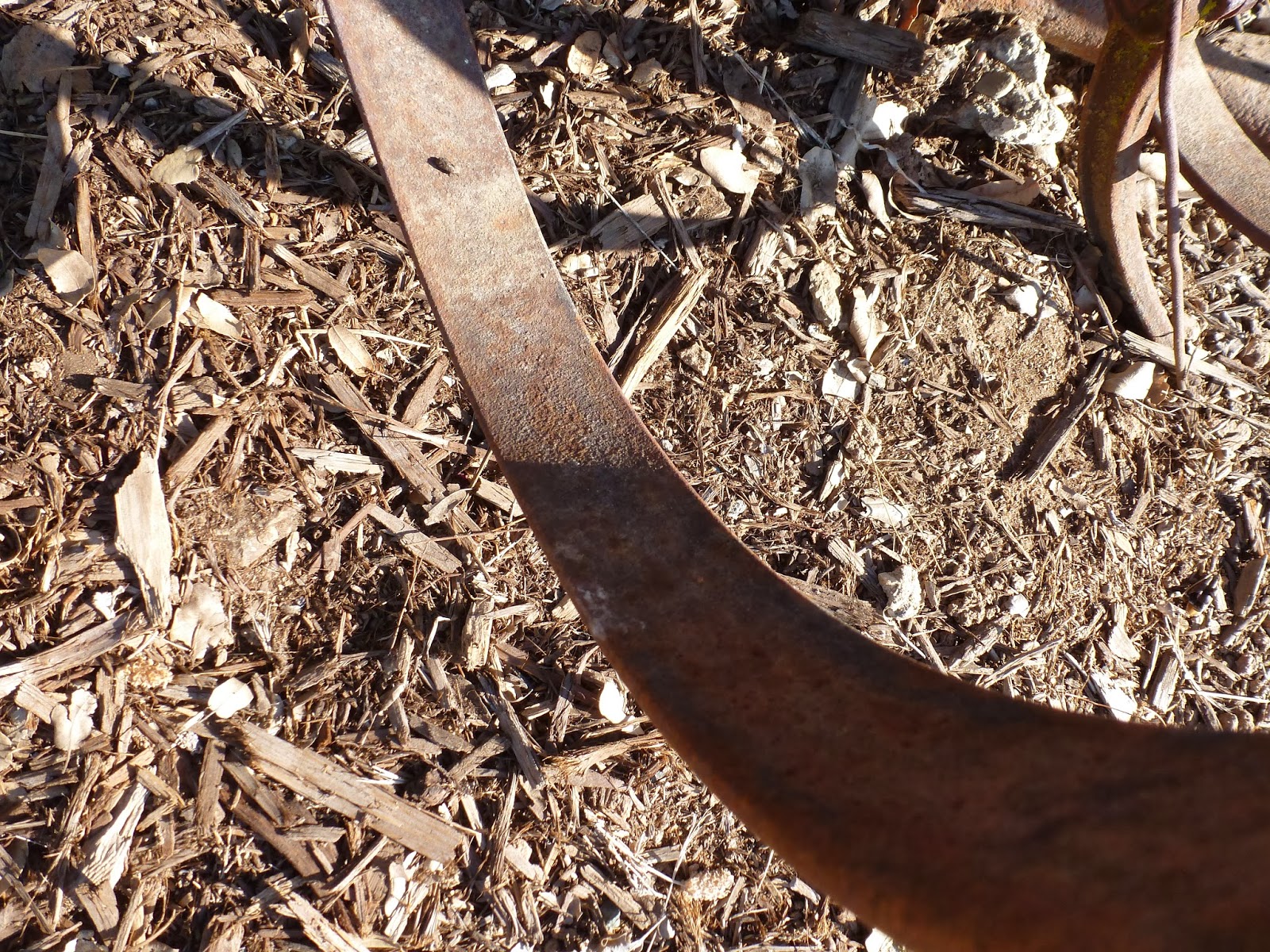
… a springtooth furrow, once used to till in anticipation of the next planting…

… another view of same…

… a disk rusts in the foreground of what once was a farmer’s field shanty turned into the tasting room for Story Vineyards.  Picnicking on this acreage affords a view of the Cosumnes.  From this vantage it is easy to see those grizzled sourdoughs looking back up the hill at us from a century and a half ago.

The autumn chill has turned the leaves to amber and gold…

… but at spots along the way, orchards not yet ploughed asunder for grape production still yield English Walnuts.

Old barns and old buildings fascinate.  A corrugated metal structure serves perhaps as a barrel room, perhaps as a workshop…

… and a red barn fronts a pasture still grazed by horses.

Glorious little roads twist behind hills and disappear.  They network in and out of stream courses and along historic fence lines.  This one leads me to a hidden gold rush era berg, one I wouldn’t have found if the road hadn’t beckoned as I crested a ridge.


I’ve visited the Amador vineyards many times since moving to the Gold County in the mid 80s.  Each time I return I find it’s been too long.  Each time I return I enjoy a relaxing rural environment that spans multiple generations; one that takes care to not depart from its historic roots.

Oh!  And the wine!

Twenty-nine years ago, I know because I just counted ‘em out on my fingers, we first discovered this region.  Living in Sonora, an hour or so south on 49, we had taken a Sunday drive, detoured off Steiner Road, up a gravel track to a metal building atop a knoll.  Amador Foothill the sign had said.  And it still does. 

In the tasting room one is likely to be greeted by either the vineyard tender (the husband) or the winemaker (the wife.)  It has been this way for 34 years, we were told yesterday as I purchased my usual half-case of Sauv Blanc – formerly known as Amador Fume.  I fill in the case with some luscious Zins and Italian varietals.  I put many of them in the “library” side of my wine rack at home.

Over the past three decades, many bigger-money wine operations have moved to the Shenandoah Valley with state-of-the-art tasting rooms, event centers, entertainment venues, bistros and paved parking.

But Amador Foothill, and a few others worth searching out, offer excellent wines at good value staffed by the farmer, his wife or one of the kids.  This is the place I seek out first.

o0o

Resources:

Amador Wine Growers Association: http://amadorwinegrapes.com

Amador Foothill Wines: http://blog.amadorfoothill.com/

Story Winery: http://www.zin.com/  (Cool URL!)

o0o

Aging cedar fence post
Today’s Route:  From Sacramento:  US 50 west to Latrobe Road.  South on Latrobe.  East (left) on Sacramento Road to Plymouth.  Cross SR 49.  Bear right toward Shenandoah Valley.  (Bearing left will land you in Fiddletown – a delightful blast from our gold rush past.)

Return:  Return to Plymouth and consider SR 49 north to El Dorado (ribs at Poor Reds) thence to Diamond Springs and Placerville (antiques, galleries.)

Or: Head east on Shenandoah Road to Mt. Aukum and on to Fair Play for some twisty pavement, river views and a case of Slug Gulch Red.

© 2013
Church of the Open Road Press

Saturday, September 28, 2013

AFTERMATH: AMERICAN RIVER WILD FIRE

A mid-September inch-and-a-half of rain to the high country was considered early this year, but not early enough.  Back in mid-July a wild land fire roared up from the depths of the Middle Fork of the American River.  For a time, the community of Foresthill was threatened.  But as the winds shifted, most of the fire’s activity worked its way east.

Earlier this month, before that storm, I decided to ride up Foresthill Divide and check out the changes in the environment up there.  At a junction in a still-green section of cedar and fir, a Forest Service Security Officer – all the way from Minnesota – stopped me.  “Fire’s still active.”  (It had been at least six weeks.) “They’re still doing water drops on hot spots with helicopters.” 

I’d seen a distant plume from a clearing back down the road and was a bit surprised by its robust nature this late in the game.  “Did it get as far as Robinson Flat?” I asked.  “Is the old guard station okay?”

“You know, I don’t know.  Ever’body who comes up this way seems to want to know about Robinson’s Flat.  I’ve never been there.  This is as far as I’m supposed to go.”

I counseled him to get up that way if he got the chance.

“Not the first time I’ve heard that,” he said with a casual grin.


Curiosity and time arc on separate trajectories.  Yesterday, mine crossed.  I straddled the Breva and headed up the Divide to tour the aftermath.

That first good soaking quelled the fire.  The security stop was gone but the area immediately around it was still a verdant green.  A map of road closures was posted there.  It indicated that Foresthill Road was open all the way to Robinson Flat and beyond, but every offshoot from Foresthill Road was closed.
A half-mile up the road, the fire’s effects were fully realized.

Blackened trees, devoid of leaves or needles stood naked against an innocent, blue sky. 

Manzanita ground cover was stripped of leaves in some areas; reduced to ash in others.
The pavement of Foresthill Road provided enough fuellessness to break the torrent from crossing and descending into the North Fork drainage.

Huge sugar pines had been expertly felled by the side of the road in an effort to push fuel back into the fire’s path.  I could imagine the heroic efforts of the firefighters wielding chainsaws in choking, hot conditions.
Foresthill Road, six weeks hence, was open, clear and free of debris, although the air was tinted with a stale ashtray aroma emanating from the moist and musty remnants of charred duff.
Three or four miles in, I came to a sign recounting the story of the last major fire in the area, one from 2008.  Conflagrations are not unknown in these parts.  Not even rare.


The drama of the American Fire was eclipsed by an explosion called “the Rim Fire” down on the Stanislaus, about 80 miles south.  In that episode, tens of thousands of acres were scorched and thousands of folks battled to save forested lands and properties.  Beyond the monetary costs and human-view losses, an unfortunate aftermath of both of these fires has been finger pointing and blamesmanship.

Some say if we’d allowed timber harvest to continue as it had in the 60s, there would not have been the fuels available for such a broad swath.  Others suggest that the government mishandled clearing of the understory.  Still others say the urban-forest interface locates people in places where protection of private property is too expensive and is accomplished at the expense of the rest of the forest.  Many, in each of these camps, are absolute in their assurance that it is the other guy’s fault, whether the other guy is the environmentalist, the government or the developer.


Some things seem fairly simple, however. 

The devastation of a forestland fire is awful to look at, but simply part of a regenerative process.  Prior to our meddling in the natural situation, fire rolled through forests cleaning underbrush, reducing fuels and enriching soils for seeds to sprout and the cycle to continue.  Then we came along with plans to improve on the circumstance.

We are all responsible for maintaining healthy forests.  We can do this through moderation in our efforts to harvest, develop and groom our wild lands.  Too much of any one puts things out of balance.  And we see the results.

Individual visitors to the forest must be careful with fire.  It has always been the case that our southwestern forests live in an arid climate.  Folks leaving campfires unattended, carelessly discarding smoking refuse, using fireworks, or especially deliberately setting fires deserve jail time salted with some time on a crew cutting line.

And this I learned from a whiskered Forest Service fire boss while hauling groceries to the huge Skinner’s Mill fire camp on the Mendocino outside of Corning, CA back in the 70s:  "We don’t put wild fires out," he said.  "They go out."

With that inch-and-a-half of rain recently, that’s what happened on the Foresthill Divide.

© 2013
Church of the Open Road Press