Showing posts with label Cloverdale. Show all posts

Tuesday, September 15, 2026

‘AMAZON’ WILDERNESS

or How We Killed Our Downtown


There once was a tidy small business,

Doing well in a long block of stores,

In a downtown of fun, warmed by acres of sun,

With open signs on all of their doors.


The inside was packed with some good stuff:

From hardware to toothpaste of mint.

The owner well spoke of this customer folk,

As their patronage paid all his rent,


And covered the cost of the pavement

For the broad shady Main Street outside,

And the cop on his feet greeting all on the beat,

And the park with the merry-go-ride.


Then corporate decided a big box

Would fit nicely just outside of town.

Folks could now shop by just making one stop,

At this huge corporate store of renown.


And the people all flocked to the big box,

Causing merchants on Main Street to frown.

The love they once felt lost by cards they’d been dealt,

And the little guy’s dreams crumbled down.


But another thing soon gained great traction:

Buying stuff with the click of a mouse.

Soon it became true: big box days, too, were through.

Seems that retail’d departed that house.


But the people delighted and reveled.

What they purchased came right to their doors!

No more would they greet that ol’ cop on the beat,

Nor visit those huge, big box stores.


The now vacant buildings stood empty.

No business, so no rent was paid.

The tax base did rupture, as did the town’s structure.

So the city could not but degrade.


Then appeared all the poor and the homeless,

Busting in to find shelter from storm,

Littering the floor with their trash and much more.

Impoverishment became the new norm.


As on-line big business grew wealthy,

Patrons found there was nowhere to go,

Save that damned old mouse click, that got stuff really quick.

Thus the wealth of the titans did grow.


A quick glance in what once was small business,

And who might be camped on the floor?

An old homeless man, we’ll recall if we can,

T'was the merchant we’d shopped with before.


The lesson is both bold and simple.

It should have been learned long ago:

Bigger and faster can lead to disaster.

So be wary ‘bout what we let go.


See, we cannot complain ‘bout our downtown,

Where drug deals and vagrants hang on,

If we don’t own our part in the death of its heart,

And continue to shop Amazon.


©2026

Church of the Open Road Press


Sunday, May 3, 2026

THE AUTOMOBILE IGNITION KEY

The Automobile ignition key, long a staple of purses, front pockets and key hooks in so many households, has been replaced by the ‘remote,’ a techno-gem that allows one to start the car while still toweling off from the shower, unlock the vehicle with the mere touch of a button and open the hatch by waving one’s foot under the rear bumper. Quoting a wide-eyed Gomer Pyle: “Shazam!”

         The downside to such magic is a) the cost of replacement – they’re, like, 400 bucks – and b) how easy they are to lose. These devises, generally about twice the size of a wad of bubblegum found under a third grade student’s desk, are, in general, always encased in black, molded plastic. Not sure why. In one’s pocket or in one’s purse, nobody’s ever going to see the thing so what difference does the color make? It’s not like a chartreuse remote will clash with the lady’s pink chiffon gown or the gent’s tan, suede Hush Puppies.

         So why not make remotes some garish color like school bus yellow or pomegranate red or fly-eye green? The argument for is compelling: The damn thing might be easier to see. 


Today, as our long-time friends rushed to depart – given the eight hour drive in front of them – one spouse queried of the other, “Do you have your remote?” 

         Response: “No, you have it.” 

         “No, I have mine.” 

         “Well, I don’t have mine.”

         “Did you check your computer case?”

         “That’s where I always put it, but it isn’t there.”

         “How ‘bout your jacket? The black one from last night?”

         The jacket in question was retrieved from the behind the front seat, unfolded and squeezed. No remote was found.

         “Did you check your pockets? The ones in the pants you wore to dinner?”

         “They’re buried in my suitcase.”

         The ensuing five or six minutes was consumed with unpacking onto the driveway, groping in dark reaches of the grip, throwing things all a-heap back into the bag and grousing, while spouse rechecked the guest room looking atop dresser and side table, under the bed, as casting redoubtable stink eye toward the host’s adorable little mixed-breed mutt who might reasonably be accused of eating anything found on the floor that was about the size of a large wad of bubblegum.

         “No luck.”

         “No luck.”


A feature of the vehicle to which the remote belonged is that the car cannot be locked if a key is inside. Quite the innovation! The scientist in me, observing the proceedings, suggested an experiment. “Close everything up and, with the one you’ve got, try to lock the car. If it doesn’t lock, then you’ll know it’s with you somewhere in the car – not actually lost, just not actually found.”

         Our anxious friends looked at each other and chorused: “Brilliant!”

         In the dim morning light, remaining remote in hand, as my pal’s wife was about to push the driver’s door closed, she spotted a molded black object – about the size of a wad of gum – sitting on the black leatherette console between the seats. Perfectly still. Perfectly camouflaged. Perfectly invisible. 


How much more efficient might their departure have been if said remote was the color of any of about 56 of the crayons found in a 64-count box of Crayolas®?

         Just a thought, GM. Ford. Subaru. Mazda. VW group. Mecedes AG, Toyota, folks who make the Space Shuttle…

         You’re welcome.

© 2026

Church of the Open Road Press

Saturday, December 20, 2025

INCIDENT WITH A DOE


She dares me to stare.


I return her gaze but blink


And she vanishes.


© 2025

Church of the Open Road Press

Monday, October 14, 2024

Recollection an Election Monitor: November 2020

                                                                                         This one’s for mamá

My final poll observation shift was from 4:00 until 8:00 on election night.  Voters came in fits and spurts with things clearing out about an hour before closing.

     Around 7:15, a large Hispanic gentleman – a bit younger than I – came in accompanying a much older woman. He was supporting her left elbow as they approached the sign-in station. Among the half dozen or so poll workers, one, adept with Spanish, helped the pair and accompanied them to the next station where they received their ballots and then to the booths where the staffer stood back as the man and the elderly woman marked their choices.

     The gentleman was done well before the woman who was struggling with an aspect I couldn’t determine from my vantage point.  Gently, the bi-lingual worker came over and, in concert with the gentleman, ensured that the woman had completed the process as she had wished to.

     Then the three of them crossed the room.  By this time, all the election workers ~ along with a couple of other voters and myself ~ couldn’t help but watch. Near the exit, a slotted, teal colored container served as the ballot box.  The man slipped his in and looked at the woman.  

     She stood clutching her ballot.

     “Aquí es donde pones tu boleta, mamá,” he said, pointing. 

     She continued to pause.  It was clear that something deeply moving, deeply personal was coursing through her. 

     After a few moments, she slowly turned ~ scanning to meet each pair of eyes in the room ~ and haltingly said [in English]: “This is my first time that I vote.” Then she slid her ballot through the slot.

     Mother and son left the polls accompanied by both our applause and our tears.


This November, as I slip my ballot into that sacrosanct box, my thoughts, in part, will be with ‘mamá.’

© 2024

Church of the Open Road Press

Saturday, April 20, 2024

"Are You Okay?"

a Saturday morning chat


“Are you okay?”  Those were the first words I uttered as I approached the ragtag tent erected next to the creek in our old folks’ community green space.

         “Yes.”  The voice was that of a woman.

         All I could see of the person was the Vibram sole of a boot and a portion of her pantleg.  There were some dishes or something clustered next to where she sat.  “Do you need anything?”

         “No.”

         “You sure?”

         “I’m sure."

         I had been alerted to the presence of this camper while engaged in my daily forty-minute exercise route on my bicycle.  Seems I need to strengthen a game knee and riding the stationary bike in the community gym lacks both fresh air and scenery.  Pedaling, a woman I know had just been walking her pup on the paved trail that traces the creek.  “You know the little park down the way?”

         I nodded.

         “Well, just across the path, next to the creek,” she began whispering, “there’s a homeless person in a tent.  What should we do?”

         “I’ll check it out.”

         It was a lovely spring Saturday morning.  First time in weeks warm enough to wear shorts while riding the bicycle.  I pushed it down the path ~ No Bicycles on the Walking Path! ~ and, sure enough, came across the tent, draped with a brown plastic tarp, tucked behind some bushes next to the whispering waterway.  A perfect place to camp, I thought, except it was on privately held property, and some in the ‘hood can be pretty grumpy about homeless people setting up camp in our greenspace.  This, I felt, I needed to share.

         “I’m not a grumpy person, but you may find there are some pretty grumpy old folks living in the neighborhood here and I really don’t want you to get busted.”

         “I’m getting ready to leave.”

         “Okay.  You sure you don’t need anything?”

         Muted: “I’m sure.”

         I finished my exercise ride and upon returning home, emailed the neighbor who’d expressed the concern, relating my interaction.  Adding, “…there but for the grace of God…” perhaps unnecessarily.  But it was my thought.


About three years ago, I volunteered to help with my little town’s homeless census. That’s an annual event where someone like me is teamed up with an unhoused individual – an individual who knows where the best camping places are.  We volunteers were given explicit instructions about how to do the count and asked not to interact with those living in tents, cars or busted down motorhomes.  

         My guide had been homeless for quite a period of time.  As we visited, he explained: “I had a pickup truck and two lawn mowers and an edger.  I did yard work, trimming and mowing and stuff for about 20 clients a week.  I even paid a guy to help me out in the summer.”  We drove up a winding road toward the lake past a large house on acreage.  “That was one of my places,” he said, his voice emoting a degree of pride.  “When the drought hit, I lost some customers and I had to let my helper go.  Then, my landlord raised the rent.  I don’t blame him though.  It’s his place and I could make ends meet pretty good.”  There was a pause.  Then, as if it were a lyric from a country-western song, he continued: “Then my truck broke down and I couldn’t pay to get it fixed and cover the rent.  The wife figured she could take my boy and move down to Monterey and crash with her folks for a while, save me some money on groceries.  But with my truck broke, I couldn’t get out to my clients, and well…”

         I recalled that a long-time city council person said in the midst of a heated debate about the unhoused: “You know, we’re all just four flat tires from bein’ homeless ourselves.”


I let an hour-and-a-half elapse and then drove over to the trail to check on the campers.  The tent was down, folded and tied onto a bicycle trailer hooked to a decrepit mountain bike.  The woman was seated, backed into the bushes.  A man was standing next to the bike.

         “Hi ho,” I said.  “I came by earlier and I thought I’d check back to see if you needed anything.”

         She looked at me and kind of tipped her head. “No,” she said.  “Thank you.”  Then she commented on the t-shirt I was wearing.  Printed on it were Adam Schiff’s final words during the House of Representatives first impeachment hearings of a former President:  Right Matters.  Truth Matters.  Decency Matters.  “I like your shirt.”

         “Yeah, well,” I said, “Some days it seems like we don’t have enough of that, doesn’t it?”

         This spawned a conversation about kindness, values, fairness, economics ~ economics! ~ and what a lovely place this was to camp.

         The man chimed in: “Sonoma County is just absolutely beautiful.  I don’t think there are any bad places in Sonoma County.”

         “ ‘The chosen place on all the earth’,” she said.  “Wasn’t that Luther Burbank?”

         “Yep,” I said, “but I think folks’ll get pretty grumpy about you all camping here.”  I pointed to a neat pile of wrappers and cans in the footprint of where the tent had been.  “You need help with that?” 

         “I don’t have a paper bag…”

         The man pulled a dirty t-shirt from his pack and fixed to wrapping the detritus in it.

         The lady and I continued to visit, agreeing that the world was a wonderful place but that it was full of problems and issues.  “Growing up in Berkeley, my Dad often griped about how the world was going to pieces, and it wasn’t like it is now.”

         I nodded. “You know, my Dad said the same thing.  I’ll bet my kids will tell their kids about me having the same thoughts as my old man.”

         We laughed together, ultimately wishing each a fine spring day.

         Heading back to the car, I realized that I’d seen this woman before, at the town plaza, hanging out with a few others.  I vowed that the next time I saw her, I’d sit down for a bit and extend our visit ~ our understanding of one another.


A dusk approached that evening, I packed some gloves and a paper bag and traipsed back over to the campsite.  The tiny pile of litter was gone.


Related Resource:  Poverty, By America, Matthew Desmond, Crown Publishing 2023. $20. [Wow!  The problem's us!]

© 2024

Church of the Open Road Press

Wednesday, December 20, 2023

THE BARN COAT

 …a retelling of an actual event…


The green barn coat I’m wearing I’ve had through three or four moves; far longer than anything else in the closet. I’ve swaddled infant grandkids now enrolled in college in the old thing and comforted a dying black kitty in it for his last trip to the vet. I seem to recall purchasing it at an outdoor goods store adjacent to the Arcata town square. Last time I checked, the store was no longer there. 

         I bought the coat because Dad had a barn coat: a big blue denim garment that hung on him like a blanket. He wore his while doing chores out in the orchard in the winter: hacking suckers off almond trees or knocking down the winter grass with a disk pulled by an old Ford tractor. Never laundered, it carried the odor of everything he’d ever done in it – sweat, dust, Zerk grease from lubing the tractor, rancid pipe tobacco smoke. The aromatic essence of Dad.

         My now-forty-year-old coat has a bit less history. I used to wear it while raking leaves in our suburban back yard, until I got too hot and steamy inside the thing. I’d drape it over a rhody or a rose bush and often forget it was there. Eventually we moved to a place with fewer leaves. I remember taking it camping – back when I was still comfortable sleeping on the ground – and let sweet and pungent campfire smoke wash over it. Haven’t felt like sleeping on the ground since I can’t remember when.  Generally, it now simply hangs on a hook in the mud room to be worn only when there’s the rare outdoor winter chore and the weather’s really dank.

         Made of heavy cotton canvas and lined with some sort of wool or flannel, the thread and woven practices that were employed when it was manufactured have been replaced by all manner of lighter more insularly efficient fabrics with labels from The North Face, Hi-Tek or Gerry. I was wearing one of those recycled soda pop bottle sweaters one night when, while sitting next to the fire, a log popped and a spark landed on my belly. Within seconds, the pleasant aroma of the Cohiba Robusto I’d been enjoying was overwhelmed by the chemical-rich odor of a refinery fire on my lap. I dropped the new age wrap on the ground, stomped out the ember and went inside the house to retrieve the barn coat. 


Today was one of those last-minute-before-Christmas days when I needed to make the rounds downtown to pick up stocking stuffers that would garner a laugh and then end up in the kitchen junk drawer for eternity. I parked a block or two away from the main drag and, as I exited the car, snapped the top snap of the barn coat and pulled my felt hat down tight against my forehead. Passing through the town plaza – a meager space this time of year when the holiday lights are doused and the area is cloaked in a gray fog – one of the denizens there greeted me: “Merry Christmas, man.”

         Our homeless population is fairly small and quite benign, yet on many days, I’ll simply nod – maybe not even that – rather than further engage but, on this day, I responded, “And to yours.”


         He roused a scraggly mongrel whose head had been resting on his lap, “This here’s all the mine I got.” The gent smiled a gap-toothed smile and rubbed the dog’s ears. “Had him the whole while.”
         “The whole while?”

         “Yep. Ever since the rent went up.”

         I couldn’t help but stop.

         “Damned rent went up and up, and with the drought and the pandemic, my lawn care business – cuttin’ grass, fixin’ sprinklers, takin’ out dandelions – sorta crapped out. Had me sixteen, sometimes twenty regular customers ‘fore they turned the water off.” The little dog licked at his fingers. “The wife and the boy moved in with her mom down to Stockton, but I thought I should stick by my clients if I could.” He offered a wry grin. “Didn’t work out all that well, I ‘spoze.”

         I thought about the money I was about to waste on triviata that would occupy the junk drawer. “Need anything?” I asked, reaching into my pocket.

         “Honestly, man, nothing. Just a Merry Christmas from a passer-by.”

         His request was easy to grant and – holiday spirit and all – it made me feel good.


I hadn’t walked fifteen steps when the door to an office building opened and a well-dressed man stepped out. Shined shoes. Creased pants. Silk, I’m thinking, tie. “Happy holidays,” I said with a wave and a smile.

         The man quickly glanced down and grunted something as he walked past.

         As it so happened, the next business up the street was the little sundry store I’d planned on visiting. It was fronted with a plate glass window. Holiday goods were displayed on the other side of the glass, but they didn’t matter. What mattered was the reflection in the window. It was of a skinny, bearded older man in faded jeans with a slouch hat pulled low across his forehead – wrapped in a weary green barn coat. All that was missing was a scrawny little mixed breed cuddling in my arms.

         I turned back toward the square, but the homeless man and his dog were gone.

© 2023

Church of the Open Road Press

Monday, October 25, 2021

MR. BUTTONS

The rule is this:  Never name a stray because once you give a stray a name, it’s no longer a stray.  It is yours.


It had been three days of rain, and, on this Sunday, a phenomenon known as an atmospheric river had aimed itself directly over Cloverdale.  Still, amid 72-hours in the house, we had to get Edward, the lab-mix – himself, years ago, a nameless stray puppy – out for a walk through our drenched neighborhood.  We’d make a short loop down the street, across a bridge and then up a paved path tracing the bank of a swollen creek.  Travelling that path, I’m not sure who noticed it first, Candi, or Edward.  But huddled next to a post on the split-rail fence lay a small cat – not a kitten – but not very big.  Cats, worldly ones, at least, flee whenever Edward crosses the horizon not knowing he’s on leash.  This cute little guy, white with tan and gray splotches, just lay under the fence, eyes following Edward’s moves.

         Something wasn’t right.

         Candi held Edward close while I approached.  At about six feet distant, the cat had had enough.  He leapt to his feet, and, after only two strides, fell on his side.  As I gingerly moved forward, he didn’t attempt to run.  He couldn’t.  Rather he hissed, bared his pin-like teeth and uttered guttural feline profanities at me.  I chose not to touch.

         A decision had to be made and Candi made it.  “Take Edward home, get a towel and a box and come back in the car.  I’ll stay here with the umbrella.”

         Upon my return Candi stood with the umbrella, but nowhere near the cat.  He’d probably exchanged words with her.  Unfolding the towel, I danced it in front of him, eliciting more kitty-cussing, then moved the terrycloth behind the split-rail where I felt I could safely sneak up on and enfold the feline without losing skin or blood.  Success.  Hissing and spitting and uttering his disdain, wrapped in the towel with pupils as big as ripe, black olives, he reposed in the box at Candi’s feet, teeth angrily clinching the towel, as we brought him home.


Now we had a cat, and we didn’t need a cat.  We posted his picture on local social media and searched for a vet or an animal rescue.  Animal rescue turned out to be animal control.  Given the rainfall, officers from this outfit were flush with rescues and orphans and injuries.  “It may be a couple of hours,” we were told.  We placed him in his box in the tiled shower stall and loosened the damp towel that encased him, figuring that if he warms up and calms down, he may want to wiggle out of the towel.  

         Social media response was almost instantaneous.  Respondent after respondent said, “Aren’t you wonderful…” or “I hope you find his Mom and Dad.”  One neighbor from a few blocks over knocked on the door having lost her kitty earlier in the morning.  This guy wasn’t hers.

         Cat cloistered in the bathroom, Candi and I kept watch. He never released his toothy grip on the towel and though his pupils diminished his eyes seemed pinned open.  Was he dead?  I blew gently across his face and his eyelids closed and reopened.  My fingers found the back of his head and rubbed his damp coat.  Tiptoeing them down to his shoulder I found the little guy had nothing between his skin and his skeleton.  His eyes looked at mine and he wasn’t cursing me anymore, so this, I thought, was progress.  I loosened the towel a bit more and fetched a tiny saucer of half-n-half, touching a droplet of it to his nose.

         Twenty minutes later, I came back to check.  He’d pushed himself a few inches further out of the box, but his mouth still clamped the terrycloth.  Rubbing down his spindly back a bit further, it was clear he didn’t like it, so I put another drop of milk on his nose and left.

         The little cat had been injured.  Perhaps he’d been hit by a car or fell out of a tree during a wind gust.  No signs of open wounds, but unable to ambulate, he was soaked and angry as… well… a wet cat.    Plus, it was clear he was both starving and not in the mood to eat – at least not what we were offering.

         Every fifteen to twenty minutes, one of us would peek into the bathroom to check on his welfare and offer the warm touch of another mammal.  On one visit, as I cracked open the door, I blurted out, “Hey there, Mr. Buttons.”  I don’t know what prompted me or where it came from.  But I was aware of the consequence.  That visit ended with the ringing of the doorbell.


The animal control officer was a big kind man dressed in a green uniform and girdled with a heavy service belt. He said he smelled “like about eleven different dogs,” as Edward sniffed his pantlegs.  We led the officer through the house to the bathroom.  Entering, I said, “Hey there, Mr. Buttons.  Help is here.”  I caught Candi’s quizzical, sideways glance.  Didn’t I know the rule?

         The big man bent down and lifted the little cat swaddled in the damp towel.  Mr. Buttons lay entirely limp.  “I think he may have passed,” the officer said, but then the cat responded somehow to something.  Now, with even more care, he cradled the kitty, checked for an ID chip – there would be none – and placed him in a carrier. 

         “What do you think?” we asked.

         “My job is just to take ‘em to the vet and they’ll decide.”  I watched from the window as he loaded Mr. Buttons into a compartment and sat in his truck, getting directions to his next rescue.  


No words were expressed.  None were needed.  Injury, shock, hunger and wet were more than the totality of his nine lives could handle.  For closure, I reported this on neighborhood social media, eliciting from someone: “You did your best.  You know there are plenty of cats at the shelter.”

         My curt reply: “We don’t need a cat.”

         I thought about this through the rainy mid-afternoon and into the evening ultimately realizing that while my comment may have been true, perhaps, in this case, Mr. Buttons simply needed us.  

         If only for his final hours.


© 2021

Church of the Open Road Press

Wednesday, February 26, 2020

BACKYARD STANDOFF

…life in the wild kingdom…

It was a pleasant, early-spring afternoon and I’d decided to sit out on the back patio with a good book and a glass of what we’ll call lemonade.  Absorbed in whatever I was reading, my concentration was shattered by a pronounced thump over my shoulder followed by a furious whoosh of wing and feather swooping under and out of the patio’s overhang.  The thump, I recognized.  Another little gray bird had collided with our window, probably knocking himself silly.  Setting down the book, I set out to find his pulsating body somewhere figuring I’d end up unceremoniously depositing him in the compost bin.

Searching low and then high, in the branch of an overhanging black oak, I spotted a small raptor of some sort, head pivoting toward me, then toward something else: our shared quarry.  I moved behind the heavy stucco pillar.  The LGB wasn’t on the concrete or in the gardening shelves. He wasn’t in the planter, either.  Settling back into my chair, I could observe the rust-colored hawk shifting on the branch.  The LGB must still be near and the little hawk – with better eyes than mine – must know where.  After a time, I returned to my chair and picked up my book.  


Almost immediately, the raptor fluttered down from the oak and took up sentry on the edge of a raised bed planter.  The eyes on birds are located on the side of the skull rather than the front.  While this affords the predators a wider field of vision in order to spot a scurrying field mouse or errant sparrow, it means they must tip their heads one way, then the other, to see what’s directly in front.  Head tipping left, then right, the rusty hawk kept an eye on me, but also kept an eye on a bonsai hemlock hidden from my view by the pillar.  Investigating, I found the LGB had taken stock-still refuge in the dense foliage of the hemlock.

So, it was to be a waiting game.  The hawk – it turned out to be a Sharp-shinned, according to my Peterson guide – paced on the edge of the raised bed.  The little gray bird – birdbrain though he was – knew his best action would be no action.  Time ticked slowly by.  Patience… Life or death concentration…  More patience…

I don’t know what distracted the little hawk, but more focused than the hawk on the quarry was the quarry itself.  The exact moment was marked only by a rustling of the hemlock’s branches.  In a blink of an eye, the little bird was gone into the woods over the fence.  Confounded, the Sharp-shinned, flew up to his vantage point in the black oak.  And I’m sure I heard him mutter, “Next time.”

In the early 60s, Marlon Perkins, curator of the big zoo in St Louis, had cause one day to visit my next-door neighbor in Chico, California.  The neighbor had owned a small circus for a time and Perkins had stopped by for a chat about lions or tigers and to cool off with a mint julep or two.  Mr. Perkins grinned at me when I hopped over the fence.  He rubbed my red head and asked, “What part of the wild kingdom do you come from?”

I thought about this little exchange after the standoff in my back yard between the hawk and the LGB and realize that part of the Wild Kingdom exists right here in Clover Springs.

© 2020
Church of the Open Road Press

Saturday, April 13, 2019

BUSTIN’ TRAIL IN CLOVERDALE

The Church of the Open Road’s
Good Deed for the Day…

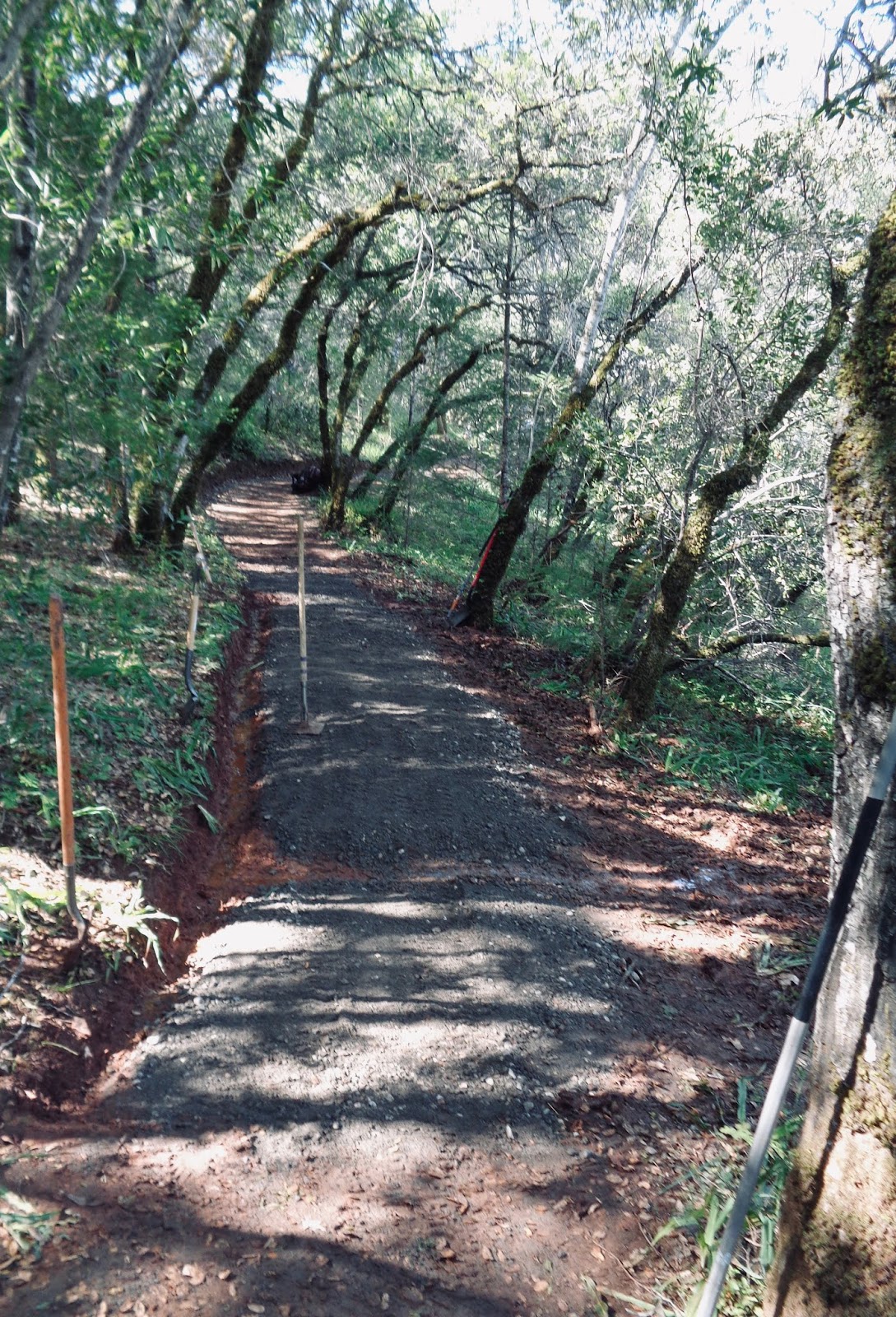
Adjacent to our little community rests an open space that sweeps from the edge of the Russian River’s Alexander Valley to the rim of some nearby hills.  Porterfield Creek drains this area – a habitat for oak, madrone, and manzanita as well as deer, gray fox and the occasional mountain lion.  The area is laced with trails – both developed and not. Background music for a hike during anytime of the year will include the melodies of whatever bird frequents the area that month along with the percussion of Porterfield Creek as it tumbles toward the Russian.

The place is a delight and, best of all, walking distance from our front door.

On hikes with Edward over the past sixteen months, a gradual transformation has occurred.  Volunteers from the Sonoma County Trails Council have been pressing back to shovel in an effort to grade and gravel sections the trails in the little park. Frequently we’ve seen ‘em out there and thanked ‘em, but the thanks never seemed like enough.

Today that changed.


Responding to an article in Cloverdale’s weekly paper, we joined the volunteers for a morning of paying-things-back labor. The network of trails was to be dedicated in an upcoming weekend, and after a particularly wet few weeks, there was work to do to spruce ‘em up.

The main task was to arrange drainage for water that would sheet down off the hillside and gather on the paths.  Soil in the area is a rather unforgiving brand of clay.  In the summer you couldn’t dig through it with a nuclear device, and in rainy season, the stuff forms a gooey glue that sticks to the Vibram of your boot soles adding about fifteen pounds each to each footstep.


Today’s job would be to channel that water along the uphill side of the trail points where a gentle swale would be cut across the path.  The gentlemen working the small crew skillfully engineered laterals and crosses knowing exactly where to dig – and how deep – checking their success by monitoring the seep water that flowed from the hillside, into the channel and then across the path.  Once certain gravity was doing her part, a number of loads of ¾ inch road base were spread and compacted across the previously muddy and slippery sections.

I learned that forming the ditches and swales was a gentle task.  Gradual would suffice as long as the water would flow away.  Also noted was how the mineral surface scraped from the trail course wasn’t just tossed down the hill side; rather organic matter (duff) was swept to the side, clay and rock deposited on other clay and rock, and then the organic matter returned to its spot.

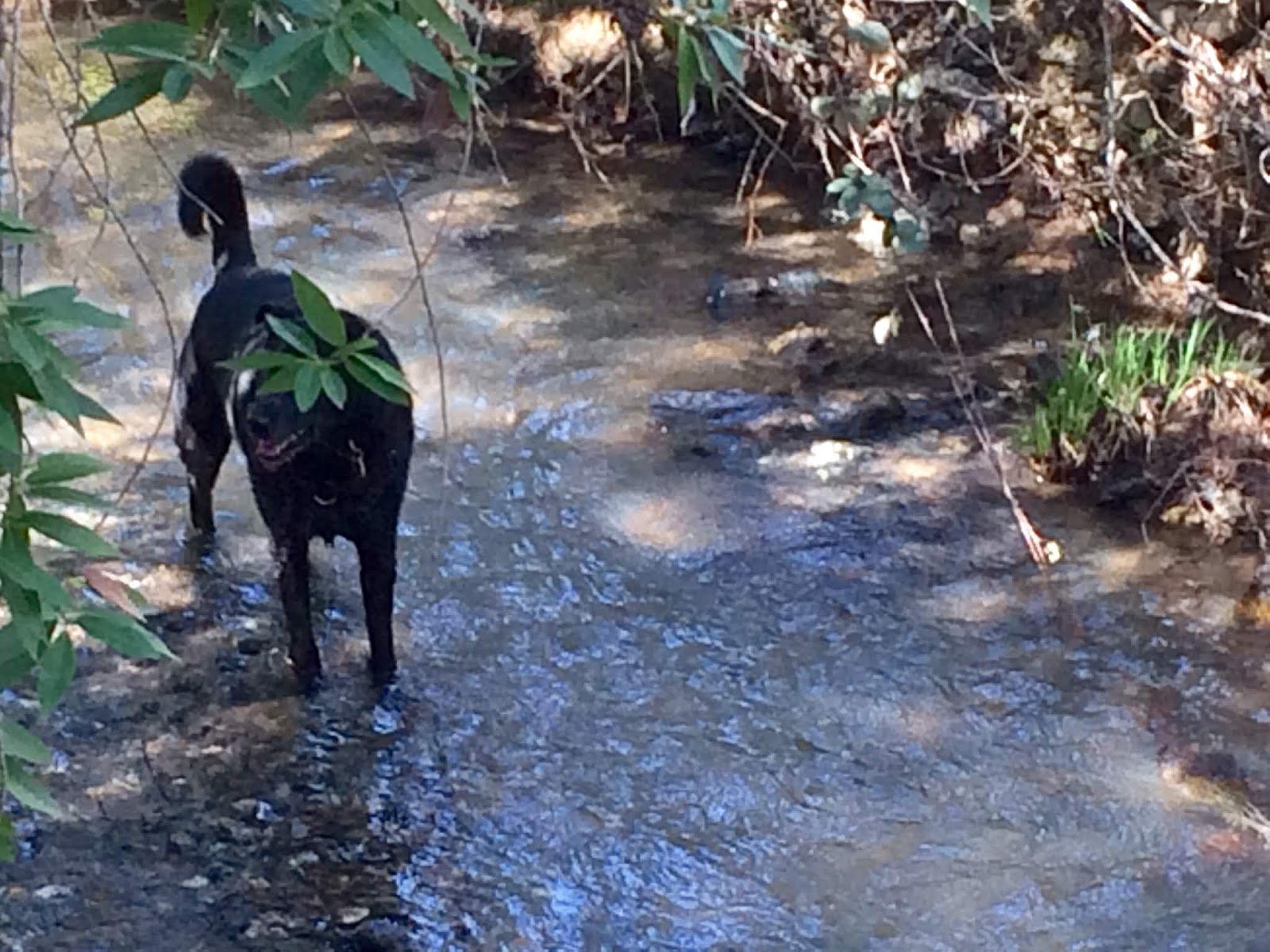
A fifty to one-hundred-yard section of what will be known as the Three Bridges Trail (we’ll always call it “Edward’s Crossing”) has been a slippery and muddy mess. Footing has been a bit like ice skating on an oil slick.  On the wettest of days, this was a trail to be avoided.


Today, after three hours of our volunteering – and five from the regular crew – the trail is dang-near all-weather.  Water drains off the low sections and gravel rests atop the gooey clay mud.  The trail looks great and will be presentable for that grand opening event coming in May. 

o0o

Our public lands and open spaces require our support and stewardship.  Certainly, some of our tax dollars fund national, state and regional parks.  But, as our recent visit to Yosemite showed us, our parks need more than tax dollars to remain viable and healthy.  They need us.

Today, we contributed with a bit of our time.  Others are better at this than we’ve been.  Sister Sue has done this in Chico’s Bidwell Park and friend Patti has done this as a Canyon Keeper along the American River near Auburn.  

Today, we also became members of the Sonoma County Trails Council with a small financial contribution.

Now, as we walk the trails of the Porterfield Creek Open Space, along with the hardwoods and wildflowers, creeks and wildlife, there’s going to be a little feeling of contribution that will make our strolls there even more satisfying.

The Church of the Open Road is sure that there is an open space in your area that could benefit from your time or a few shekels and asks that you look into how you can help. 

Notes:


The Sonoma County Trails Council Website: https://www.sonomacountytrailscouncil.org

On why we’ll always call it Edward’s Crossing (previous pst):    https://thechurchoftheopenroad.blogspot.com/2019/02/the-search-for-edwards-crossing.html


© 2019
Church of the Open Road Press