Showing posts with label East Coast Swing. Show all posts

Friday, July 15, 2011

DAY 16 – A VISIT TO THE REST HOME

Last of a random series of recollections about a recent trip to New York City, Boston, MA and the wilds of the Maine’s “Down East” coast.


“ONE OL’ GAL who sits at my table seems kinda glum. Never smiles.” Mom was preparing me for lunch at the independent living home. She’d moved in – joined the community – only two weeks prior. “It’s all about attitude, I try to tell her.”

“What’s her name?” I ask.

“You know? I don’t remember. Her last name is the same as a small town back in Texas.”

I’d missed the big move. It seems the east coast holiday celebrating our 25th had been on the books for, well, 25 years. Mom’s transition came with significantly shorter notice.


“SO WHAT PLAYS did you see?” The glum woman seemed not at all glum. She became quite animated when I told her we’d seen two shows on Broadway. “And what theaters?” There was a bit of electricity in her blue eyes.

I recalled that “Phantom of the Opera” played at the Majestic, but I drew a blank on where we saw “Catch Me If You Can,” as well as who played what roll.

Mom’s tablemate continued to press. “Didn’t Norbert Butz get the Tony last week?”

“Why, yes.” [Best actor: musical for his role in “Catch Me…”]

“And Tom Wopat. He’s in that one. He used to be on TV.”


I NEVER ANTICIPATED actually seeing a Broadway show on Broadway. Raised on Rogers and Hammerstein and Lerner and Lowe – as opposed to the evils of the Beatles, the Stones or any of a number of other British invaders. I could sing along with, play the tuba part for, and direct most of the songs from most of the musicals of the 50s and 60s. Mom was so proud. And she was assured that I would never experiment with sex or drugs because there would be no rock and roll.

In high school, I hung with the members of the concert band. Some of the guys went on to teach music. Some to perform. The rest of us just went on.

Once I tried out for the lead in the Music Man, but I experienced trouble getting my chops around the syncopation in Professor Hill’s soliloquy about the pool table.  End of career.


AS THE CONVERSATION continued, Mrs. X shared of her love of Broadway. She’d made many trips back. She knew the Majestic and suggested that wasn’t “Catch Me” playing at the Neil Simon? It was. She’d been to the Neil Simon before the name had changed. And the Majestic. And several others.

“You know what?” she said, fixing her blue eyes on mine. “My son opened in ‘A Chorus Line’ back in 1975.”

“Really?”

More electricity.


ROCKY CRAWFORD sat a row or two behind me in 9th grade English and played clarinet in the band. After graduation, he more or less left town; dropped out of sight. Someone said he’d moved south and picked up a gig dancing on the old Carol Burnett Show. None of us quite believed this, although I do remember watching the Tom Hansen Dancers and thinking I might have recognized Rocky.

Using the magic of the Internet I looked up my old classmate. It turns out I had seen him on TV. And from the small screen he went on to Broadway. Not much else was listed in his bio. Again, he dropped out of sight.


AFTER LUNCH, mom had shared the directory of residents with me. I looked for a last name that was the same as a small town in Texas. I’ll need to ask Mrs. Crawford [the small town in Texas and surname have been changed for this piece] how my high school classmate is doing next time I stop in for lunch.

On second thought, maybe not. The delight in her eyes tells me Rocky is doing just fine.


o0o


AT THE LAST MINUTE, we picked up tickets to see the Pops at Symphony Hall in Boston. The program included tributes to Richard Rogers and George Gershwin. From our seats in the first balcony, I recalled the late Arthur Fielder’s aplomb as he conducted this orchestra. Keith Lockhart brings a different, lyric style, but the results are perfection. 101 musicians performing as one. Perfection.

An old gentleman and an old lady crept down the balcony steps just prior to curtain. She had to use the back of each end seat to steady herself as she moved. At intermission, the old gentleman took her hand. Laboriously they climbed the steps. They reentered at the end of intermission in much the same manner as before, with her using each seat back to stabilize her cautious steps.

At the end of the concert, after the orchestra romped through their signature encore – Stars and Stripes Forever (this has to be the group Souza had in mind when he wrote the piece) – the audience buzzed as it cleared. The old man had made it up the small number of steps and had disappeared, but the woman struggled. I stepped forward and offered my hand, which she took.

She looked up at me. “Wasn’t that just wonderful?” She squeezed my hand. “You know, we’ve known Keith since he was a small boy growing up next to us in Poughkeepsie thirty-eight years ago.”

I smiled and shook my head. “No, I didn’t know that.”

She squeezed my hand again and walked with me to the top of the stair. It felt like a second encore, just for me.

© 2011
Church of the Open Road Press

Thursday, July 14, 2011

DAY 12 (B) – A VISIT TO THE QUILT STORE

Yet still more of what has become a random series of recollections about a recent trip to New York City, Boston, MA and the wilds of the Maine’s “Down East” coast.

HER SALT AND PEPPER HAIR was actually salt and cayenne. My curious affinity for those – like me – with red hair prompted me to steal a second glance. The soft flannel shirt – casually draped over her shoulder – looked as if it might have been sourced just down the road in Freeport at L. L. Bean a decade or so ago. The blue jeans, likewise.

Tending this quilt store, the woman looked quite at home. Her knowledge of fabrics and patterns seemed innate. It was matched by an encyclopedic awareness of the burial ground down the block, the current – as well as all previous – disposition of the oldest building in town and (thankfully) the location of the area’s best cinnamon roll. I liked that she knew the area’s history, which, if we forget, we’re doomed to repeat. I thought, however, that the history of this area didn’t seem all that bad. You know: repeatable.


THE BEST ASPECTS of travel are the people you meet and the stories they tell about the places they live.

“A good quilt store isn’t recession proof,” she said, “but with the right fabric – you know, colors, patterns, choices – it will survive.” She fingered pulled a bolt from its moorings and directed my wife to something complementary. Then she added: “I just moved to this location because I needed more space.”

I looked at the calendar on my watch. 2011. The recession isn’t over yet, is it?

Not a retired teacher or office worker or store clerk, the proprietress had always wanted to own a quilt store. “It’s the warmth, I think.” I noted how her green eyes complemented that salt and cayenne hair. I think she caught me doing so but she went on to ask more about the specific project.


FEELING A BIT OF THAT WARMTH myself at this juncture, I walked the block or so to the town’s burial yard, noting how the grave stones in this section of Maine were a mere 30 years older than the oldest of the gold country in my native state of California – and a hundred and fifty years more recent than the oldest in Boston, only 120 miles south. It got me thinking about the big picture and history’s odd cavalcade.

I was pleased to return to see my wife had selected some fat quarters and a pattern or two for purchase. Not that I was surprised.


NOTES:

The quilts illustrated here are those of my wife with the exception of the appliquéd example. It was handed through her family having been discovered in the attic of an indeterminate ancestor. It is presumed that this hand-stitched quilt was fabricated sometime in the 1930s. Currently, it hangs in our front room.


© 2011
Church of the Open Road Press.

Monday, July 11, 2011

DAY 13 – A VISIT TO MOUNT DESERT ISLAND

From a random series of recollections about a recent trip to New York City, Boston, MA and the wilds of the Maine’s “Down East” coast.


MOUNT DESERT ISLAND is home to Bar Harbor, a Mendocino-like burg on the Down East Coast of Maine. The village boasts some nice eateries, expensive hostelries and more than its share of t-shirt shops. It is the jumping off point for Acadia National Park, an absolute gem with roads for motoring, trails for hiking and peaceful spots for “peacefulling.” After five days of overcast and below-normal temperatures, the day arrived for our walking tour of the park and with dawn, came the sun.

Geologists will tell us that our eastern seaboard is older than our western shore. Evidence of this is the low elevations of area highlands. Nature has worked over the area pretty well. Cadillac Mountain rises to only 1500 feet, but it is the highest point on the Atlantic shore north of Rio de Janeiro, Brazil.  I did some math.  That's a long way south!

This road to the “top” invites the use of two wheels rather than four, but our two-wheelers are safely locked in the garage at home. I guess we’ll have to return.

Walking around this summit, the granite proves both impressive and unique. On this, the first sunny day in a while, folks flocked to the summit, exiting their cars to hike all over the exposed granite surface. From a distance, the crowds gave the mountain a curious ants-on-a-jelly-sandwich look.

In California, granite is silvery white. Along the upper spine of the Appalachians, its tint is rosy due to the presences of pinkish or red (rather than white) feldspar – although sometimes the quartz component in granite can be quite pink.  All of this, of course, is chemistry - something I didn't study closely enough when I had the chance - so some of the afore-mentioned scientific mumbo-jumbo may be taken with a grain of salt.

A series of trails web Acadia National Park with some climbing to various promontories and some tracing the edge of the down east Atlantic Coast. The term “Down East” comes from the fact that sailors out of Boston and Portland would sail out of port downwind and be carried northward and eastward along Maine’s rocky shore; heading then east across the North Atlantic to Europe.

From almost any shoreline vantage point one can see a small businessman plying his skills and hoping for a good catch. Suspended beneath each of those tiny white buoys is a lobster trap. In the more heavily harvested areas, the buoys are painted with distinctive designs to ensure no one gets some other guy's bounty.

The seas are calm - at least this day.  Still, having spent so much time on the rugged Mendocino Coast, it was interesting to view the placid nature of the Atlantic. Doesn’t Pacific mean, well, 'pacific' and Atlantic - Titanic?  They rhyme, you'll note.

Evidence of how eons have worn down the granitic structure. Here a tree continues the process with its roots working their way into what once was solid rock. The mosses continue to do their share.

A bit higher in elevation, lichens can be seen actively, quietly beginning the process that breaks down solid rock so that mosses and then rooted plants can ultimately take hold.

I think this is a Rose of Sharon, the likes of which are seen nearly everywhere on the Maine Coast.  Note that the comments (above) regarding chemistry, apply, as well, to botany, biology, and a whole host of other "ologies."

Another view of a pacific North Atlantic.

A US Coast Guard family resides and cares for this active lighthouse located at Bass Point outside the park.


Ending our day, we caught the ferry from Mount Desert Island over to Swan Island. Looking over our shoulder it was easy to imagine this scene was frozen in time from a century or so back.


Upon return, it was clear how low in elevation Acadia’s home island rests. Cadillac is located in the center of this shot. Back east, they call this a mountain.

© 2011
Church of the Open Road Press

Sunday, July 10, 2011

DAY 7 – A VISIT TO THE FREEDOM TRAIL

More of what has become a random series of recollections about a recent trip to New York City, Boston, MA and the wilds of the Maine’s “Down East” coast.


WHEN JOHN WAYNE was dying of cancer, President Ronald Reagan asked all Americans to hold in their hearts and pray for “a real American hero.” I recalled this State-of-the-Union comment several times as I walked through the oldest sections of Boston on the brick lined “Freedom Trail.”

Early on, we come across the first of several “burial grounds” around which the old city of Boston grew. Out west, we call ‘em cemeteries, although Dad called them “Marble Gardens” to the undying chagrin of Mom. No marble in these however. In the late seventeenth century, markers were carved into slabs of slate, the most readily available resource.

Some three hundred years later, layers of these markers have dissolved or exfoliated to dust. Letters and symbols are mere shadows of the remembrances carved so few centuries ago.

There’s a monument marking Paul Revere’s eternal plot in this first burial ground. John Adams, too. Hancock rested in the next yard. These were men who pledged their lives, their fortunes and their sacred honor to something bigger than themselves. Make that “people:” Some say Hester Prynne’s real-life personage is interred locally.


THE CITY OF BOSTON, in conjunction with the National Park Service has marked the 2.6 mile walk though the United States embryonic beginnings by laying a double course of bricks into and out of the oldest buildings in the city. Streets are narrow and crooked – perhaps only enough room for a citizen on a horse to pass another. An old European urban geography invites exploration down alleys and through passages that ultimately open onto one of many widened thoroughfares.

America’s oldest tavern is close by.

There’s a church where Charles Wesley preached.

As is the south meeting hall where locals devised plans to protest that the tax on tea did not come with a representative voice for the citizenry. There, too, plans to alarm the hinterlands regarding British movements were hatched.

Down the path apiece, because things advanced the way these things do, thirteen colonists were shot dead by redcoats who received no return fire.

Up a few blocks north, another church: one from which, one April evening, lanterns hung.

We passed by another burial ground. I can’t remember who, if anyone, famous reposed there. But the dates suggested that the souls interred interacted with those whose words and actions are heralded by history. In some way, each of these early citizens had a role to play in the early days of the protest, revolution, conflict and ultimate birth.

Walking along the Freedom Trail, I considered the heroes of our early history and those we revere now. I nodded at a City of Boston firefighter, sitting on the bumper of his engine, just inside an open garage door, then took liberties in shaking his hand. A bit later, a cop blew a shrill whistle, pointed directly at me, admonishing me not to cross against the light. I thought of the serviceman, still in his fatigues I’d seen over at Logan International, and the teacher walking beside me.


REAGAN’S “REAL AMERICAN HERO,” the late Marion Morrison – the “Duke” – John Wayne was a movie actor. Early in career, the roles were simple: read the lines slow, ride a horse and hit someone in a bar room brawl. Later, he received a bit more compelling roles. I’ll always like the way he pulled off Rooster Cogburn in “True Grit.” But, as far as reality goes, the Duke was only a man delivering someone else’s lines. Unfortunately, just like Mr. Reagan and many of the political leaders of our day.

I wondered if this doesn’t, somehow, happen to all of us. Stepping aboard the USS Constitution, I caught a glimpse of myself reflected in an ancient, bubbled piece of glass and couldn’t help musing that I, myself, may have slipped into a life where what I did was as insignificant as the delivery someone else’s lines.


AMONG THE REASONS we restore, protect and maintain sites such as Paul Revere’s house or the Old North Church is so that passers-by can pause for a moment, and, perhaps, catch a reflection of some larger image.

This I did. “The Freedom Trail,” I said, to the teacher walking beside me, “is not a mere 2.6 miles in long. The Freedom Trail is a path of undetermined length – one that spans the nation over which we had so recently flown, and one that continues to expand.” I gesticulated with a finger swirling in the air. “It expands as long as we respect and revere those who spend their lives in services to causes greater than themselves!”

The teacher walking beside me, not aware of my inner machinations, looked at me curiously, took my hand and patted it gently.  She suggested I might be taking things a bit too seriously.

Stopped in my esoteric tracks, I nodded and laughed out loud. Together, we wished we could remember how to get back to that old tavern.

© 2011
Church of the Open Road Press

Thursday, July 7, 2011

DAY 2 – A VISIT TO CENTRAL PARK

Still more of what has become a random series of recollections about a recent trip to New York City, Boston, MA and the wilds of the Maine’s “Down East” coast.


SOMETHING ABOUT THE RAIN in Central Park conjured up the final scene of “Breakfast at Tiffany’s.” Moments earlier, we’d walked past Tiffany’s – that Tiffany’s – and I had been strongly advised not to go in and order an omelet. Never the less, circumstance called that while entering the Park from 5th Avenue, the heavy, late-afternoon New York City skies opened up and poured.

It is interesting what rain does to an environment. Not only will it settle the dust and freshen the air, but it will pacify the noise. The cacophony of taxi horns – the city’s own unique background score – softened in the gently falling rain. The song of the eastern mockingbird quieted, only moments prior delighting from the thick canopy overhead. The voices of passers-by – with the city’s cornucopia of languages – stilled. All that could be discerned – and this only barely – was the product of this cold front falling against and being absorbed by the broad leaves of the park’s only-one-of-its-type-in-the-world collection of trees. That and the splash of the bicyclist’s tires as they split the puddles formed in the low spots impounded by asphalt.

We’d been talking, but soon, our voices stilled as well.


NEW YORK CITY, if one is equipped with a subway pass and a good pair of Keens or Clarks or Mephistos, is a great walking city.

From our headquarters on the 18th floor of the Beacon Hotel on Broadway,

...we traipsed past the Empire State Building, and into Times Square, SoHo, the Village, and...

Rockefeller Center.

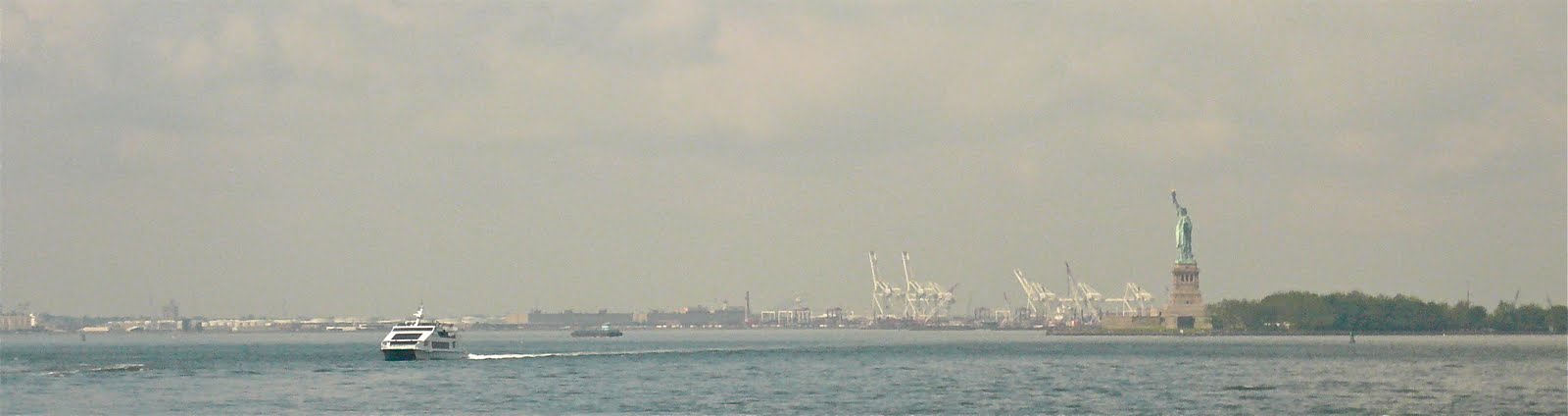
Playing out-of-towner role to the hilt, we viewed of the Statue from a great distance following that with quiet moments at the Vietnam Veterans memorial - courtesy, we understand, Donald Trump.


The city turned out to be like a big small town with folks willing to look out for one another as if everybody lived only down the street. A recommendation for good Italian food is only one question away.

Accompanied by Mr. and Mrs. Lake
Directions for the subway line to Flatbush were for the asking – although nobody seemed to know the location of the nearest Moto Guzzi dealer. Cabbies actually yielded to jaywalkers. In-line skaters did not. Firemen sitting in front of the station house accepted a handshake with grace. Local precinct police served as ombudsmen for those of us clearly foreign to the city.

Even though I wore a ball cap emblazoned with the interlocking “NY” of the old National League Giants, it was clear I wasn’t from around these parts. Perhaps if I’d removed the price tag…

Folks seemed happy to see our little party, interested in where we were from and what we had planned for our vacation. It wasn’t long – perhaps only hours – until I realized my picture of New York was horribly skewed by a jealous Hollywood’s representation of it. New York knows that tourism is the blood that pumps through the heart of the city. And they know how to make folks feel like family.


WHEREVER WE HIKED – Wall Street, the World Trade Center site, the East River –


(c) CentralPark.org
...we always seemed to circle home through Central Park: past the Wednesday fun run,


...the Friday free jazz, the everyday lovers stealing kisses semi-hidden down some dirt path.

The skies cleared as we exited the Park on this, our first visit. We walked past the Dakota where the cast busts guarding the front entrance seemed still to be crying after all these years.


Heading two blocks west to Broadway and our hotel, I found that the little town blues - the ones I didn’t know I had - had melted away.

Maybe it was walking though canyons of soaring buildings...

...or the collection of people each as unique as I...


...or maybe just the intense vibrancy of Manhattan – with its capital-of-the-world cosmopolitan-ness.

Perhaps, however, like the cleansing of Holly Golightly’s put-on face in “Breakfast,” it was simply the New York City rain.

© 2011
Church of the Open Road Press

Wednesday, July 6, 2011

DAY 6, 7, 10, 12 AND 13: A VISIT TO A NEW ENGLAND GUZZI DEALERSHIP (PLEASE?)

More of what has become a random series of recollections about a recent trip to New York City, Boston, MA and the wilds of the Maine’s “Down East” coast.


DATELINE NEW YORK CITY (2011): I've not been one to picture myself associated with the term "exclusivity." But in research this, my first trip to New York City, I figured it would be fun to drop by the local Moto Italiano and talk Guzzi like the Guzzi groupie I am fast becoming.

Sitting with an exclusive looking crowd at a corner Starbucks, I check on-line. "Moto Guzzi New York" leads me to Vespa of Brooklyn. Vespa Brooklyn - at least on line - lists no product from Mandelo del Lario, at least in stock. I'll take the subway, anyway. You know, just to hang out.

Well, that didn’t happen. What we did visit was a fine quilt store in West Village and another one in Tribeca.


DATELINE BOSTON (2011): The MG dealer is out of town a bit. Lacking anything but access to public transit, it may be a challenge making my way over there. I check a map provided by the hotel management and the transit lines in the greater Boston area, all the while humming a tune about some guy named “Charley.”

If only I had a rental car. But that wasn’t scheduled to happen until our day of departure. And we were headed in a different direction. One that would take us to a quilt store in Portsmouth, NH and a quilt store near Cape Neddick, Maine. And one in Rockport, Maine, and one in Ellsworth and one in Bar Harbor. And Old Town. And Concord.


DATELINE GILL, MA (2005): On a late December day, with the temperature hovering between seven and ten degrees, I dropped into A-J’s BMW-Guzzi. The owner was assisting a client in loading a classic BMW K-1 onto a trailer. I lent a hand. Later, inside, coffee and talk was offered:

“Where you from?” “California.” “What do you ride?” “An RT” (at the time.) “How come you didn’t ride it out?” I looked at the sheet of ice that formed the parking lot and crept into the lanes of travel on US 2. “Next time I see you,” he admonished, grinning and refilling my cup, “You oughta be on that bike.”

Six years had elapsed and again I was in a rental car. I couldn’t stop in Gill. It looked as if my goal of hanging out and talking Guzzi would be unmet in the Northeast.

By the way: there’s a nice quilt store in nearby Shelbourne Falls.


DATELINE SOUTHWEST FLIGHT 484 FROM CHICAGO TO SACRAMENTO (with continuing service to San Diego): Flying home, I looked out the window at the occasional towns that dot the region west of the hundredth meridian. I recall those days when outposts sprung up and matured and had but one church to show for every fifteen or so saloons. The upstanding, the pious and the preachers would shake their heads at this ratio. Most everyone else was fine with it.

Now, as I rocket along, I think about the ratio of New England quilt stores to New England Italian motorcycle dealerships and I, too, must simply shake my head.

© 2011
Church of the Open Road Press

Tuesday, July 5, 2011

DAY 8 – A VISIT TO BASEBALL’S CATHEDRAL

Day 8 of what will become a random series of recollections about a recent trip to New York City, Boston, MA and the wilds of the Maine’s “Down East” coast.


IN 1960, a classmate’s dad decided his farm supply store needed bigger quarters. So at about 5th and Cherry Streets in Chico, Jack Vanilla had a huge building constructed out concrete slabs. The slabs were poured flat on the ground, as I recall, and then tilted into place. We see this all the time, now, but back then it was something to behold. “This is going to last a hundred years,” classmate Cheryl said with pride as the thing rose from flat to vertical.


WHICH GETS ME TO YANKEE STADIUM. We visited baseball’s “home office” even though the Yanks were out of town. My first impression was how much this new building resembled Vanilla’s Farm Store. Large concrete panels tower skyward. To be sure, the architects used glass and space to create deep concourses and open interiors. I’m sure it’s a wonderful venue to watch some ball, but I couldn’t get past how sterile the place looked.

We did visit the team outlet but elected not to take the stadium tour, which would have afforded an entirely different emotion. I know I would have been speechless in Monument Park. And I do very much appreciate that the Yankees always tip their corporate caps to their heritage of great stars as witnessed by the banners adorning the exterior walks of the yard.


THE NEXT DAY, WE RODE THE “D LINE” out to Flushing. The Mets were in town and this would be our chance to watch an inter-league game at their new stadium called Citi Field. This yard is constructed with a nod toward Ebbetts Field, the hallowed grounds upon which the Dodgers played in Brooklyn before coming west in 1957.

1969.  "Amazin'."
As a senior in high school, I had the privilege of taking Civics class. This is not where they teach you how to tune up a Honda, but rather where they teach you about how to tune up government. My teacher was a fellow named Ken Miller. Big deal, right? It was. Before getting his certificate to teach, Ken Miller roomed with Tug McGraw when both were in the Mets farm system. The year was 1969. I’d been a Mets fan since I’d read Jimmy Breslin’s tome Can’t Anybody Here Play this Game? – a comical look at the loveable losers the Mets had always been. I figured I was a bit of a loser myself, so the fit seemed right.

On this day, the Mets looked not too far removed from the team that everybody loved to watch fail. An exception was Jose Reyes. He made three sparkling plays ranging far to his right at shortstop to snag sharply hit ground balls and then fire absolute missiles over to first base to nail the speedy runners: all in the same inning. (This happened while I was in line trying to buy a beer, which more or less substantiates my loser-ness of yore.)

The Mets didn’t seem to have their heart into this inter-league game against the Angels. We toured the stadium a bit and found styling cues from history pushed to the background. Again the preponderance of exposed concrete had me thinking about the feed store. We left before the seventh.


THEN WE ATTENDED THE CHURCH OF BASEBALL in one of baseball’s only remaining cathedrals. Notwithstanding the DH rule*, the great thing about baseball is its tradition. And with tradition, history can go back as far as history goes back.

Fenway Park breathes history. A half a week into our east coast swing, this would be the first day of five consecutive where the existence of the sun was based only upon faith.

And today's game would be delayed due to showers sweeping across the area. Still, this was Fenway. Babe Ruth pitched here. Ted Williams roamed the outfield, as did Yaz. The greats played here, and their echoes can still be heard.

We walked from Yawkey Avenue, beneath the seats – some still enameled wood set in cast metal frames – to our space just beneath the upper deck. The cleats of those who went before clattered and scraped across the timeworn concrete. I walked in their footsteps.

And as the heavens rained, not once or twice, but three times, I stood in front of my antique seat, beer in hand, with one of those dopey ear-to-ear grins that could only be belied by the tears in my eyes and the tightness in my throat.


History can happen anywhere at any time. But it will happen here again. Perhaps today.

We waited out the rain.

---

* There are those who suggest that God considers many of man’s acts and proclivities abominations. Has anyone ever asked God about not having the pitcher come to the plate and hit?

© 2011
Church of the Open Road Press