Monday, August 5, 2013

DUSK IN THE WESTERN DAKOTAS


impressions of a trip through our northern plains
…third in a series…

After two days wandering across the high plains’ rise and fall, we arrived at the ranch house outside of Custer, SD about 4:00 PM.  Our immediate goal was to freshen up, catch a quick nap, then venture into town to secure supplies.  Just as a century and a half ago, on the list were flour, salt, bacon, raw meat, and whiskey.  In short: grub.

I had ridden north and east from the Sacramento area.  My riding partner hailed from Seattle.  Our spouses flew into Denver, rented a car and were expected at any time.  Our mission would not be postponed.

Under a slightly ominous sky we remounted riding through a cloudburst, which might have been refreshing had it not been for the previous hours of saddle time and the fatigue associated therewith. 

The mercantile had everything we needed and, perhaps, more than we could cram into the panniers without some deft engineering.

Fortunately, with our saddlebags laden with supplies for four for a couple of days, the clouds had scurried south and our ride back was over dampened pavement and dirt, but under clear skies.  With degrees of relief, and after a 300-plus-mile day, we parked the bikes in the “stable,” set not to re-employ them for several days.


An evening storm gathered – bigger than the last – as I worked the grill outside.  I harbored grave misgivings about tending to a marinated tri-tip with a sixteen-inch set of metal tongs as lightening fired up in the area, but I’d drawn the short straw this evening, and my life insurance, set to lapse this coming November, was paid up.

While setting the expanded metal table on the porch for al fresco dining, the storm snarled and spat prompting us to retreat indoors.  A stray from the neighboring property, who’d been hanging about close to the grill and the beef, divining our change of heart, asked to be invited in from the impending fury.  He wasn’t.

Upon finish our indoor evening meal along with a bottle or two of serviceable red, we dispatched a scout to the porch to reconnoiter the weather and report back.  The fury, it seems, dissipated just as quickly as it had formed.  We would take advantage of the cool evening to enjoy some fresh air perfumed by the moistened hay stacked in the field a few yards away.  Nothing smells so sweet as after-the-storm.

To the chagrin of our spouses – who by now have come to expect nothing different from their men – we cracked open a bottle of Jefferson’s Reserve (in honor of Thom, whose face graces the mountainside only 16 miles to the north) and lit up a pair of Flor de las Antillas purchased at Stogies, a day’s ride back in Billings, MT. 

With the men downwind – the men always seem to be downwind, with or without cigars.  Why is that? –  the four of us watched the storm retreat and the sky evolve.

As the angry behemoth subsided, the sun dipped through the Ponderosa Pines and behind the hills immediately to our west.

A full moon rose illuminating those receding clouds from behind; within their midst lightning coursed in greater or lesser flashes. The Big Dipper was revealed, as was Alpha Centauri. Soon, everything faded to black.

Or perhaps it was the whiskey.

© 2013
Church of the Open Road Press

Friday, August 2, 2013

ON HALLOWED GROUND: THE LITTLE BIGHORN BATTLEFIELD


impressions of a trip through our northern plains
…second in a series…
  
America’s northern plains is a limitless steppe, nothing but rolling hills and knee-high grasses for as far as one might be able to see.  The Sioux saw something here.  The Americans didn’t, but it didn’t matter.  Monroe’s Doctrine of Manifest Destiny, although gauntlet laid down to prevent other European powers from colonizing North America, presumed for us right to lands across the continent regardless of who might already be there.


Rolling out of Billings, Montana, I was eager to check a location off my bucket list: that of the Battlefield along the Little Big Horn.  Clipping along I-90 at posted speed, it was difficult to see what all the ruckus might be about.  Then we arrived.

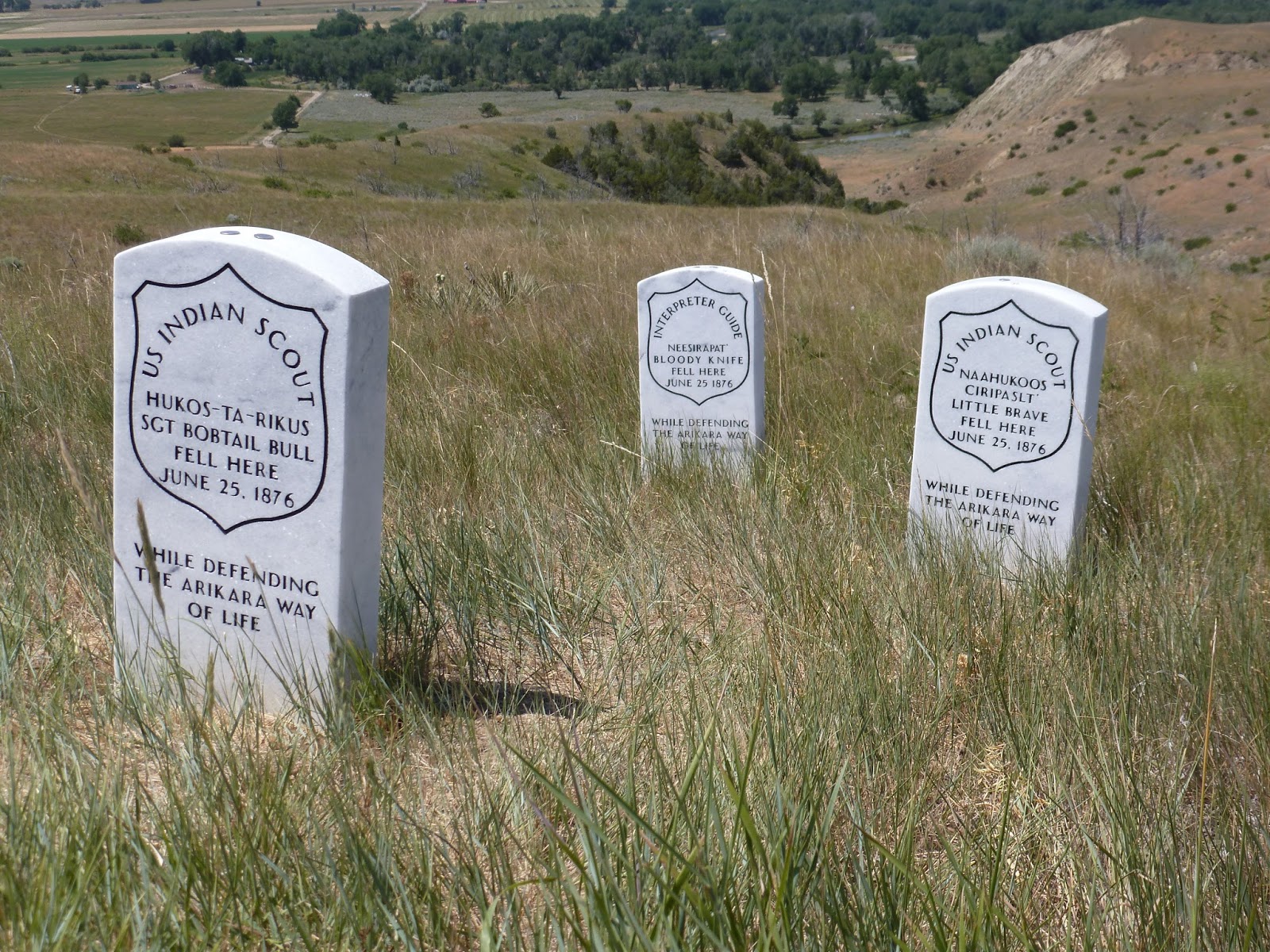
Idling up a rise off US 212, we entered, parked the bikes and began to explore.  With each step, something grew.  I think it was reverence.  Stones mark the location where soldiers fell. 

Stones mark the locations where some of the Indians fell. 

A cavalry soldier’s mount may be his most trusted friend.  A stone memorialized the horses as well.


Decades ago, I bought a copy of Dee (Bury My Heart at Wounded Knee) Brown’s book, The Fetterman Massacre.  (University of Nebraska Press, 1962.) This historian outlines the missteps and terrible fate of an over-zealous junior officer stationed at Fort Phil Kearney.  “The Fetterman Massacre,” Brown writes, “was the second battle in American history from which came no survivors.”

We’d rocketed past Fort Phil Kearney this trip, neglecting to stop.

John Byrne Cooke – son of Masterpiece Theatre long-time host Alistair Cooke – composed a brilliant trilogy of historical fiction called The Snowblind Moon, (Tor, 1984) chronicling the ten years between Fetterman and that which hallowed the ground upon which we were about to tread.  (My copy was autographed by the author as we enjoyed a burger on the Fourth of July a couple of decades back.)

At the Battlefield bookshop, I picked up a copy of Crazy Horse, a Life, a biography by Pulitzer Prize winning novelist Larry (Lonesome Dove) McMurtry.  (Penguin, 1999.)  There’s something that a novelist brings to history that, in turns, brings history to life.

Sitting Bull suggested that white man simply wanted to exploit the resources of the Lakota.  President Grant said that our efforts were intended to civilize and Christianize the Indians.  And it is said that those victorious write the history.

As we approach a century and a half since the events on the high plains took place, perhaps there is small solace in the fact that our more recent literature reflects not only the actions of those fulfilling Monroe’s vision, but also the bravery, courage, character and loss of those whom we overwhelmed.  Therein lies the lesson.


Among the best things about the road are those from which we learn: those flashes of truth that change our viewpoint, broaden our perspective and enrich us.   

Coupling solemn walks along hallowed paths with the literature that recounts the events of the past make a ride through seemingly forgettable prairie meaningful and rich.

© 2013
Church of the Open Road Press

Tuesday, July 30, 2013

AT YELLOWSTONE’S MAMMOTH HOT SPRINGS

impressions of a trip through our northern plains
…first in a series…


Late in the afternoon, after having started somewhere on the other side of Bear Tooth Pass, Yellowstone's Mammoth Hot Springs teemed with so many visitors that I took a pass and found a room in nearby Gardener, MT.

The next morning, as I left town, the springs had no such crowd.  So I engaged in a leisurely stroll up the wooden walkways enjoying the aroma, the steam and the views.


RIDING AWAY, curiously, I recalled the grandma-type who lived down the street while I was growing up. Rose Carah (née: Wild) was her name. 

Well into her 80s, with a mother’s touch and wisdom, she'd round up the neighbor boys, offering us store bought cookies and Kool-Aide because we'd listen to her Bible stories.  But the Bible wasn't her only source of material. More than once she told us of visiting these very springs as a little girl. "Rode in on backboards and wagons. Tethered the stock to posts and slept out under the stars for a good week or two."

My thoughts while piloting the big BMW the next twenty or so scenic miles surrounded something about how close in proximity we are to history - history that when we read or hear about it seems ancient. That, or, how brief our time in any one place is.  Or...

"Church" file photo*
…I was in the middle of this cogitation when a momma grizzly stepped into the highway in front of the car in front of me currying along two furry offspring still in need of a mother's touch and wisdom…

...and my train of previous thought just sorta went away.

o0o

* Point of clarification: I didn't catch a photo of the momma bear and cubs in Yellowstone.  This one is from a month ago in Alaska.


© 2013
Church of the Open Road Press

Tuesday, July 2, 2013

ALASKA BY RAIL

…my introduction to Seward’s folly…

My beloved does not pillion, at least for very long.  Therefore, our vacations involve her using a car as a chase vehicle or relegate us to a plane, a train or an automobile.  So our exploratory trip to the Last Frontier would not involve the bike.  As it turns out, this was not such a bad idea.

We accessed the Alaska Railroad website, perusing several tour plans there offered.  Alaska’s National Parks by Rail seemed to fit the time slot we had in mind, but I held some trepidation about hanging with twenty-five or fifty folks whom I would meet, greet and not particularly care about for the period of the tour.  The first of the really good news is that by booking through the rail company, all one is receiving is transit, lodging and a few activities.  There is no tour guide hustling folk through this cathedral or that museum with an eye toward the watch that dictates when the tour bus is going to depart.  Nope.  Passengers ride the train from Anchorage to Denali or to Seward and hook into activities that no one else aboard may have decided to partake.

Here is a little photo gallery of thing seen and enjoyed that I might have missed had I been astride the “Horse.”


Day 1: Traveling from Anchorage to Denali by train is a six-hour excursion into among the least populated geography on the continent.   
Two husky GP 40s pull about 13 rail cars from Alaska’s largest city into a rugged and beautiful landscape fed by rivers fueled from melting glaciers.
The trek northward becomes more and more dramatic…
…and we are told that we might be among the few who are afforded an unobstructed view of Denali – the continent’s highest point. 

Luck, and a string of eleven days of record-breaking heat winks, and, indeed, we do.
Laying over at near the administrative center of the National Park for a day, we engage in a 94-mile bus ride into the interior of the park.  Critters abound.

Like this foraging Grizzly…
…a bachelor moose…
… a pair of cows wondering what the hell to do about all the tourists…
… a red fox wearing black stockings…
Photo: Courtesy of fellow traveler Annette Reimer
… and this little fella who felt we’d wandered to close to the nest.

But the mountain dominated from tens of miles away to close up.

Just as on a bike, the return trip was as enticing as the trip out as the views changes with each sinewy turn of the rails.


Day four found us heading south from Anchorage to Seward.  Sweeping turns…

and views of glaciers dominated the route over the pass and toward the Gulf of Alaska

Our objective was to do “the tourist thing” catching a ride on a launch that promised an up-close view of a remnant of the latest ice age.

Along the way, the captain nosed into rookeries…
… and sea lion habitat…
…before high-tailing it out to the gulf for a view of a living-breathing chunk of history.
A frolicking male Orca decides to accompany us.
The Kenai Fjord Glacier proves to be a mile across where it breaks apart into the brine.

The captain skillfully steers us past a tiny iceberg, not likely big enough to harm our craft.  Still I could help thinking of the Titanic – which is likely why he piloted us so close.
Then, pausing to drift for the better part of a half-hour, the 80 of us on board listened to what sounded like cannon-fire or thunder.  This was the fracturing sound of the ice, the magnification of what we hear when we drop and ice cube into a tumbler of water.
Drifting, our collective reverie was broken when the skipper intoned that we were experiencing the tail end of the last ice age adding, “Welcome to Chicago 10,000 years ago.”


Days five and six found us again on the rails, this time on the local between Anchorage and Seward. 

The Alaska Railroad is the only rail operation in the country serving both passengers and freight.  Thus, if the engineer sees something the customer might enjoy - unlike the UP - he slows down so that we all might get a good look.
Today’s mission would be to visit the Spencer glacier and her attendant icebergs.

A lupine informs us that in late June, spring is only just arriving to the north country.

A guide explains to the gathered what to do when – not if – the raft capsizes into the 34 degree water.

Then we launch to drift among ice that was formed sometime during one of the seven migrations from Asia of the folks who would come to be known as “Native Americans.”


We did not approach the glacier to the extent we may have wished. 
Soon we were tumbling down the gray waters of the silt-laden river.
With impeccable timing, we arrive at our portage point, just as the Local pulls up to carry us to whatever our next destination might be.


So: Alaska by bike or by rail?  Next time, I’d certainly want to travel north on the bike.  But for an introduction to this rugged wonderland, it’s tough to beat a few days riding the Alaska Railroad.

o0o

Resource: 


© 2013
Church of the Open Road Press