Thursday, June 7, 2012

WRONG TURN OUT OF FIDDLETOWN


I sat on the deck out behind the house, contemplating.  The sounds of day transitioned into night.  Three quarters of the way through a creamy hand rolled San Lotano and enjoying about a jigger of 10-year-old Laphroaig, I stroked the black coat of Edward, our stray Lab mix.  He sighed, resigned to the fact that we weren’t going to play ball on the lawn this evening.  Dusk gathered and I thought about where I’d gone wrong today.


Pilot Hill (in the background) near Jackson, CA
A good day can begin with breakfast fifty or so miles away at a favored cafĂ©, roadhouse or greasy spoon.  Today, that was Mel and Faye’s in Jackson California, an hour or more south on State Route 49.  I met two buddies who’d driven north in their Acura from Sonora.  Over coffee and omelets from the senior menu, we caught up, solved a few of the world’s crises and vowed to meet again in a month or so.  Departing, and taking a tip from the wise men of yore, I vowed to return home by a different route.

I hadn’t visited the Gold Country’s Shenandoah Valley outside of Plymouth for some time.  Here the roads course between vineyards and small farms.  A small clutch of wineries had developed into a larger collection somewhat reminiscent of the Napa Valley forty of fifty years back.  Always a pleasant tour.  East from Plymouth I decided to revisit the area.  A mile out of town, Shenandoah Road arcs north, but a smaller strip of pavement heads east toward a place I’d never been before: Fiddletown.  I like a calendar page that is blank because I can do this.

Fiddletown Road, I figure, will take me to it namesake town.  From there, I’ll find a secondary route north, down into the Cosumnes River Canyon, swing through the Fair Play appellation, catch US 50 and head home through Placerville.  I didn’t carry a map on the Guzzi.  No pocket for it.
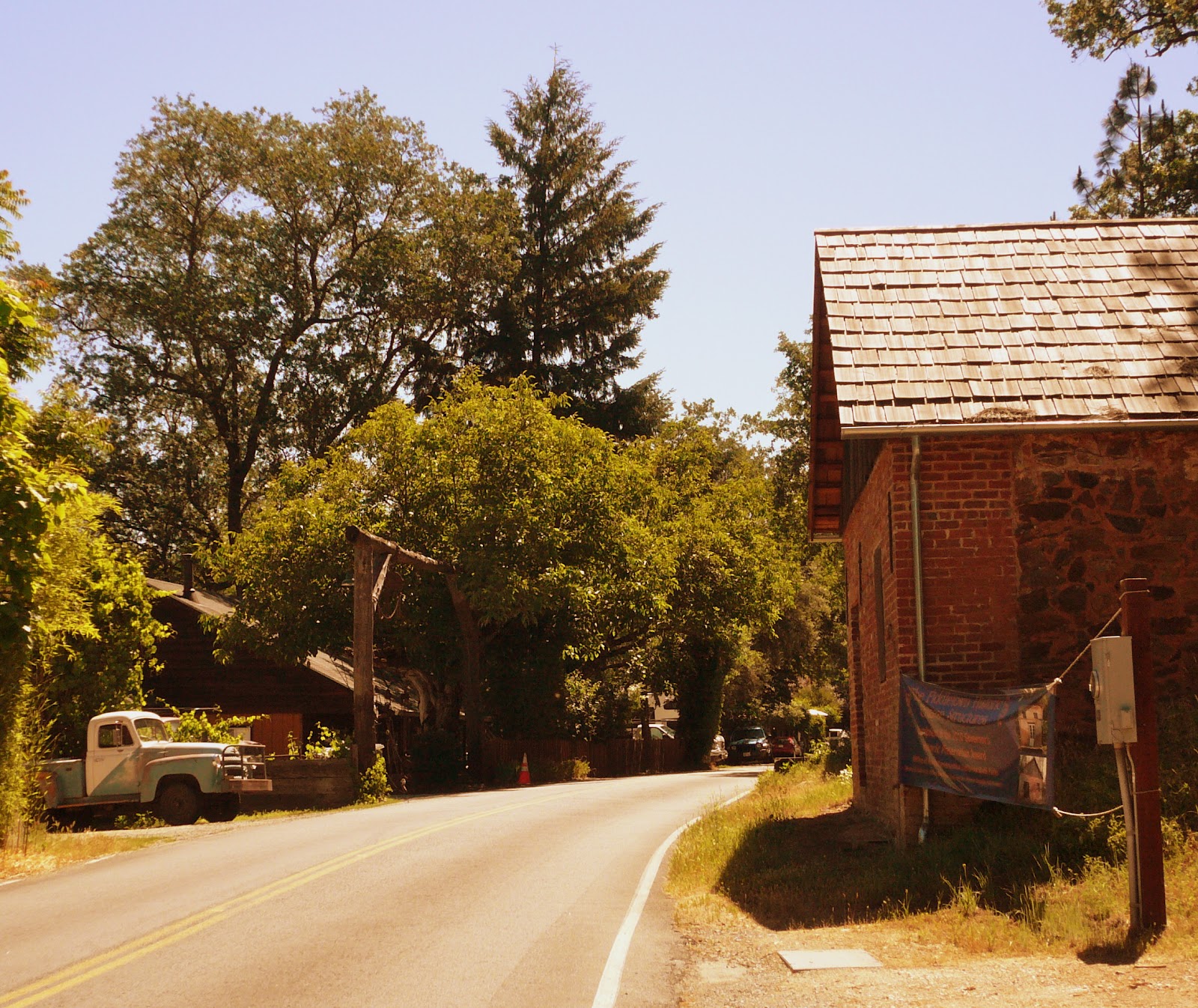

Fiddletown, CA
Fiddletown is one of those bergs that recalls life decades back.  Entering town, a mid-50’s era International pickup sits backed into a driveway.  The owner is shoveling mulch out of its bed.  A few serviceably restored and nicely kept homes line the road.  Oaks, walnuts and, perhaps, elms shade the street.  Over a rise, buildings from the gold rush stand, some housing businesses, some just standing. 

The Express Office, Fiddletown, CA
The “Express Office” is one of those just standing, its walkway choked with wagon wheels, oxen yoke, iron mining artifacts and a safe that had haled from Boston.  Up the street a way, a chicken crossed the road, but I don’t know why.  I stopped for pictures and for one of those moments when I wonder whether I am still in the 21st century.  I frequently hope I am not.

Fiddletown, CA: Main (and pretty much only) Street
Removing the Shoei from my head, I let the helmet noise clear.  When my hearing returns to focus, the sounds of a latter day village become clear: the distant bark of a dog, the chatter of a Rainbird sprinkler, the taunt of a scrub jay, the putter of an unseen farm tractor, the cluck of that chicken or one of his cousins.  A soft breeze pushes through gently rustling the elm in front of the Express Office.

It takes five minutes to stroll town and pick up a bottle of water.  I joke with the clerk about the days when you could drink out of the stream and she nods.


Soon I am again asaddle.  Fiddletown Road climbs out of town rising from scrub oak and pasture to Ponderosa Pine.  I look for the turn to the left that will drop me down into the canyon and lead me over to 50.  And look.  And look.  Fifteen minutes on, Fiddletown Road tees into Shake Ridge Road.  Right would take me back to Jackson.  Left would take me to CA 88 and Hope Valley.  Still, there must be a secondary road that will complete my circuit north.  Twenty minutes further, I’ve found none.  At a wide spot where log trucks are entering the road, I turn around.

Following Shake Ridge Road past the former intersection, I trace a stream course into and out of Volcano, a slightly more thriving berg with a sweet little tavern, a period hotel and a nice B&B.  The local NPR station has spoken recently about production at the community playhouse there. 

Enjoying oneness with the Breva I, regrettably, don’t stop for pictures.  I dive into and out of the tight twists of, now, Sutter Creek Road, more than once being snapped back to reality by some decreasing radius turns.  In time, I find myself in Sutter Creek, the antique town I’d passed through 75 minutes before just after having left Mel and Faye’s.  


I don’t regret not carrying a map this day.  I do regret not stopping for pictures in Volcano or along the route somewhere.  I’m sure there is a way from Fiddletown Road across the Cosumnes, I just took the wrong turn somewhere. 

Stroking Edward’s ears, crushing the cigar, finishing the last dram of Scotch and listening a moment longer to those sounds of the night, I come to a realization: I didn’t take a turn wrong at all this day.  Not one.

o0o

Today’s Route:  CA 49 South to Jackson.  Return:  49 north to Plymouth.  East on Shenandoah Valley Road; east on Fiddletown Road; east on Shake Ridge Road.  Then west-southwest on Shake Ridge; right at sign for Volcano; east to Sutter Creek; north on 49.

Resources:

Mel and Faye’s in Jackson, CA: http://melandfayesdiner.com/

Fiddletown (Amador County) CA: http://www.fiddletown.info/


© 2012
Church of the Open Road Press

Wednesday, June 6, 2012

WHO IS TO BLAME?


If corporate (or, some would argue, Labor Union) big money can buy elections by making up facts and spreading fear and misinformation in campaigns for or against candidates and issues, does that say something negative about the big money – or does it speak to something worse about the electorate? 

If, collectively, we don’t have the time or inclination to separate truth from campaign rhetoric, we cannot blame big money.  The blame rests with us.  Voters can only be “tricked” when they don’t pay attention to the facts.  And if we are being tricked, perhaps we are just too busy or too disinterested to be effective members of a participatory democracy. 

That, or we’d have to believe big money wins because it supports that which parallels the will of the people.

© 2012
Church of the Open Road Press

Monday, June 4, 2012

THE ROAD UNTAKEN


Tahoe National Forest Road 54

Artist's Rendering
Bassett’s Station is at a crossroads.  East on CA 49 rests Yuba Pass, a wonderful route.  West on CA 49 rests Sierra City and Downieville, a wonderful ride.  North on the Lakes Basin Highway rests Gold Lake, Silver Lake and Graeagle, a wonderful route.  South is Weber Lake and Jackson Meadows Reservoir on the old Henness Pass Road via Tahoe Forest Road number 54, again a wonderful route – one I’d only taken from south to north. 

Given that any ride at another time or in the other direction on a road you’ve already taken is a whole different ride all together, I left Bassett’s Station, fueled with peach pie and coffee and headed south.


Green Acres
A tiny subdivision of summer homes called Green Acres occupies one of those checkerboard square miles of private land just south of the Yuba.  Years ago, a lot came up there for about 20k.  I traveled up 49 several times to walk the property trying to develop a rational for buying the lot, building a cabin within earshot of the river, living close to Eva Gabor, and composing a series of nationally renown literary best sellers.  Waiting too long to formulate a plan, the lot sold, a cabin was built – something like what I would have placed there – and now the little home is on the market.  I stopped, walked the property and added another item to my list of shoulda-coulda-wouldas.

Tahoe Forest Rd 54
Forest Road 54, I’d forgotten, had been, at one time, paved.  After a millennia of summer sun and winter snow and lack of maintenance, said pavement now consists of large dry lakebed sized chuckholes inconveniently dotting the ancient tarmac.  I set my suspension on “mountain terrain” and sallied forth.


Tahoe Forest Rd 54
A wonderful thing about the high country is the collection of olfactory sensations one is likely to encounter.  Smoke from a summer home’s morning fire; must from the moist duff in the forest’s shadow; lilac where some pioneer broadcast seed; pastureland fetid with that which makes pastureland green.  Easily one is lost in these sensations.


Sierra Buttes - filtered
I’m not sure of the origins of Forest Road 54 but tiny roads fork here and there to logged forests, grazing meadows or fishing access.  North facing slopes are thick with firs.  Though one stand I glimpse the heights of the Sierra Buttes, an 8,000 foot granitic uplift a few miles north of the river.  I travel further eying the forest for a break through which to take a photo, but, like the spoiled former belle-of-the-ball, the hummocky pavement reminds me to concentrate on it.  The suspension performs yeoman-like service but the occasional jolt makes its way to my jaw.  The best picture I would get of the Buttes would be filtered.

The road courses around a ridge end and into a glade drained by a stream.  Willows arch over the creek.  Snowplants dot the shaded surface and mules ear sprouts from the recently snow covered clearing.

End of the line
The road continues to climb.  Small banks of snow at the side of the road appear to almost be creeping onto the right-of-way with each tick in elevation.  One covers the right while rut; the next reaches all the way to the midpoint.  A few hundred yards beyond, a mass covers the entire passage – one several soccer venues in length.  It is the one time I wish for my no-longer-owned old Jeep CJ over the GSA.  The big Beemer doesn’t cotton to snow.  The tire clogs quickly, I recall.  And then I fall over.  I recall.

Duc Club at Yuba Pass: circa '08
I opted to reverse course and return to Bassett’s.  The entire round trip to nowhere took thirty-five minutes.  A return will be in order in a few weeks.   In the meantime, I think I’ll head over Yuba Pass.


Today’s Route:  From CA 49 at Bassett’s Station south on Tahoe National Forest Service Road 54 to snowfield.  Return:  Reverse course.

© 2012
Church of the Open Road Press

Thursday, May 31, 2012

CONSTRUCTION UPDATE: CA 49 – DOWNIEVILLE TO SATTLEY


As a public service to all the “Church of the Open Road” sacrificed the spanking cleanliness of the GSA to investigate conditions on California State Route 49 over Yuba Pass this on May 30.

Owing to the fact that there were road construction signs west of Downieville, I elected not to hang around and stretch my legs in town thinking there’d be enough stoppages ahead.  I was nearly wrong.  Nearly.  The first five or six miles east, the road had one of those new asphalt surfaces that most of us only dream about.  Smooth.  Superbly engineered. 

Delays east of D'Ville
However, six miles east, we were stopped for nigh onto 20 minutes for the pilot car (which is always a big pickup truck) to lead us through the zone.   After a time, the fellow in the Ford Explorer behind me got out of his car and the conversation ensued:  “Nice day for a ride.”  “What kind of bike is that?”  “Where ya goin’?”   I found out the gentleman had eschewed I-80 construction on his way to an annual golf tournament in the Graeagle area, involving Nevada Union’s class of ’60 or thereabout.  I immediately regretted losing track of Chico High’s Class of ’70.  He regretted not having taken I-80.

Initial pavement along this section was fresh with the eastbound lane having its second layer of asphalt, the westbound lane waiting its second.   
Along Cal-Ida Road a half mile up from CA 49
There’s a short stretch free of delays then, four miles west of Sierra City, another wait.  Here, I learned from the gentleman in the Explorer about the history of the Cal-Ida Lumber Company who’d logged the area and transported timber to Auburn for milling back in the day.

At this point, route 49’s old surface is being heated and removed.  From here into Sierra City, expect to drive on deteriorated road base not suitable for your Sunday-go-to-meetin’ bike.  The water truck did a fine job keeping the surface muddy enough for those later to ask how long it’d had been since I returned from Alaska on the Beemer.

Stop in for the pie and the latest...
By Bassett’s Station, the work had concluded, however, my sources there (the young man who served me a wonderful hunk of warmed peach pie with ice cream and said, “Yes, if you want to call it lunch, you can call it lunch”) reported that the section from Downieville to Sierra City should be completed in the next couple of weeks, but that they were still slated to tear up and resurface the rest of the route to Yuba Pass with completion being around the first of July.

He added that CA 89 from Sattley to Truckee was slated for similar work beginning the first of July.

Sierra City prior to road resurfacing
Use caution or select alternate routes like the Lakes Basin Highway from Bassett’s Station to CA 89 below Blairsden or CA 70 through Oroville, Quincy and beyond.

© 2012
Church of the Open Road Press

Tuesday, May 29, 2012

“TODAY’S PERFECT...”


Robinson Flat Road – Placer County, CA

...Or so said the man piloting a county dump truck laden with gravel up the hill.  Just above Robinson Flat, I’d pulled over to the side of the road giving him ample berth to pass. 

“You okay?” he’d asked.

“How could anyone not be okay up here?” I responded.  Then I added, “Unless you gotta work.”

“Yeah,” he said looking down from the cab of his International 2½ ton, checking out my abnormally clean GSA, “but I getta work up here.”

“Today is perfect,” I said as he waved and shoved the rig into gear.


Robinson Flat is a favored destination.  About 70 minutes from home we frequently find ourselves with a better bottle of Tokay, a couple of chicken sandwiches, folding chairs and a free, languid afternoon. Whatever book has been resting unfinished on the bedside table will be finished while the dogs freely gambol in the meadow.

Today’s mission was simple reconnaissance: take the bike up there to assess the condition of the road and the meadow and parse out how soon one of those lazy afternoons might safely be added to the summer schedule. 

Although a storm had blown through on Saturday prompting the local TV station to be agog about snowfall in the mountains, the intervening 80+ degree-days wiped out any accumulation.  The 29 miles of paved route from Foresthill were clear and dry, and the tiny bit of gravel I traveled was being filled and graded by a county crew that included the young man. 

The guardhouse near the meadow looked as if it has struggled through a winter that was not yet fully finished.  Refurbished about three years back, its brown painted sides looked in need of another coat and the green painted shingles on the roof made it appear that painting roof shingles green was not such a practical plan.  A mitten of snowfield wrapped about half the base of the cabin.

Likewise, the meadow had yet to see spring.  Water stood atop the saturated glade with no place to run off and nowhere to sink.  I was reminded that this spot, long before man, was a tiny subalpine lake – probably home to the ancestors of today’s black bear and whitetail deer.  Whatever wildflowers I might expect to see in a month or so were probably still encased waiting for a longer spell of warm weather to break out of their shells and splash their color on the landscape.

Hiking around the grounds, the litter of the prior season had been either picked up or scrubbed away by an icy, departing winter.  I did find a derelict poster warning of bear encounters tattered and tossed on the moist duff.  I wondered whether the vandals responsible for the defacement of this government notice were named Bubba and Jim-Bob or Yogi and Boo-Boo.  I hoped it was the latter.


Opting not to traipse through the county’s construction zone this day, I retraced my steps back toward Foresthill.  While riding on gravel and dirt is pleasurable on the big GSA, having time to simply ride and enjoy the nectar of the first breaths of spring is as well.  I could take the long way home next time.  I figured I’d be back up this way in about three weeks with a good book.


Today’s Route:  I-80 west to Auburn; exit Foresthill Road.  East on Foresthill Road 17 miles to the community; continue 29 miles further to Robinson Flat.  Alternate return:  South, over the ridge on graded gravel Robinson Flat Road, passing the road/trail to Duncan Peak LO (Hike this!); right on Mosquito Ridge Road (paved) back to Foresthill.


Related Posts:  Having been to Robinson Flat numerous times, here find a couple of Church of the Open Road posts about rides and hikes hubbed from that point.


Also, click on the “Foresthill Road” label and see if something else shows up.

© 2012
Church of the Open Road Press

Friday, May 25, 2012

NINE NOT-SO-EASY STEPS TO FIX OUR SCHOOLS


Recently, NPR aired a story about an Indiana third grader who was at risk of being retained if he didn’t retake and pass a statewide reading assessment this summer.  The child was compellingly sad.  His summer was shot and it hadn’t even started.  The mother, however, was not so compellingly angry at the system.  Quote: “It breaks my heart that my nine-year-old thinks he’s stupid.  It isn’t fair…” 

The agonized mom’s comment forces a question or two:  Did the she spend time reading with her child?  Or is she just concerned that he thinks himself stupid?

But larger questions arise as well:

·      Do annual state assessments give educators enough data about students and programs to make fully informed decisions?
·      When parents of failing schools are offered choices do they take them?
·      Are Alternative Schools like Charters (Charters being publicly funded institutions given a mulligan on certain public school requirements) proven to provide better results than their public brethren?  If so, what are Charter Schools allowed to do that traditional schools cannot?
·      What evidence exists that large-scale privatization of schools will achieve better results?  We know privatization of prisons hasn’t proven overwhelmingly successful.
·      As funding falls, class sizes rise, materials tatter and facilities crumble, is it logical to expect today’s students to do as well as yesterday’s?

And Saturday Night Live's "Church Lady" is always more than willing to ask this one:

·      Somebody benefits when we don’t provide support for our schools.  Who might that somebody be?

Arguments about how to reform schools are generally specious in nature, politically or selfishly motivated and espoused by people who may not have much experience actually doing the good work of educators.  Too frequently they are folks who, because they attended for twelve or thirteen years, think they possess some magic wellspring tonic that will fix our schools. 


Sadly, the solution to improving our schools is easy to state but grindingly difficult to implement.  Here are nine needs to consider:

1.     Parents need to take an active role in supporting their kids' education.  That means turning off the TV and video games, prioritizing school with Little League and soccer and actually spending daily time on schoolwork with the kids.  This is more than wafting parental pixie dust over the homework.  It involves checking for their understanding of the math page, listening to them read, and spending time each day reading to them.
2.     Teachers need to respect those practices that have proven successful while seeking innovative ways of doing things.  Technology can be wonderful for reinforcing new learning or exploring wider concepts, but it does not replace the teacher going face to face with the student who is struggling – or the student who is not. 
3.     Universities need to provide the system with inquisitive teachers who have demonstrated the ability to think critically and solve problems - not just credential individuals for having put in seat time in a graduate program.  A university dean responded a question of mine with another question of his own: “How would the parent of a college kid feel if, after five years of university, we told him he wasn’t qualified to teach school?”  “I don’t know,” I didn’t say because I was just a young punk myself, “perhaps like someone wasn’t doing his job?”
4.     Curriculum needs to reflect learning that goes beyond knowledge to include critical thinking and problem solving - things that cannot be assessed on an annual fill-in-the-bubble assessment.  In general, the only time a citizen has to fill in a bubble after finishing school is when he or she takes the written driver’s exam.  All other questions that confront us involve greater than yes or no answers.  Take, for instance, climate change, Middle East peace, or what to have for dinner tonight.
5.     Administrators need to work with staff to constantly improve instructional practices; they need to more easily be able to release ineffective teachers for cause; and they need to know that "cause" is not strictly defined by student performance on yearly exams.  Students who struggle can be led to improvement; likewise with teachers who struggle.  Administrators unwilling to do this should be led to the door.
6.     Localities need to hold superintendents accountable; superintendents need to hold principals accountable; principals need to hold staff accountable - but PARENTS need to hold kids accountable. If that isn't happening, it ain't gonna work.  Parents: It’s part of the bargain you signed on for when you decided to have offspring.
7.     Politicians need to cut the crap with retention.  Study after study proves retention doesn't work.  Talking tough doesn't help.  Rather: Politicians need to ensure schools have the revenues necessary to provide a free and appropriate education to all kids.  For some kids, that means more individualized attention and support - with or without a Special Education Plan.  Politicians:  If this conflicts with some pledge you’ve ascribed to other than to protect and defend the Constitution from all enemies foreign and domestic, decide which one is more important to you.  Your response may cause you to have to resign your elected office.
8.     The nation needs to simply get past the idea that the measure of a good education is how much wealth one amasses over the course of his or her life.  “Job-ready” is a fundamentally low bar for schools.  Literacy teaches perspective.  Algebra teaches reason.  History teaches a sense of place.  Science allows us to wonder.  The Arts release our spirit.  All are essential.  None are typically addressed on a job application.  Each makes us more human, more able to connect and, most would contend, more content.
9.     Finally, we all need to support our school system with our time, our money and an understanding that the democratic foundations of this country rest on the bedrock of a sound education – one that is available to all kids regardless of wealth or disability.

If all stakeholders: kids, parents, teachers, principals, superintendents, trustees, communities, politicians and the nation pull together to show we value schools by our words and actions, we will see an upward sweep in student performance.   

If however, we succumb to stakeholder subgroups or talking heads who sidetrack us by spurning the system and pointing baseless fingers of blame, we’ll continue to get what we have now: Children – like that little guy in Indiana – left behind.

Resource:

The clip from NPR may be accessed at:

© 2012
Church of the Open Road Press

Wednesday, May 23, 2012

THE AMERICAN RIVER INN: HOSTELRY TO THE GOLD COUNTRY AND GRANITE BASIN


The American River Inn
Living in the Sacramento area, one is spoiled by the year-round nature of and the sheer number of miles of excellent roadways to explore.  We get up in the morning, down a cup or two of coffee, then saddle up for a four to six to eight hour mini-vacation.  The Pacific Coast is two hours away; Tahoe, two hours; the Gold Country, walking distance.  Alas, not every rider is so fortunate.  For those from further afield, the American River Inn offers the perfect home base for exploration.


The American River Inn is an historic hotel located in old Growlersberg – now known as Georgetown – California.  Proprietress Betty greeted me warmly, as if I were some wayward relative away too long.  She introduced me to Dolly, an ample but spunky black Cocker and only then asked if she might be able to help me with something.  “Folks are coming from throughout the west coast for a little celebration,” I explained, “and we need a place to house up.” 

The American River Inn
“Look around,” she suggested with a confidant smile, encouraging me to trundle up the stairs.  The innkeepers have carefully transformed this fourteen-room hostelry with period antique furnishings and fixtures.  The American River offers suites, as well as rooms with private and shared bath accommodations.  A pull-chain John Douglass invited my scrutiny.

American River Inn
A full, hearty and delectable breakfast – apple pancakes one day, ham and delightful egg puffs the next – is served in a quaint parlor. 

Wine is sipped on the veranda evenings around 5:30.  And a late evening nightcap including a bring-your-own cigar is not discouraged.

Georgetown, CA
Just out the front door, the main street boasts two or three watering holes, a very nice cooperative art gallery, a couple of antique outlets and a friendly and comprehensive general store.  The family owned Mexican Restaurant down the street and around the corner is nicely down home.  Clampers have placed plaques in front of each historic building to remind us of their heritage.

Walking distance from the hostelry is a cooperatively maintained nature preserve, well positioned for a morning stroll before saddling up for motorized adventure.


Coloma
Georgetown is situated on the divide between the north and south forks of the American.  About eight miles down the hill, James Marshall changed the course of history.  Thirty miles east puts one in the Granite Basin Recreation Area home to dozens of lakes and miles of nicely maintained Forest Service Routes. 

Entering Granite Basin
Sixteen miles south to Placerville and US 50, Echo Summit and the Tahoe Basin is only 90 minutes off.   Nineteen miles north, Auburn straddles I-80.  In between, the area is webbed with paved and graveled roads leading from the depths of the American to the crest of the Sierra.

Stumpy Meadows
Wentworth Springs Road heads east from Georgetown past Stumpy Meadows Reservoir, a nice fishing lake with accessible picnic spots…

… skirting Uncle Tom’s Cabin, a place I’ve yet to experience, lacking a big V-Twin Cruiser…

… and up to Ice House Road.

Loon Lake
Left on Ice House takes us to Loon Lake where the construction superintendent’s cabin is available for rent…

Wentworth Springs
… or through a cluster of privately held historic cabins (no trespassing please) at Wentworth Springs…

Rubicon Trail
… and up to the Rubicon Jeep Trail which crosses just above the Desolation Wilderness area before descending into the Tahoe Basin.

There is plenty of still and cascading water, glaciated high mountains, fragrant pine forest, exquisite pavement and peaceful footpaths.

American River Inn
Easily, one could off-load the panniers and spend several days enjoying glorious loops exploring some of the California’s most historic sites and some of its grandest scenery.  If so doing, the American River Inn is an ideal home base.


Routes not to miss in this area:

State Route 49 from Auburn to Placerville though Coloma, the site of Marshall’s gold discovery.

Greenwood
State Route 193 from Cool to Georgetown to Placerville – check out the historic schoolhouse and cemetery at Greenwood.

Marshall Road from Lotus to Georgetown through Garden Valley – a ride with nice elevation gain, that tunnels through woodlands and breaks into panoramic views.

Wentworth Springs
Wentworth Springs Road sweeping upward to the Granite Basin Recreation Area – use caution – three times – three times! – in our two-night stay emergency personnel were dispatched to scrape up some poor hot-rodder who thought he could outsmart a decreasing radius turn.  Medi-vac isn’t cheap.

Loon Lake
Ice House Road – pack a picnic and stop at all the reservoirs: Loon Lake, Union Valley, Ice House; then enjoy the descent into the South Fork and Highway 50.  Better yet, start at highway 50 and ascend into the Granite Basin.

o0o

Resources:

The Historic American River Inn: www.americanriverinn.com

DeLorme’s California Atlas and Gazetteer (2008 or newer) pages 58, 59, 60, 65 and 66.  Comprehensive collection of topo maps for the entire state.  I carry a copy on board anywhere I go.

Gudde’s California Place Names – always a good place to find out why something might be named what it is.  Additionally, this book can help you appear to be smarter than your fourth grader.

© 2012
Church of the Open Road Press

Monday, May 21, 2012

OF WHISKEY AND MY FRIENDS


When I’m worried and cannot sleep,
I count my blessings instead of sheep…
 Irving Berlin


Click on any picture to expand for detail.
I will readily admit that I have a rather comfortable relationship with John Barleycorn.  By sixty, one either coexists with moderation or one does not.  Sadly, those who don’t, may not see sixty: think decreasing radius turns. Still, I was a bit surprised when my affinity for moderate amounts of the hard stuff made itself known to the mother of the wife of my best friend and riding buddy.  [We’ll pause here for a moment allowing the reader to sketch the necessary branch of a rather extended family tree.] 

On the occasion of my 60th, said friend treated me to a baseball game at AT&T Park followed by a night’s respite at his beloved mother-in-law’s house before returning home.  She prepared ribs.  Between the rib course and the lemon meringue pie course, a box was placed in front of me.  Attached to it was a note, which I will transcribe in its entirety:


This is a story for the “Story Man”

When a gentleman holding the rank of Captain of the Hillsborough Police Department was recovering from pneumonia in December 1982, Cathy Crosby, wife of the famous crooner Bing Crosby, brought her favorite cop a present.  It was a bottle of Bing’s favorite Bourbon.  Bing, she said, would always have a sip before he “crooned.”  But this was a special bottle, made before prohibition but not legally sold until after, according to the stickers on the bottle.  Bing just kept it in his booze collection and never opened it.  It was 53 years old and starting to evaporate when she gave it to the Captain.  Not being a bourbon drinker himself, the bottle rested, never to be opened.

Years after Bing died, everybody told the Captain he should have the bottle sealed to prevent it from evaporating completely.  That is how it got waxed and sealed.  When the officer died in 1992, he was toasted with his favorite alcoholic beverage, champagne.  For the next 20 years, Bing’s bottle of Bourbon got shoved further and further to the back of the liquor cabinet.  Occasionally the story of the old bottle in the torn box would be told and some smart youngster would say, “Hey Mom!  I bet you could get a bundle for that on E-bay!”  Bing – and the Captain – would roll over.

So here we are today, getting ready to celebrate a storyteller’s 60th birthday.  Who better to carry on the famous “Bottle of Bourbon” story?

Love always,
“Mom” and Captain Ernie
 

The neck of the bottle peeked above the tattered edge of a box opened and closed many times as the story was told and retold.  The front of the box carried the hooch’s brand “Old Charter,” as well as the name of the distributor “Wright and Taylor.”

Along one side read the words “Fully matured in wood;” along the other: “For medicinal purposes only.”  This was a product of a thirteen-year Constitutional fiasco called Prohibition.  Clear wax covered a foil wrapping further sealing the mouth and a cork that had slightly imploded into the bottle. 

Carefully slipping the package from the package a curious amount of empty space topped the four/fifths full vessel, though the cork had never been pulled.  Original paper labels were still affixed to the bottle as well as the paper tape that banded the wax on its neck.  There were two dates.  One here, “made spring 1917,” one there, “bottled fall 1929.”  Originally, the contents had been aged 12 years.

I set the bottle in front of me and looked at “Mom.”  Crosby had handled this.  It was his brand.  It helped him croon.  Are you sure?  Her eighty-three-year old eyes expressed nothing but delight.  I found myself running through my limited catalog of Crosby songs and settled on lyrics from a tune which had debuted in the 1954 musical “White Christmas.”


The vintage bottle rests in the back of my liquor cabinet, behind the Knob Creek, the Basil Hayden, the Lagavulen and some 18-year-old Macallan.  In five years it will be a hundred.

Between now and then, my riding buddy and I will debate long and hard whether to, if, and if so, how to dispatch its contents.  I lean toward simply parking it in a dark corner of the cabinet and, when the time is right, passing it on to some next generation.

However, I have this comfortable relationship with John Barleycorn – one that, sometimes, nudges me toward less than the most appropriate end.


Resources:  Crosby sings “Counting Your Blessings”: http://www.youtube.com/watch?v=4qmMaPTuTEE

© 2012
Church of the Open Road Press