Wednesday, February 26, 2014

AN OPEN LETTER TO THE ARIZONA STATE LEGISLATURE


Greetings:

In the 1920s and early 30s, my father lived in Douglas as his family managed the beanery at the railroad depot there.  Across the border, he claimed, a billboard painted on the side of a cantina pitched “Miller High Life – the Champagne of Bottle Beers.”  This early memory was etched into his brain until his dying day in 1995.  For the entire adult portion of his 77 years, he never ordered any cerveza but Miller High Life when eating Mexican food.

At his passing, I added to my bucket list a trip to Douglas in order to peer across the border and confirm or deny his billboard claim.  April of this year it would be scheduled.

Your passage of SB 1062 has changed that schedule.  Regardless of how you parse it, 1062 amends the existing statutes, allowing business owners to deny service to gay and lesbian customers so long as proprietors were acting solely on their religious beliefs.  Since business owners have long been entitled to “reserve the right to refuse business to anyone,” this legislation serves nothing more than to codify discrimination against a particular group of citizens.  The veil of protecting a religious class edges frighteningly toward the tenets of Islamic fundamentalism you elsewhere so vehemently oppose.

If the esteemed legislators in Arizona wish to practice a Judeo-Christian form of Shiriah Law, they are free to do so in their homes and their churches, but a careful reading of the United State’s Constitution’s First Amendment would preclude this from happening in the halls of the State Capital in Phoenix.

Until the legislature demonstrates a grasp of:

·      What is and what is not constitutional,
·      What actions do and do not protect the rights of all citizens, and
·      How discriminatory legislation such as SB 1062 conflicts with Jesus’ principal message of love,

…scheduled visits to Douglas or other part of the state will have to remain on the bucket list.

This is truly sad because I’d really like to enjoy something besides a Miller with my enchiladas.

Sincerely,

The Church of the Open Road

Wednesday, February 12, 2014

Review: This House of Sky – Landscapes of a Western Mind


I just returned from a quick trip to mid-twentieth century Montana.  The vehicle?  Ivan Doig’s 1978 memoir “This House of Sky.”

Mr. Doig’s enchantment with the land and the work grounded thereon is exceeded only by his appreciation of family.  Doig’s father, Charlie, wed a woman much younger than he.  Tragically, only a few years after Ivan’s birth, she dies.  Her mother, after a time, comes to live with the bachelor pair, forming a unique family unit with uncommon stresses and uncommon devotion.

Ivan Doig recounts the hopscotch life of a ranch foreman (his father) across Montana’s landscape of ferocious beauty and through towns the map has long forgotten.  Doig tells of his times summering with sheep in high meadows (catch the rescue efforts during an unseasonal storm to realize it ain’t all that bucolic all the time), rooming in town with, essentially, strangers, because that’s what had to be done while attending school, and wrestling with the conflict of honoring his Dad’s legacy and life and turning away from it for a university education and the potential of better tomorrows.  Along the way, we are introduced to a cavalcade of characters that will come to populate much of Doig’s fiction. 

This is a touching, evolutionary tale set in a past kids my age still remember.  It is a book that, once again, once I finished it, I didn’t pick up another for a few days, simply so I could savor the story and its telling.

See your local, independent bookseller.

o0o

“This House of Sky – Landscapes of a Western Mind” Ivan Doig. 1978, 1998.  $14.95.

© 2014
Church of the Open Road Press

Monday, February 3, 2014

THERE ONCE WAS A RESERVOIR…

The Lord raised his hands high over the course
of the American River and said “Dam it…”
…And they did.

 Impetus for the start of construction 
of Folsom Dam, 1952

The upside of an unseasonably warm and dry winter is the elongated riding season motorcyclists are enjoying in California.  The downside is drought.

Back in the early-fifties, Sacramento, located at the confluence of the American and Sacramento Rivers lay rife for a catastrophic flood.  One storm barreling up the American River complex could inundate the capitol, flood tens of thousands of homes, sacrifice countless lives and cause untold sums in damages.  The Folsom Dam, just east of Reprisa – site of Folsom Prison – would serve to protect the city, provide hydroelectric power, offer irrigation for valley farms and serve as a minor Mecca for recreation.

The story goes that upon completion, a three-year fill timeline was expected.  But an unexpected storm did, indeed, barrel up the canyon and the lake was filled in less than a year.

Through wet years and dry, the reservoir has risen and fallen at the command of those who mete out water satisfying the needs of farmers, city-folk, power companies and salmon.

Until now.


As recently as April of 2013, Folsom Lake was nearly brimming.  Along its springtime shores grew acres of Lupine.
Click on any photo to expand 'em all.

The Bureau of Reclamation makes commitments to interests down stream, and by September, the reservoir is drawn down ready to accept the upcoming runoff due to begin in October or November.

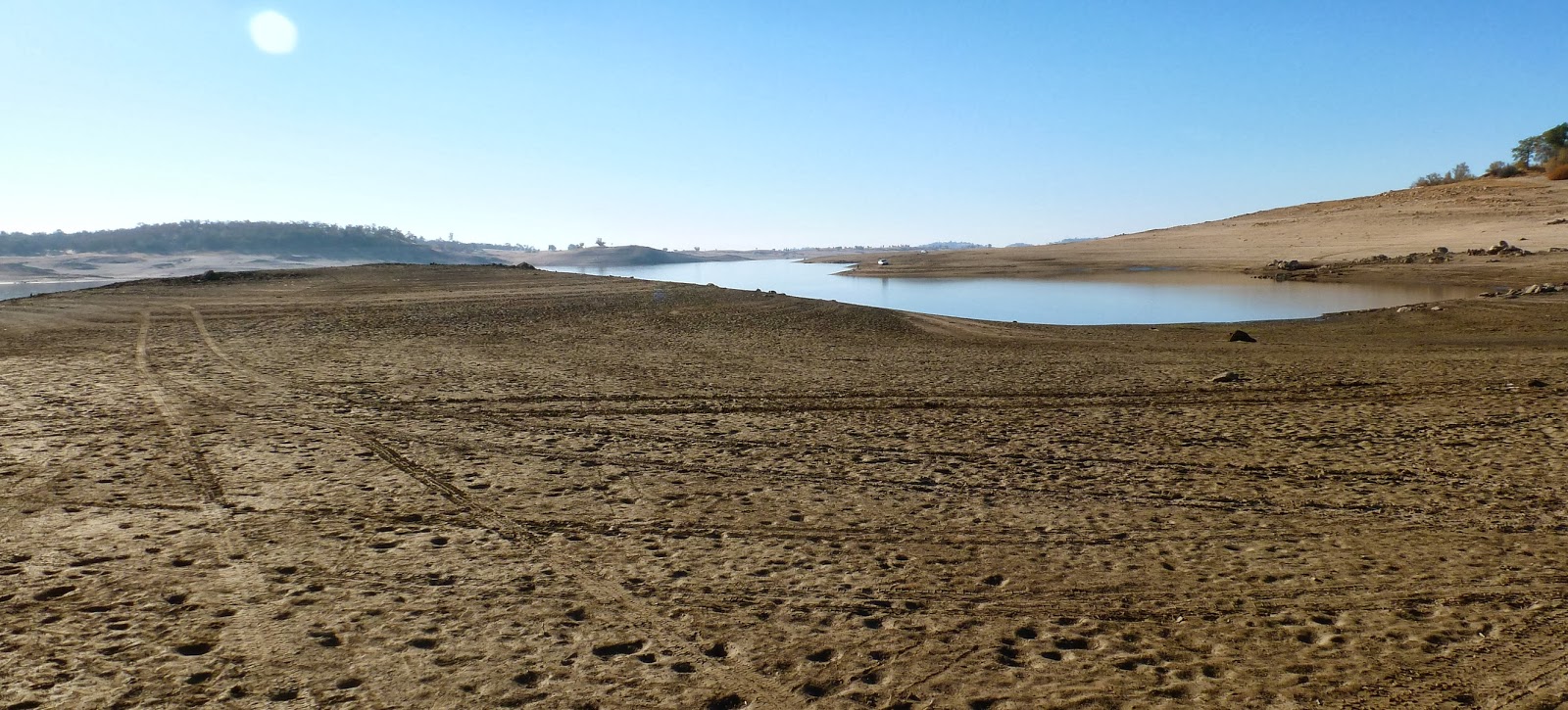
In preparation for its initial fill, the basin was denuded of plant life.  When the capacity is reduced, interesting evidence of our geologic past appears.

Boating access is stymied as the water level falls below the reach of the ramps.  But usually, not this far.

A larger than usual amount of lake bottom is exposed.  After decades under water, many of the soluble minerals have melted away.  Much of the granite that once graced the area has decomposed.

Rounded domes and outcrops remain in places – looking, perhaps, a bit more weathered than before the lake.

Some say it looks like a moonscape.  (I've not been to the moon, although I understand Alice might have.)

As the reservoir drains away, the American finds its old course slipping past gravel bars around sweeping bends.

Our history, of course, predates the dam.  And with the pool of water depleted it is easy to find artifacts of our past.  Water had been diverted into a canal on the South Fork.  A mechanism was installed to keep debris out.

Bent iron stock served as steps in the side of the dam that diverted water into the canal.

Some artifacts are easily dated.  Note that this can had both a pull-tab – outlawed some time ago – and a bar code – something relatively recent.

Others not so easy.  A busted obsidian point similar to this was spotted half buried in some decomposed granite.

Some are tricky.  A tin sign, neatly punch-lettered “Red Rock Mine” floated downstream from somewhere.  Perhaps a decade or two after the rush?

Close examination of the nails holding the sign to the log show that they are round-headed not cast square ones.  This tells us “Not quite so old…”

Whole communities lived in the canyon.  Foundations and walls, under the surface for six decades are again exposed.


And then there’s just the weird remains of those things natural and man made that set the mind to fantasy.  A Spielberg creation?

Neptune’s lectern?

Remnants of an alien craft?

A sea creature vanquishes whatever it’s vanquishing…

One wonders whether someday the old dam itself will be an artifact upon which people look back and, well, wonder.


As of January 31, the region has received 17% of its seasonal precipitation.  The lake stands at less than 15% of capacity.  Its drained carcass serves as a stark reminder that the west is arid land.  With the allure of majestic coastal vistas, verdant, fertile valleys, gold in the foothills, timber in the Sierra, winter sports and summer ones, too, it is easy to overtax Mother Nature. 

An argument could be made that we’ve done that.

Note:  If you are an east coaster with plans to escape the terrible winter you are experiencing by coming out west, please consider packing a bucket or two of ice that you can drop in the remnants of old Folsom Lake.  You probably’d be happy to rid yourself of it.  And we could really use the water.  Thanks.

© 2014
Church of the Open Road Press

Wednesday, January 29, 2014

TO THE GEYSERS


Geysers Road – Sonoma County, CA

It was the 19th of January.  Temps were predicted to touch 70.  We’d gone oh-for-the-month on rainfall and none was on the horizon.  I was in my new digs in Northern Sonoma County.  Mama was visiting the grandkids and the BMW lay fallow in the garage.  A frequently passed sign on US 101 says “The Geysers – 17.”  I liked Yellowstone’s Old Faithful as well as the next guy so I figured it was time to see California’s take on the theme.

Geysers Road forms a short but entertaining jog from State Route 128 east of Healdsburg into a remote reach of the Coast Range, then back along twisting stream drainage to meet up with 101 at Cloverdale.  Cautionary signs warn us that road conditions are variable which we come to learn means some stretches of gravel, some stretches of blacktop crumbling and falling down the hillside and some stretches as smooth as something you’d hope to encounter on track day.

Leaving 128 northeast of Jimtown, Geysers Road quickly affords a panoramic view of the Alexander Valley.  Vineyards creep down the hillside, blocks of each producing unique fruit prized by skilled area winemakers.  (My daughter’s one of ‘em.)

Reaching a summit, the road dips into a dry little valley, climbs out the other side and dances for a few miles along the side and top of a ridge.  This day, the winter grass has, for lack of rainfall, failed to sprout.  The scenery looks more like October than three weeks into the New Year.

Fourteen miles on, Geysers Road tees.  To the right it’s Geysers Road.  To the left, it’s Geysers Road.  What we’ve just been on is Geysers Road.  A directional sign tells us that “The Geysers” is two miles east.  Right I go anticipating plumes of steam reaching like misty fingers into an unseasonably blue sky.


A geyser is a geothermal phenomenon that occurs when moisture from the surface sinks into the substrata and follows underground routes to cracks in the earth’s crust.  The water follows those cracks until it makes contact with a molten mass not too far below the oaks and chemise we’ve been riding through.  Vaporized, it rockets up through the vents and would form one of those steamy plumes, except…

…Except that we’ve figured out how to capture this energy, cap it, pipe it, turn turbines with it and power 60% of the electrical needs of the California coast from the Bay to the Oregon border.  A snapshot from a stopping point shows pipelines and metal buildings, locked gates and power lines but no graceful mists shooting into the air and dissipating on the mountain breezes.  No national park here.  Still, it’s all pretty amazing. 


And, as if to prove that the journey is often better than the destination, Geysers Road swings west following Big Sulphur Creek back to 101.  Here’s where most of those variable conditions come into play.  A gentle hand on the throttle is advised as the gravel portions can sneak up on the rider and while they’ve learn to harness steam just up the road, they haven’t yet mastered “guardrail.”

A few miles west, a wide spot affords a place to view what another passer-by claimed was an abandoned quicksilver (mercury) mine.  A tall tank of what appears to be clear redwood stands akilter like a latter day Pisan tower. 

A series of rusted up and down pipes were a “separator,” the fellow says.  I couldn’t recall enough chemistry to remember what was being separated from what.  I suspect it had something to do with those little liquid chromium colored balls we shouldn’t have played with as kids.  I do know that there are quicksilver mines up along SR 20 so his guess made sense to me.

Further west, tiny, gated roads snake off to the left and right, each following the contour of this tributary or that one to another mining site or another geothermal well.

An historic bridge awaits us at the bottom: built in 1909 and moved here from somewhere back in ’37.  The embossing on the steel tells us it came from Philadelphia.  I consider its rugged trip from there to the middle of nowhere.

A few miles further and we reached 101.  It’ll be ten minutes to home.  Mom’s not back from the grandkids and I’ll wish I taken a bit longer journey this warm January day.

o0o

Today’s Route:  US 101 north from Santa Rosa.  At Healdsburg, west on Alexander Valley Road.  Left on 128.  Left (which will appear straight) on Geysers Road.  Return:  West on Geysers Road.  Right on River Road to US 101 north of Cloverdale.

© 2014
Church of the Open Road Press

Monday, January 27, 2014

Review: "The Sense of an Ending"


It seems I’m always a bit late to the party when it comes to the work of compelling authors (or just entertaining storytellers.)  As a teacher, school principal and curriculum director, I used gallons of ink and reams of paper promoting literacy to the parents of my students.  “Get ‘em to read and they’ll be more successful in school!” I’d repeat and repeat and repeat.  But, it seems, I spent very little time actually reading stuff myself.  Thus, the Julian Barneses of the world have been out there writing for decades and I randomly stumble across their work while killing time in a bookstore. 

Better late than never.

“The Sense of an Ending” shares the story of an about-my-age Brit named Anthony.  He finds himself reflecting on a long-ago past prompted by the late mother of a nearly forgotten flame who has remembered him in her will.  Starting with prep school chums (whose names, if changed, could have been high school pals of mine), through the failed flings, affairs and tragedies of youth (who hasn’t experienced ‘em?), Barnes gives us Tony looking into a mirror of personal history fractured by time.  Tony has lived a take-pains-to-harm-no-one type of life, apparently, we find out – actually, devastatingly, he finds out – not so successfully.

I finished “Ending” wondering whether all mirrors to the past are similarly fractured or just Tony’s mirror and my own.

o0o

“The Sense of an Ending” by Julian Barnes.  Vintage Books. 2011.  $15.00.  See your local, independent book seller.


© 2014
Church of the Open Road Press


Tuesday, January 7, 2014

RESEARCHING THE RED ROCK MINE


A month or so ago, while exploring the basin of a nearly empty reservoir, I stumbled across a “find.”  A chunk of yellow or ponderosa pine log, perhaps eight to ten feet long, had migrated from somewhere upstream and nestled on the shore.   

Then the shore receded.  The low foothills in the region of this find never supported conifers of this type, so I wondered from where it might have migrated.

I walked up to the log for a closer look.  Catching my interest was a rusted rectangle of tin attached to the log.  With the low late-autumn sun casting just the right light, I could see holes neatly punched into the metal forming letters that spelled out “Red Rock Mine.”

A scan through my collection of maps and a quick search on the web indicated that no “Red Rock” mine was listed in the watershed, however a “Redstone” claim had been laid upstream quite a ways.

Curiosity taking hold, I contacted an official in charge of the administration of the reservoir who passed my query onto the state archaeologist.


Today, after the intervening holidays, I received a return call.  The archaeologist proved to be the extremely knowledgeable head of a state department employing, at this time, one person: her.  How gracious that she would find time to return my call!

In the course of our conversation she thanked me for providing the pictures (included with this post) and for my interest in preserving what might be an interesting relic from the past.  She spoke of her growing up in gold country and her knowledge of the mining regions.

She shared some thoughts specific to my theory that the artifact may have tumbled a distance down stream suggesting that many names for mining claims were duplicated throughout the Mother Lode.  She said that aspects from the photographs bear witness to the probable age of the sign and that it may not date back to the earliest of days in the area.

On review of the photographs, it appears she nailed the whole date thing.


Still, the artifact poses some interesting questions.  Where’d it come from?  How’d it get here?  Should it be and how might it be preserved?  Where might one go to trace the historic threads back to its origin?

As a retired school principal, I will be promoting the idea of researching this piece to a couple of schools folks I know.  I see it as a unique opportunity for some hands-on learning involving a multiplicity of curricular areas: history, geography, geology, hydrology, cartography and even government bureaucracy.  Almost makes me wish I were back in the game!

In this post, I have been careful to not reveal the location of the artifact, although frequent readers will undoubtedly figure it out.  So in the strongest terms I would admonish folks that, should they come across the thing, leave it as you find it!  With it now resting on Federal land, one would rightfully have hell to pay should the thing go missing and later be found in their possession.

o0o

Further Note:  My conversation with the state archaeologist has prompted me to seek opportunities to volunteer in the location, identification, and preservation of similar finds.  She has provided resources, which I intend to pursue.

© 2014
Church of the Open Road Press

Saturday, January 4, 2014

A FAREWELL FROM A FRIEND


On the last great day, I walked through a forest with you.
You marveled at the light filtering through the deep, dark trees.
Your feet made no sound on the soft, fragrant duff.

You cuddled me and said some things.
And I thought:  This is great.  I’m on a walk.

On the last great day, we stepped over a tiny brook.
Because the water was clean and cool and pure,
You paused for me to wade and enjoy a refreshing sip.

You cuddled me and said some things.
And I thought:  This is great.  I’m on a walk.

On the last great day, we climbed out of the forest to a grassy hill.
When we got to the top, you wondered at the view.
You talked about seeing forever and you sang some notes.

You cuddled me and said some things.
And I thought:  This is great.  I’m on a walk.

On the last great day, we loaded up to go home.
You lifted me into the way-back because, for some reason, I couldn’t jump in.
But I felt warm and tired and fulfilled all at once.

You cuddled me and said some things.
And I thought:  This is great.  I’m on a ride.

On the last great day, we lay on the floor.
The evening’s darkness slipped in through the window.
You held me close, your hand rising and falling on my restive side.

You cuddled me and said some things and cried.
And I thought:  This is great.  I’m taking a nap.

On that last great day, we climbed a hill –
A second one – a different one.
And before you unhooked my leash and set me on my way,

You cuddled me and said some things.
And I thought:  This is great.

© 2014
Church of the Open Road Press.

Thursday, December 19, 2013

FELLING THE YULE TREE


Holiday Greetings 2013
From the Church of the Open Road

An old gentleman struggled to shuffle up an icy winter hillside.  He was not well outfitted for either the weather or the terrain this day.  A brisk mountain breeze shot through his light trousers, pasting them to aging, spindly legs. Mud caked his soft-soled shoes and the cane he relied upon carried a nasty dollop on the tip as well.  He stopped for a moment’s arthritic fumble with a fleece’s zipper then the zipper of his too-light topcoat shell.

The younger people had hiked ahead, scouting through the grove of scotch pine, silvertip and spruce for the perfect holiday tree.  Occasionally, they tossed a glance over their shoulders just to see that the old man was still progressing.  But when the quest for the tree became more intense, the little check-in glances became less frequent, and, once over a rise that split the acreage, those glances were rendered useless.

In due time, a small but handsome specimen was selected, felled, and dragged back up the path.  However, upon cresting the hill, the old gent was nowhere to be seen.  The couple rolled their prize to the side of the trail into the grove – didn’t want some Johnny-come-lately to claim this little beauty – and searched up one lane of trees and down the next.  Forgetting the severe impairment of the aged man’s hearing, they called “Papa!  Papa!”  To what avail?  Their words were likely lost on that chilled mountain breeze anyway.


The holiday crisis was averted when, near the Christmas tree farm sales office, the old man, jacket and fleece now open, was spotted alternately warming his back, then his front from the glow of a huge pine bough fueled bonfire.  Facing away from the blaze, he gazed at the glazed winter peaks some thirty miles east, marveling, perhaps, at this late opportunity to have them so near.  When turned about, activity around the dancing flames enchanted him.  He laughed with the offspring of our fellow tree fallers – kids whose names he would never recall – as they darted in and about; even holding one’s Styrofoam cup of hot chocolate and marshmallows as the tad frolicked in and amongst the boisterous little mob.


After loading up the tree, we encouraged “Papa” to shuffle toward the truck, no mean feat given that, for a time, back at the campfire, he had been declared “home base.” 

Once tucked inside, the delight of the fire still glowed. 

“I’ve been eighty-five years,” he said, “and always had a Christmas tree in the house no matter whether we felt rich or poor.”

He paused. “But this is the first time I ever went into the woods and actually cut one.”

Then he added with a timeless grin and a slightly dampened eye: “I think I’ll remember this forever.”

Here’s hoping the holiday season
brings each of us something to “remember forever.”

© 2013
Church of the Open Road Press

Friday, December 6, 2013

REDISCOVERING THE WEST BRANCH MILL


A book review and part two of this two-part epic…

The West Branch Mill of the Sierra Lumber Company Andy Mark; The History Press; Charleston, SC; 2012


Tucked away in a corner of your local independent bookseller, or, perhaps, sprinkled through their collection, one will find gems not destined for the New York Times Best Seller List.  Works by little-known local authors who have a story to tell or a piece of history to regale, simply because that is their passion. 

Back in about 1969, my father and I took it upon ourselves to find West Branch, the site of a small lumber mill that, by the time we’d arrived, vanished. [See related Post: http://thechurchoftheopenroad.blogspot.com/2013/12/discovering-west-branch-mill.html]  I'd been reminded of our adventure by an old Kodachrome slide of his I uncovered.  Then, the other day, while shopping for books for others, I stumbled across Andy Mark’s The West Branch Mill at a small bookseller in Chico.

Mr. Mark apparently shares my love of history that oozes from the canyons and foothills in and around Chico.  But he did me one better: He researched and wrote about his discoveries.

Within the cover of this little work one finds the thread linking Chico’s earliest pioneers to an industrial past I still remember.  Historic photos and their contemporary counterparts illustrate the massive efforts in which men engaged in order to tame this little corner of the west – and what remains of their work.  I’d heard that flumes not only carried logs from the mountains to town, but also, on rafts constructed solely for the purpose, injured loggers.  A photo shows Dr. Newton Enloe (grandfather of a high school classmate) riding the flume on one of these.

I thought I knew Chico Creek from headwaters to the Sacramento.  As a kid I swam and canoed in the creek.  I bicycled and hiked in Upper Bidwell Park and was tapped, at 16, to help designate the route for the Yahi Trail, which is maintained by the City of Chico to this day.  In 1986, my wife and I chose to be married at the headwaters of the creek in Chico Meadows.  Still, I had no idea that, four or five miles east of the park, a huge, hand-built arching, wooden structure supported a flume from the mill.

Original Source: Mr. John Nopel
Well-researched (Recall church elder “John” from a previous post?  That’d be John Nopel, longtime area historian who contributed the flume picture included herein) it contains stories of humor, determination and grit.  This piece of local history makes me want to discover more bits of lore in the field and more historic works in the bookstore.

One unfortunate footnote, however:  The text and the maps included in Mark’s work confirm that all those years ago, Dad had not parked the Land Cruiser anywhere near the old West Branch Mill.  I think we may have found the hotel a mile or so up the hill from the mill.  To me, this revelation appears to present a challenge, now doesn’t it?

© 2013
Church of the Open Road Press