Sunday, October 14, 2012

THE BEAUTIFUL SELKIRK LOOP – at night!


Second in a series: 
The Oregon-Idaho-BC-Washington Autumn Tour

The whole point of our October journey to the far north was to enjoy the International Selkirk Loop.  The loop is a scenic highway incorporating farms and fields in Washington and Idaho with mountains and glacial lakes in British Columbia.  Our day started in Spokane as we jetted east on I-90 then north from Coeur d’Alene on US 2/95.  Approaching the border, the rolling prairie gives way to blue mountains and delightful curves. 

Vistas to the north prompt anticipatory salivation and twitchy throttle wrists.  The design was to travel the loop in a counterclockwise direction, tracing the east side of Kootenay Lake for 100 km, crossing the ferry between Kootenay Bay and Balfour and overnighting in historic Nelson, BC.  Idiocy on my part (see below) caused a delay entering BC, forcing a change in plans.

Entering the province around 5:30 PM, we opted to reverse our course, heading west on BC 3.  As dusk fell, so did the temperatures.  The route rose over what was probably a glorious mountain pass with undoubtedly spectacular views north into Canada and south into the States, but in the gathering dark, all I could focus on was the thermometer on the big BMW’s dash flashing 36, then 35, then 34 degrees.  I cursed the irony of taking a scenic route after dark.  A northward jog BC 6 heads us northward through Salmo.  The nicely groomed road banks into and out of increasing levels of gloom.  Lights from farmhouse windows flicker through the spruce and fir.  I think about suicidal elk.  We enter into and pass out of valleys carved by streams we know we flowing based upon the moist coolness that violates our riding gear.  Each exhale clouds our helmet shields; cracking them vents away the moisture but freezes my punk, fleshy American face.

Ninety minutes or so on, a road sign indicates Nelson is but 27 km away.  I do some quick “point 6 multiplication,” estimating our time of arrival to be about 40 minutes.  A second road sign invites us to stay in the historic Ymir Hotel central focus of the little berg bearing the same name.  It would have been interesting to explore that little place in the daylight, but frosted face shields, frozen fingers and all and only a little more than 30 minutes to go, we press on. 

Our thanks for this decision appears in the form of a third sign, perhaps five minutes further down the line cautioning “Road Work – Pavement Removed.”  I slow down and crank up the Krista running lights just installed on the Horse.  They illuminate those terrifying grooves that, on a good day, cause the back tire to dance a wicked jig at speed.  Additional warning signs threaten: “Caution: Guard Rails Removed.”  Cursing more than a visitor to Canada has a right to, I slow further.  Would we ever reach Nelson?

After endless descending curves, the sign for a Best Western glows blue and gold and pure.  Not pausing to check with my riding partner, I find the parking lot, set the Beemer on the side stand and secure a room.  We’d made Nelson.

The lovely hostess there suggests that, “Yes, the BW’s dining is fine, but if you want to do the town, you should try the Library over at the Hume Hotel.”

Warm light pours onto the sidewalk as we hoof it toward the Hume.  Strains of what sound to be Paul Desmond – arguably one of the best sax men ever – waft from an active and cheery indoors.  We enter, are seated, handed a menu and realize that the late Mr. Desmond has come back from heaven to engage in a live performance this Thursday night along with a guitar man, a keyboard man and a snare.  A few morsels into a healthy portion of just-right beef filet and after a couple of sips of a very suitable red, the terror (or just plain stupidity) of the preceding two-and-a-half hours slips into some sort of kismetic balance.


The dawn breaks clear, but the waters of nearby Kootenay Lake kept the temperatures right for continued travel.

The 40 km run to the ferry crossing at Balfour follows the northern rim of an arm of the lake.  Lucky Canadians own homes along this stretch, awakening daily to grand vistas of mountains and water.

The wait for the ferry offers an opportunity to grab coffee, visit with others and find out that we were on the leading edge of Canada’s Thanksgiving weekend.

Our bikes are positioned at the front of the starboard lane.

From atop the ferry’s passenger deck we enjoy great views of the region during our forty-minute crossing.

Once ashore, we travel the sinuous east side of the lake – a ride so reminiscent of a run along the Nevada shore of Lake Tahoe – only one that lasts for 50 miles rather than just 20.  And one with far less traffic.

We pause for portraits of the bikes…

…and a final glance at Kootenay Lake.  A stop in Creston, BC affords us some pretty fair Thai cuisine before we return to the States and a second night in Spokane.

o0o

Notes and Resources:

Travel information on the International Selkirk Loop is located at: http://www.selkirkloop.org/ Allow more time than we did.  Plan better, too.

The Historic Hume Hotel in Nelson, BC is worth a visit.  Details at: http://www.humehotel.com/

Clearwater Krista lights: http://clearwaterlights.com/ These paid for themselves on this trip alone.


Last time I visited Canada there was a screening process to get in.  It went like this:

Border agent: Pronounce a-b-o-u-t.
Me: Aboot.
Agent (seeking clarity): Rhymes with?
Me: Hoot.
Agent: Have a nice day.

Twenty or more years later and a heckuva lot of history has intervened.  Thanks, Osama.  “No, honey, I don’t think I’ll need it,” I’d said to my wife before departing.  “Besides, I don’t think I know where my passport is.”

Arriving at the border, sure enough, the request was made.  My reply was sheepish.  My application denied.  Our planned trip to Nelson, BC appeared scuttled. 

(c) BBC
Attempting entry at a second crossing, apparently my piercing blue Steve McQueen-like eyes did the trick.  That and the fact that the agent realized my loaded BMW GSA could probably leap the fence far more efficiently than McQueen’s Tiger – whether or not it was me or stunt double Bud Ekins actually piloting the thing. 

The truth of my crossing is sworn to secrecy but the lesson is carry your passport or your birth certificate when desirous of entry into Canada.

© 2012
Church of the Open Road Press

Friday, October 12, 2012

EASTERN WASHINGTON – EARLY OCTOBER


Crossing on WA 2

If there’s an upside to this whole climate change thing, it is that my Puget Sound area buddy gets a few more weeks to acquaint himself with his cool Moto Guzzi Stelvio – a purchase he’d made only last June. 

Washington’s previously unheard of “Indian Summer” stretched into October this year, so, as luck would have it the weather was perfect for our final day of a five day tour, an east to west crossing of the state on Route 2.

We parked the bikes in a “secure location” the night before…

…only to awake to 36 degree temperatures.  The GSA’s heated grips helped, as did loads of layers of fleece and Gore-Tex and Denier.  But once we got going, slipping away from I-90 only a few miles west of Spokane, we opt not to stop until the sun has plenty of time to warm things up a bit. 

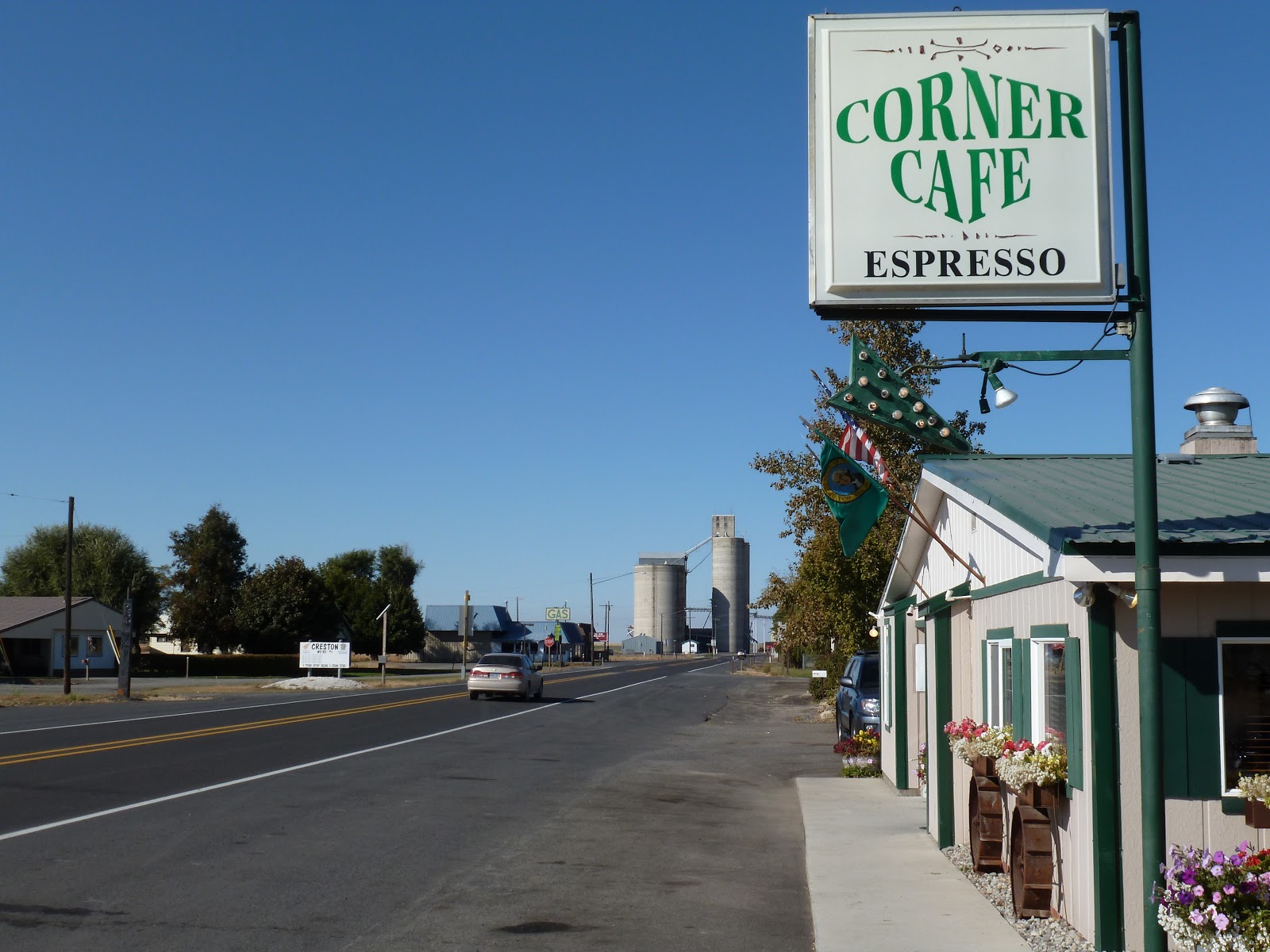
Creston, an hour or so on and billed as the highest point on the Burlington Route between Wenatchee and Spokane, offers a quaint place to wrap cold fingers around welcome coffee mugs and catch up on the local gossip.

A pair of Harleys rest outside, so we figure the place would be welcoming.  Two couples had ridden the 32 miles from Coulee City and our parking lot conversation with them devolves into how pristine their bikes looked compared to our bug-encrusted models followed by laughs, handshakes and “ride careful” comments.


Somewhere back toward Davenport, things had gotten really good.  The traffic all but disappeared.  Fine pavement split Americana scenes from today that just as easily could have been captured 50 or 100 years ago.

The road rising and falling over eastern Washington’s vast prairie reminds us that the west begins about 50 miles east of the Pacific Ocean.  From there it goes on nearly forever.

Dotted along the way are the remnants and whispers. In the not-too-distant future, the incessant north winds blowing out of Canada will tear this old farmhouse asunder.  In the meantime, this stands as a monument to folks who turned their backs on the security of a populous for a chance to be part of something large and beautiful and romantic.  And the work attached thereto.

A derelict schoolhouse sits atop a rise.  Vandals tried burning this place down, but it persevered against this and other elements.  Walking the grounds, the echoes of rural tots still ride on the wind as they kick the can in the play yard at recess. 

With the advent of state routes and inter-states, these farmers could move into towns like Reardon or Wilbur or Hartline or Douglas for a more convenient life.   The entrepreneurial among them rented out their barn sides and roofs for commercial purposes.  Outside of Coulee City, one has been restored.

On that vast plain I am reminded that retirement is the workingman’s reward for his efforts over a long career.  Those who work the land – because the work is never done – may be less able to enjoy a few golden years of leisure.  Perhaps it was the sight of this old Chevy: knee high in weeds, watching the traffic slip by on the state route, patina deepening with each passing day.  This old boy appears to enjoy a richly deserved rest.


After a delightful descent between Waterville and Orondo, we follow the Columbia though rich orchards to Wenatchee, Cashmere (great barbecue place there) and beyond.

Crossing Stevens Pass, we find that the little dots the 3-A places next to this scenic route are justified with sweeping curves, expanses of fall color, gorgeous peaks and glimmering rivers.  However, with those dots come increased traffic – many of the drivers, perhaps, amateur.  We find an alternate route from Monroe to Snohomish, where we’ll call it a day.


This day’s route:  From Spokane, west on I-90, taking airport exit; Continue west on Rt 2 through Davenport, Creston, Wilbur, Almira, Hartline (zealous patrol presence as the route slips through many of these bergs) Waterville and Orondo.  Conflue with US 97 south toward Wenatchee, but resume westward movement as Rt 2 splits and heads toward Cashmere, Leavenworth (Germanesque-themed touristy enclave), Stevens Pass, Monroe and off to the Sound around Everett.

© 2012
Church of the Open Road Press

Monday, September 24, 2012

ALL THE GEAR, ALL THE TIME – JACKETS


Third in a series…

My nurse friend wants to ensure that her son on a new-to-him Honda 750 Shadow is properly outfitted for safety.  Posts one and two regarded helmets and gloves.

As a guy who has ridden for the better part of forty years, I cringe when I see riders in T-shirts – or riders in gear with their girlfriends aft in tank tops or less – batting through suburban traffic or racing between lanes on the freeway.  Perhaps it is because I have daughters, both of whom are married and well past that stage.  Or maybe I’ve just seen a bit too much.

Today I own five motorcycle jackets: three textile, two leather.  (Yikes! I have no idea how I’ve acquired so many.)  Each jacket has a specific purpose and is worn on specific riding occasions, although there is much overlap in their use.   

Each of the jackets has some type of reinforcement at probable impact points like shoulders and elbows.  In some cases the reinforcement is thick foam padding, in others a less pliant more armor-like material.  

Each jacket has zippers that open vents allowing air to course through and cool the rider. 

Some of the jackets have an interior zipper in the lower back area that matches the zipper at the top of riding pants.  When connected, this lessens the calamity of pants and jacket separating to expose bare back to chip-seal at 55 miles per hour.   

Closures at the neck and cuffs may be snaps or hook-n-loop like Velcro®. 

Synthetic jackets come in a variety of colors.  Black is a favorite but bright or “Hi-Viz” colors are far more see-able by others on the road and, therefore, a good safety choice.  Many jackets come with reflective piping making them more visible at night.  Many come with removable liners making the garment useful in both cooler and warmer riding conditions. 

Jacket fit is incredibly important.  The jacket should be snug enough to protect you in a fall but not so uncomfortably tight that you are tempted to leave it on a hanger at home.  It should shield the rider from such diverse elements as rain, cold, and heat.  It might help if it were stylish, but trading safety for style, something I’ve admittedly done, is always a bad bargain.  It should be kept clean and dry and inspected for signs of wear – a cause for replacement – before it is called upon to sacrifice itself for you.


Textile jackets’ exterior material is engineered out of synthetic fabric.  It is strong, light, breathable and will experience less abrasion when sliding along the pavement.

On a steamy summer day in the Sacramento Valley, a t-shirt covered by a textile jacket feels much like having only the t-shirt on in terms of ventilation and coolness.  The function of the jacket then is to provide a layer of protection between the skin and the tarmac and to hold those impact pads in place. 

One of the textile jackets is a three-season coat.  It is three-quarter length, belted, padded, and brightly colored. It is my ultimate go-to on road trips.  There is plenty of room for gloves, maps, notebooks, telephones and small kitchen sinks in the various pockets.  Slipping a Gore-Tex rain parka underneath this puppy, I find I have really good protection from rain and even hail.  Adding a layer or two of turtleneck or sweatshirt or wool allows me to retain enough warmth to ride nearly twelve months out of the year. 


The leather jackets are dissimilar.  One cuts the winter chill.  The other is strictly a late spring to early fall garment.  The heavier of the two has a shell of much thicker leather prompting me to believe I would fare better in a crash if wearing it.  The removable lightly quilted liner, I have recently found, makes the unit extremely tight around my midsection – but keeps me incredibly warm on short mid-winter trips.  Interior pockets hold a checkbook or datebook; exterior pockets accommodate light gloves or a small camera.

The other leather jacket, which I like a lot, I’m embarrassed to say, I purchased because of its cool Guzzi logo.  Styled and built in Europe, it was on the sale rack, so I snared it.  The leather appears to be much thinner and the padding much more “foamy.”  I’m not sure I’d like hitting the pavement in this one although I’m sure it would spare me from abrasion.  But it certainly looks groovy.


One of the great things about adopting a hobby or a sport – be it woodworking or waterskiing – is the plethora of tools and equipment one must acquire in order to fully enjoy the endeavor.  Motorcycling is no different.  Good equipment makes the experience much safer and more satisfying.  

o0o

As twelve and ten-year-olds, my brother and I (with permission of our folks) launched the family’s classic Old Town wood and canvas canoe in a rain swollen Chico Creek one October Saturday.  Chico Creek bisects beautiful Bidwell Park, heading westerly toward the Sacramento River.  Our five acres lay west of town.  That would be our point of disembarkation.

Sans life jackets and clad in Army surplus fatigue jackets – the look of the day [mid-60s] for kids our age – to insulate us from the foggy 40 degree cold, we put in.   The swift autumn current would carry us the six miles home.  The first five-and-a-half miles were trouble free.  However, only a few hundred yards upstream from the house, an ancient sycamore tree had collapsed the night before, much of it landing across Chico Creek.  The venerable Old Town, speeding downstream, rounded a swirling bend and immediately lodged its bow in the windfall.  The boat lifted, cracked, twisted and pitched us into the drink.  Our fatigue jackets filled with heavy frigid water as the current dragged us away from the canoe.  Somehow we clambered out, hiked home and spent about forty-five minutes in a hot shower thawing.

A few years later, that Army fatigue jacket – I’d now almost grown into it – served as my insulator from scrapes and bruises as I puttered around town and into the woods on my first motorcycle.  It was the wrong tool for that application as well. 

How we survive our youth is one of life’s great mysteries.

© 2012
Church of the Open Road Press

Saturday, September 22, 2012

TEN OBSERVATIONS ABOUT ELECTION SEASON


On facts and fiction:

1.   Facts are inconvenient.  A major candidate’s campaign mucky-muck declared that fact checkers would not direct the campaign.  One must ask: Why not?

2.   That fact checkers oft-times find one campaign less bound to constitutional principal, historic or economic precept, or the plain old truth, does not imply that said fact check organization favors one effort over the other.  It does imply something about the “one campaign.”

3.   Having recently reread the Ten Commandments, I find only one speaks to the issue of telling the truth: “Thou shalt not bear false witness against thy neighbor.” (Ex 20:16)  Why is it okay to bear false witness against thine opponent in matters political?  Why isn’t there a commandment that simply says: Thou shalt not fib?


On economics and the budget:

4.   The debt is greater now, in terms of dollars, not in percentage of GDP, than it has been throughout our history.  Inconveniently, this is because we waged two – some might say questionable – wars on a nation’s credit card.  It is unclear why furthering debt for international conflict is more acceptable than furthering debt to help Americans at home.

5.   In times of recession, the government traditionally increases expenditure, circulating money through government-sponsored projects implemented by private industry, in order to pull the country out of the malaise – unless we are misguidedly concerned about "burgeoning" debt.  Or we have a political party who’s admitted “top priority” is to deny the current administration a second term.  http://www.youtube.com/watch?v=W-A09a_gHJc

6.   Folks wishing to “shrink the government until it can fit into a toilet and then flush the toilet” (think Grover Norquist and his minions) would be well advised to research other nations of the world where the citizenry is allowed more freedom and opportunity for their tax dollars than what is enjoyed here.  Then, if they think they like the place, hell, move there.  We’ll welcome you back after your dose of reality.  In the meantime, many of us would like a government that serves the needs of its people – and fairly taxes said people to cover the costs.


On punditry: 

7.   The media are not liberal.  An organization may not be as far to the right as Fox News but it doesn’t follow that that organization is liberal.

8.   Some media have a decidedly liberal slant.  So?

9.   A well-known major mouthpiece is more interested in selling mattresses and Snapple and promoting his personal brand through bombast, shock and insult than in promoting what’s good for the United States.  If the other side paid better, I’d wager he’d jump.  And, yes, I do listen to Rush on occasion.

10.   Political postings on Facebook frequently serve to provide belly laughs to those who agree and inflame those who don’t.  Too many of such postings do not further the debate; instead, they widen the divide.  And, yes, I do find some of them quite humorous.


If, indeed, this is the most important election to come along in years, the outcome will be specious at best unless all Americans look past what is convenient to believe, or what profits each of us individually. 

We need to pay attention to real issues and respond – sometimes rather inconveniently – in a manner that honors the greater good.  I believe Thomas Jefferson, Benjamin Franklin, George Washington, Abraham Lincoln, Franklin Roosevelt, Edward R. Murrow, Ike, members of “the Greatest Generation” and a host of others would agree.  Probably including Jesus.

© 2012
Church of the Open Road Press

Thursday, September 13, 2012

ALL THE GEAR, ALL THE TIME - GLOVES


Second in a series…

Recall the good friend and colleague Registered Nurse whose son, after being exposed by his mother to this blog, decided to purchase a Honda Shadow 750 upon his return from Africa, as his first bike.  Her query of me: “What stuff should he have to be as safe as possible?”

“If something happens to my hands, I’ll find myself livin’ under a bridge in less than month.”  So spoke an affiliate of mine who works with his hands, freelancing as a piano mover and a mid-weight equipment operator. 

“So why’re you wearing THOSE gloves?” I asked pointing to the pair of hardware store Wells Lamonts. Great for wrapping around a shovel I’m thinking but not so hot on a twist grip. 

It’s been said that the cheapest thing on a BMW is the rider, and this guy is no exception.  Dismounting his meticulously cared for 80s era vintage R80RT, he as much as said, Gloves schmuvs.  “I get these for twelve bucks a pair an use ‘em for everything.  Why should I spend five times that?” 

“I don’t know.  Because you don’t want to end up under a bridge somewhere?”


Gloves are an important piece of motorcycle safety equipment.  I’m no expert, but chances are, if one takes an unintended dismount at any kind of speed, hands, or portions of them, will be worn off as they skid along an unforgiving section of pavement.  Quality motorcycle gloves provide extra protection in such an event.  Constructed of combinations of leather and a synthetic fabric sometimes known as Cordura (a trademark registered product of DuPont Corporation.)  High quality gloves may include an envelope of gel that can provide extra cushion for impact points in the event of a fall.   
While leather palms may abrade as one skids across the pavement, better the leather than the flesh. 

Motorcycle gloves are engineered for specific purposes.  As a road rider who occasionally finds some gravel to enjoy, I have four pair.  I choose the glove for the ride I anticipate I’ll be taking.

Around town in spring summer and fall, I wear a short glove with a hook and loop strap (Velcro®) that secures them at my wrist.  Made fully of leather, a gel pack pads the palm and a portion of the back.  The gloves fit nicely at the end of any jacket I may choose to wear, but usually, these are worn with a light leather jacket or with a summer weight mesh jacket. 

They are stylish (the least of my concerns) and fit nicely in my helmet or tank bag for storage – or in a jacket pocket if that’s more convenient when checking out some local bookstore or bistro in town.

On a road trip or if I know I’m doing some gravel, I choose ventilated gloves with a longer gauntlet that is snugged under the end of the jacket sleeve.  This pair has a poly-plastic vent atop the knuckles that allows the flow of air in.  The fingers are leather (kangaroo, I believe) but the body is perforated thus aiding in cooling and breathability.  There is a gel pad in the palm. 

A Velcro attachment secures the wrists.  These gloves are durable and have proven to be my go to choice for versatility.  If I were counseling a beginner, something like this might be my first choice for an “only pair.”  They aren’t cheap, but remember the whole living-under-a-bridge concern…

Winter and rainy day riding can be quite an experience – and a good thing to do to keep one’s skills fresh in the “off season.”  My waterproof winter gloves are thickly padded providing some insulation from cold blasts at speed.  Their long gauntlets stuff inside the sleeves of my three-quarter length three-season jacket, but can slip over the ends of the insulated leather jacket I sometimes wear. 

I find that the middle finger of my throttle hand sometimes gets very cold – even numb – a situation that is both uncomfortable and distracting.  I stop occasionally and dip the finger in hot coffee (a dumb thing to do) while the waitress stares at me incredulously.  Still, well-insulated winter gloves are essential because hand dexterity is exceptionally critical when operating the bike.  I try to always have these with me – particularly on  long trips – in order to accommodate changing weather conditions.

My back up pair of gloves is a pair of lambskin leather jobs from Germany.  Their interior lining is softer than the proverbial baby’s bottom.  They have the gel and they’re really attractive.  They’ve proven to be rugged and durable, providing a little bit more coverage and warmth than the shorties mentioned earlier.   Although this pair is pricy, something of similar design and construction would be another excellent choice for an “only pair.”


Properly fitting gloves need to, well, fit like a glove.  They should not be so tight as to restrict hand movement or bind fingers.  They should not be so loose as to compromise positive contact with controls and switchgear.  They should be thick enough to protect from impact and/or cold, but not so thick as to inhibit one’s ability to feel those switches and levers.  They should be kept clean and allowed to dry thoroughly after wet-weather or hot, sweaty use.  And they should be replaced regularly.  The last thing a rider wants to find out is that their gloves have rotted out 3/100ths of a second after having met the pavement.

Gloves are an essential part of the safe rider’s gear.  On that bad day, they could prove to be the difference between simply an unfortunate spill and finding yourself living under a bridge somewhere.  Don’t skimp.

o0o

[Update (14 Sep 12):  Check the thoughtful words shared by Tina Ingle, Cordura brand account manager, regarding the Church's representation /misrepresentation of Cordura applications in motorcycle gear.  It is located in our comment section below this post.  Thanks for the clarification, Tina.]

© 2012
Church of the Open Road Press

Monday, September 10, 2012

ALL THE GEAR, ALL THE TIME - HELMETS


First in a series…

A professional acquaintance of mine – a Registered Nurse – approached me the other day brimming with chagrin or, perhaps, something else.  It seems her son had returned from overseas and, after having read portions of my blog (which, I believe she turned him on to), purchased a Honda 750 Shadow.  As all concerned mothers are, she was interested in him surviving this phase.  (After 40+ years of my riding, my mom is still concerned about my “phase.”)  The conversation steered itself toward riding gear.  I promised to gather some resources and share some thoughts, all of which prompts this short series of posts.

The most important single piece of riding gear one can use is a helmet.  Helmets are engineered to withstand and distribute tremendous force all in an effort to protect the rider’s delicate cranium better than the mere ¼ inch of bone matter with which we are all naturally endowed. 

I’m no expert, but it seems to me like the physics of a bare head hitting a freeway divider at 65 miles an hour are a lot more unforgiving than that same head encased in Kevlar, Fiberglas and thick foam padding. 

Helmets must meet regulatory requirements that have been established both in the US and Europe.  Two standards setting organizations are ANSI (American National Standards Institute) and Snell.  The US Department of Transportation awards "DOT" stickers to helmets meeting specific standards, but the Snell benchmarks are far more rigorous, so I look for that Snell approval.  While most (all?) marketed helmets meet accepted standards, there are styles of helmets that are inherently safer than others. 

Full coverage helmets are one-piece units that that fully cover the rider’s head from the top of the skull to below the chin.  A thick, padded band of the same material that makes up the helmet wraps around the lower part of the face protecting the rider in situations where one may be tossed over the handlebars and skidding along the pavement on one’s face.  Full coverage helmets have a clear or tinted visor that rotates into place protecting the eyes from bugs, debris and wind.  Full coverage helmets come in range of prices, but price should be the lesser of the buyer’s concerns.  Comfort, fit – it should be very snug, ventilation, and weight should enter into one’s thinking.  Mine is white in color because it shows up better and because it is cooler on hot summer days. Also, find one from which it is easy to remove the face shield for cleaning. 

Convertible or modular helmets serve as an alternative to the full coverage model.  Although they look the same as full face, the chin bar is hinged so that with a push of the button, the bottom of the unit can be rotated up and out of the way when safe.  “When safe" does not include while riding.  Modular helmets can only fully protect the rider at speed when closed.  However, when filling up or when stopping by the side of the road for a conversation, the flip-up nature of these can prove to be more convenient than having to take the whole thing off.  Convertible helmets used to get a black eye for product integrity in the event of impact, but manufacturers and enthusiasts seem to think this is no longer the issue it once was.  Modular helmets can be a tiny bit heavier than full face.  I wear mine on short trips around town.

Open face helmets are those units the more gentrified among us may have remembered as kids.  A.J. Foyt?  Indianapolis 500?  They lack the chin bar.  Snaps are provided around the front from ear to forehead to ear so that plastic eye protection can be added.  Open face helmets are cooler but do not afford all the protection that the full-face units provide.  I use mine only if I am driving around the block to dry the bike after a wash.  And once my open face helmet is worn out, I’ll not replace it.

Shorty helmets offer the least protection.  While many are padded like their afore-mentioned cousins, chances are that in the even of an impact, parts of the head and neck will be less protected.

Resources: 

Snell Foundation helmet standards: http://www.smf.org/stds

How to identify unsafe helmets (from the National Highway Traffic safety Administration: http://www.nhtsa.gov/people/injury/pedbimot/motorcycle/unsafehelmetid/pages/page2.htm

Enthusiast magazines offer product reviews on helmets from time to time.  Here are just a few of many, many magazine websites worth exploring:

Also: plugging “Motorcycle Helmet Product Review” into your search engine may access many on-line sources.

California has a mandatory helmet law for all riders of motorcycles.  Three years back, riding home from work, I-80 was clogged.  Rescue personnel had arrived, their bobbling red lights indicative that something up ahead wasn’t good.  To avoid the jam, I exited, taking an available off-ramp to an overpass and planned to use surface streets to wind my way home.  Looking down on the six-lane, medicos were just draping a green plastic sheet over a crumpled body recently moved away from the concrete divide.  Later, I found out that the victim had just rented the Harley he’d wrecked some three miles up the road.  In keeping with the law, he had equipped himself with a “beanie” style helmet, one that is thin in structure and that passes over the rider’s ears, offering little protection for the temple or the base of the skull.  Frequently this style of inadequate protection bears an after-market protest sticker reading “Helmet Laws Suck.”  The Church of the Open Road believes that being dead (or permanently disabled) sucks more.

© 2012
Church of the Open Road press

Tuesday, August 28, 2012

IN PRAISE OF SMOKING (FOOD)


About 16 years ago, I purchased something for around 200 bucks that I still use today.  Think about that.  What have you purchased that has stood the test of a decade and a half?  Probably not your refrigerator.  Perhaps your laundry pair?  Your car?  Carpet for the house?  Your cell phone or computer? 

A now out-of-business retailer (Barbecues Galore!) sold me a smoker built by a bought-out-of-business manufacturer.  I’d seen one of these cookers at a small commercial eatery in Old Sacramento and after a bite of smoked brisket, I knew I had to have one. 

A smoker differs from a grill in that there is one chamber for fire and another for cooking.  A traditional smoker is really a barbecue.  A grill is not.  Smoking food – or barbecuing it – is a process of long cooking times using low heat.  Here’s how to do it.

The night before – if I’m planning ahead which I’m usually not – I either apply a dry rub to what is to be cooked, or immerse the product in a marinate.  Sources abound for rubs and marinates although I look for products or recipes that minimize the use of corn syrup and/or white sugar.  About the time I’m going to fire up the smoker, I pull the meat out of the frig. 

Dried hardwood (oak, almond, pecan, fruitwood, hickory) is a more flavorful fuel for barbecuing than most commercially obtainable (and chemically laced) charcoal.  Filling a large bucket with water, I soak the firewood for 30 to 60 minutes prior to throwing it on.  Most of my fuel I’ve harvested from the oak trees in my back yard, but I’ve been known to purchase a downed peach tree during orchard removal or swipe a few chunks of almond from my brother.  Particularly when smoking pork, the smoke from different woods impacts the flavor of the finished product – always in a distinctive and positive manner.

Compromising my disdain for charcoal, I do light a small pile.  Once ashed over, I toss the wet log on the pile, open up the chimney and wait for the cooking chamber to achieve the temp I want – usually between 220 and 250 degrees. 

I place the seasoned chicken or marinated tri-tip in the middle of the smoke chamber and wait – sometimes forgetting to monitor the heat which is easily adjusted by allowing more or less air into the fire chamber.   

The aromatic smoke wafting through the neighborhood invites more questions than the purchase of that new Rav 4 sitting in your driveway.  And the new Toyota will only be new for about a week. 

Because it takes between 3 and 5 hours to fully smoke a chicken, this is when a nice cigar with a smooth bourbon over a little ice comes in handy.  Your “customers” will think you’ve been slaving out in the hot sun for that entire time so act worn out when you bring it in the house.  A couple of “Sen Sen” will mask your foul cigar breath and cover up the whiskey so you may continue the ruse another day.

Enjoy your meal and accept the accolades you will receive for your cooking prowess while the rest of the household was mashing potatoes, steaming the green beans, baking biscuits, brewing ice tea, setting the table, and on and on.  Your guests will think you did all the work.


The New Braunfels Smoker Company, out of the hill country in Texas, sold to CharBroil, a competitor.  In the transition, the new company “improved” the old smoker by reducing the gauge of the steel and swapping out wooden handles and shelving for plastic making the unit lighter and more readily able to rust through.  In short: they improved on it until it didn’t work as well.  It costs less, however.  [If anyone sees a New Braunfels “Black Diamond” still in a box, contact me.  I’ll buy it in a heartbeat.]

Resources:

The Smoke and Spice Cookbook, by Cheryl and Bill Jamison (Harvard Common Press) is a terrific primer on smoking food.  The Jameson’s provide information on smoker types, woods, food preparation, recipes for sauces and rubs and recipes for foods that will complement a nicely smoked entrée.  My copy was © 1994, but I see an updated and revised is still available at your local bookstore. 

The Jamison’s website may be accessed at http://cookingwiththejamisons.com/cookbooks.html
© 2012
Church of the Open Road Press