Showing posts with label ATGATT. Show all posts

Monday, January 29, 2018

KLIM "LATITUDE" THREE (OR FOUR?) SEASON RIDING JACKET


Seasonal Affective Disorder be damned!

The new Klim Latitude Jacket arrived on the perfect January day.  Four or five days of thick, drippy tule fog, and my Seasonal Affective Disorder (SAD) was kicking in.  Enrico, my Yamaha Super Tenere, was probably feeling about the same as me.  We both knew that the cure for SAD was a trip to some high ground somewhere above the fog.

The parcel from RevZilla arrived exactly as scheduled; the contents were just as advertised.  I donned my new Klim Latitude and marched around the house, past the mirror several times, adjusting the jacket to fit my girth and the sleeves to my spindly arms.  (Fifty years ago, pulls-ups in gym were not my friend.)  Given my odd shape, I was curious as to whether the jacket could be snugged just so.  Walking around the house was fine, but the real test would lay inside that blanket of moisture.

Thumbing the starter on the Yamaha through my winter gloves, it was as if Enrico's exhaust note was grumbling, “It’s about time!”

A block away from the house, I felt a draft that I knew was gonna bug me.  But the tabs on the Velcro® closures at both the elbow and the wrist were easy to manipulate even with those clumsy gloves on. 

A mile from home, I entered the 101 freeway and headed south at the speed limit.  Moisture collected on the face shield of my Shoei and I fingered it away; but even after twenty minutes at speed through this pea soup, nothing seeped through the Latitude.

Sunshine, if there were to be any today, would be found near the crest of the Maacama Mountains.  Heading east out of Santa Rosa, a twisty Mark West Springs Road is a delight when dry.  In January its curves can be more challenging when wet, especially considering the erosion caused by the rains that followed the area’s recent devastating fires.  I hoped not to try out the jacket’s impact protection.

North of Calistoga, I coursed further north on CA 29 as it climbs out of the Napa Valley on a six mile stretch that recalls Stelvio Pass.  Somewhere in that section, I broke through the fog.  The temperature rose from mid-40s to nearly 60.  Not enough to remove a layer or open a vent, but while having coffee at an outdoor table in Middletown, I fiddled with all of the zippers and closures, pleased with so much of the design of this unit.  I’m gonna like this a lot!

The coffee warmed my insides and on the 55-mile return ride, the jacket kept my outsides dry and snug.  Returning to the garage, I know Enrico was happy with the outing and I was happy with the bike, the jacket, the roads and the past three hours. 

Seasonal Affective Disorder be damned!

Tuesday, August 9, 2016

FOX CREEK VENTED RACING JACKET


A product review

Over the nine-plus years that I’d owned my trusty Tour Master Coaster II leather jacket, somehow the thing had shrunk – just hanging there in the closet.  The process was gradual having occurred hand-in-hand with an increased consumption of bacon-cheeseburgers on my part.  Regardless of the cause of the “shrinkage,” it was time for me to find a replacement, so I did a little shopping around and recently dropped five bills on a Fox Creek Vented Racing Jacket. 

Shortly, I hopped astride the T-Bird and, with the chest and back vents open, headed out toward Napa, then across the Sacramento Valley with temps rising to mid-80s.  When the mercury started to embrace 90, I transitioned to the summer weight Dianese I was carrying along. 

The following day found me at the 5,000-plus foot level in the Sierra, where the jacket was again employed, vents closed for a while, against the chill.

My impressions of this jacket are quite positive.  The thing is heavy like that lead apron they put on you when they’re doing dental x-rays.   

But with the vents open, it is cool and makes me feel secure – if that's the right word – no matter what the traffic conditions. The quality of this jacket is superior to anything I've ever owned and I thought I'd been buying good stuff in the past. The zippers are substantial and appear not prone to failure.  Their antique bronze finish is a nice touch.   
The leather itself is supple and thick – doubled in impact areas – very nicely finished and smells terrific coming out of the box.  Seams and stitching appear flawless. 

Having heard about this while doing my research, I did find that because of the thickness and structure of the front pockets – there are inside and outside pockets to contend with – I get a little "Dolly Parton" effect as the bottom of the jacket tends to migrate northward from my waist when in the saddle.  This is just an observation, by no means an annoyance.  Besides, those pockets are quite commodious capable of stowing extra gloves, the cell phone or the camera easily. 

I am looking forward to how this performs as the temperatures cool in the fall and through the winter as I zip in the liner that seems easily deployed and comes with a neck muffler designed to keep cold air from entering your helmet from beneath your chin.

I appreciate Fox Creek's corporate story – a Vietnam era entrepreneur who dabbled at one thing and another until he struck upon making really good stuff out of leather.  Stateside.  Equally impressive is Fox Creek’s customer service.  They took the time to contact me prior to shipping the jacket to ensure the size I ordered was correct for my build.

Not only do I think this may be the last leather jacket I'll need to purchase, I am now hoping for a grandson who rides to whom I can pass this on in about twenty-five years.  Earlier, if I don’t cut down on those bacon-cheeseburgers.

o0o

Note:  Fox Creek Leather’s web presence: https://www.foxcreekleather.com/

© 2016
Church of the Open Road Press

Tuesday, April 30, 2013

SLIDERS CARGO RIDING PANTS

Initial Product Review

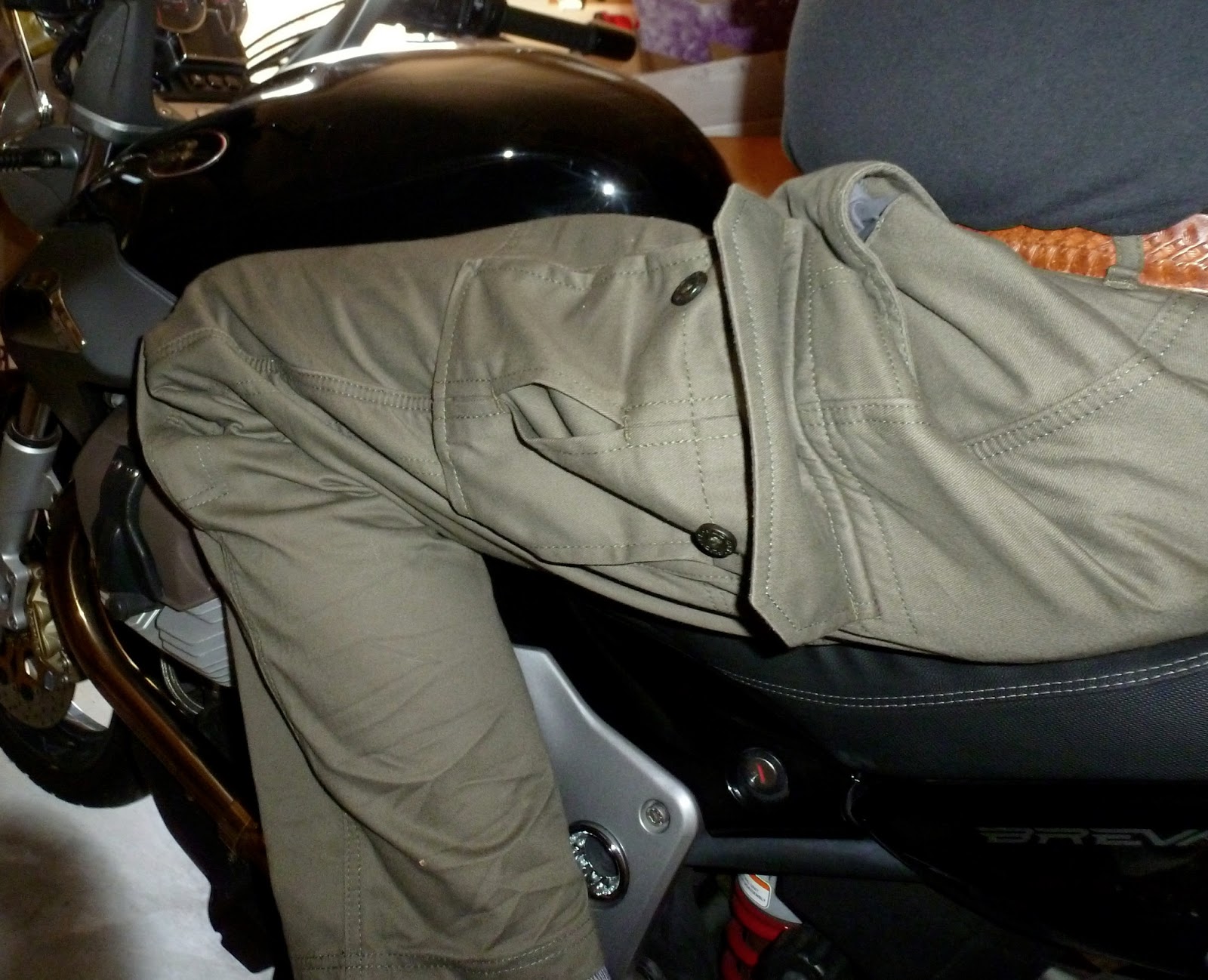
Last week, my new pair of Sliders arrived via parcel post.  I ordered them with cargo pockets: a feature that would give me access to my little camera without having to hang it on my belt or fumble with a tank bag zipper.  I was impressed with the soft texture of the khaki fabric.  These felt like pants, rather than riding pants.  Also impressive was the workmanship involved in stitching layers of cotton and Kevlar and mesh together.

One thing missing was the armor I’d grown used to.  The catalog suggests that for about ten dollars more, one can purchase CE approved inserts that fit nicely into some interior pockets at the knee.  I missed how to order these when I purchased on-line – a circumstance I’ve since rectified.

Upon their arrival, I put ‘em on and traipsed around the house. Right out of the box, the Sliders felt soft and broken in.  I did some squats (ultimately having to use a dining room chair to get my creaky knees fully straightened back out – yikes!) and found plenty of room for leg movement. 

The following day, I mounted the Guzzi and headed out for a little get acquainted tour.  Temps would range between 58 and 90.  I’d read that these trousers might feel a tad warm but my impression was that, rather than being too warm, they were successful in insulating my ankles from heat I sometimes feel blowing over the Breva’s heads.  

I purchased this pair with an inseam two inches longer than my street clothes.  The Sliders seemed to crest the tops of my riding shoes, but stayed below the tops of my more substantial boots.  The cargo pockets stowed the camera quite nicely although buttoning and unbuttoning the pockets invited fumble.  I found the camera quite secure with the pockets unbuttoned.

Getting on and off the bike multiple times for breaks and walks, I felt as if the belt I was wearing looped around my midsection where I wanted it to, not lower as was my niggle with the expensive, bike-labeled brand I’ve worn and liked for some time.  (I also own some rather cheesy denim riding jeans that I purchased just because they were denim.  They really have some fit issues.) Engaging in a little rock scramble to get a particular picture, I noted ample room in the Sliders and no binding.  “Relaxed fit,” I think they call this.

After six hours in the saddle I came home and sat down to check e-mail and do a little office work.  Two hours later, I realized I was still wearing the motorcycle pants.  I guess that says something about their comfort.

© 2013
Church of the Open Road Press

Monday, December 17, 2012

SELECTING A CYCLE

 
“Don’t trust everything you read on the Internet.”
- Abraham Lincoln

Returning to my old office of employ, my former secretary said, “My son is thinking of getting back into motorcycling.”  I cringed a bit.  “He doesn’t quite know what he wants, but I told him to log into the Church of the Open Road and see what’s there.”  I cringed some more.  (See Lincoln’s quote, above.)

Most everybody’s initial foray into the sport of two-wheeled travel is a shot in the dark.  So many makes and models to choose from!  What to own?  My first bike was a 90cc Honda.  It was great for putting around town and knocking out some forest service roads up in the hills, but getting to those dirt roads was a bit more problematic.  As I raced up (and I do mean “up”) state highway 32 toward Forest Ranch at 27 miles per hour, even at seventeen years of age, I knew the bike wasn’t intended for the demands I was asking. 

My daughter’s experience is similar yet different.  Her soon-to-be husband had come home on a Triumph Bonneville Black – one of the Hinckley models.  Daughter went for a spin on the back and wondered why we hadn’t told her what a blast motorcycle riding could be.  She took the course, got her license and some gear and went shopping.  She fell in love with what would become her first – and only – bike: a 2007 Ducati Monster S2R.  No amount of counsel could convince her that something a bit more mild would be a better selection for the new rider.  One first-day spill and the thing was sold.

My secretary told me that her son’s first bike was one of those lean over motorcycles and this time he was looking for something he could sit up straight on.  He’ll have a fire-related job up in the mountains this summer and would like something to commute on.

I immediately thought of the KLR 650 I’d owned a while back.  The thing could clip along at highway speeds.  For sight seeing on back roads and forest service routes, the thing was terrific.  But, the handling wasn’t too precise and the brakes were anything but state of the art.  Still the upright-ness is good as long as her son’s inseam isn’t as short as my brother-in-law’s.  He’d straddled the Kawi once and could barely reach the garage floor using the tips of his toes. 

I reverted to son-in-law’s Bonneville Black, recently sold.  There’s a bike with some solid engineering, a moderate sit-up position, and cool retro looks - especially the McQueen signature Scrambler derivative.  Downsides might include the weight and the fact that in the mountains or far northern California, it might be tough to find a nearby dealership.

My two current rides are a BMW 1200 GSA – probably too big and undoubtedly too expensive for an I-wanna-save-money-on-my-commute livery – and my beloved and thus-far rock solid Guzzi Breva – see issues with dealer networks.

There are a ton of great bikes to choose from now.  Honda, Yamaha, Kawasaki and Suzuki are all producing some mid-weight bikes that are reliable and economical.  They come in a range of styles and seating positions and dealers are always close by.  Triumph has some 800cc Adventure triples and BMW some 800 Adventure twins that set butterflies loose in my tummy.  A Ducati Monster would be fabulous on the paved mountain roads where I know the young man will be stationed.  Not so hot off the tarmac.


What counsel I would offer this young man? 

Substance over style:  Determine where you’re going to ride, why, and on what surfaces.  Cross out anything on the list that doesn’t match.  Those bikes you check off will be there when your riding circumstance changes – and it will.

Dealer network:  If he lacks the mechanical skills I lack, having someone within shoutin’ distance who can keep the thing in top condition will only lengthen the life of the machine and greatly increase the enjoyment of ownership.

Fit:  Sit on several making sure your feet can rest firmly on terra firma at full stop.  Ensure the relationship between the handlebars, seat and pegs don’t cramp your style.  (After an hour on my old R65, I routinely had to stop, get off, and reestablish blood flow to my butt and joints associated with my hips.)  After you’ve narrowed it down, insist on as lengthy a test ride as the dealer will allow.  Sitting on it in the showroom and operating it on the highway are two completely different arenas.  Both need to be experienced, with the fit on the road being, by far, more important.

Research:  Read reviews from multiple sources and be prepared to eliminate that favorite bike that the press just can’t seem to get its arms around.  Look also for user reviews.  (I just eliminated the BSA 441 Victor from my wish list because circa 1969 reviews I found on line made the thing – new – seemed like it falling in love with a beautiful woman who had no intention of loving you in return.)

Gear:  Get good gear and wear it all the time while riding.  (Click the Church’s ATGATT label at the bottom of this post to link to some thoughts.)

Training and skill:  This is the most important consideration of all.  If you haven’t been riding in a while, take the MSF safety course.  Again.  The stuff you forget or the stuff you’re rusty on will be the stuff that gets you hurt.


I know the area where my secretary’s son will be summering. I used to live up that way myself.  I know the bike I’d want to have if I were blessed with the opportunity to ride those ranges.  But I’m not going to share that thought here, because what I’d choose bears no relationship with some other rider’s needs.  I hope my secretary’s son finds the perfect bike for him and that it will bring him great pleasure and very little pain.  I also hope he looks further than the Church of the Open Road for advice.  (See the quote from Abe Lincoln at the top of this piece.)

© 2012
Church of the Open Road Press

Monday, September 24, 2012

ALL THE GEAR, ALL THE TIME – JACKETS


Third in a series…

My nurse friend wants to ensure that her son on a new-to-him Honda 750 Shadow is properly outfitted for safety.  Posts one and two regarded helmets and gloves.

As a guy who has ridden for the better part of forty years, I cringe when I see riders in T-shirts – or riders in gear with their girlfriends aft in tank tops or less – batting through suburban traffic or racing between lanes on the freeway.  Perhaps it is because I have daughters, both of whom are married and well past that stage.  Or maybe I’ve just seen a bit too much.

Today I own five motorcycle jackets: three textile, two leather.  (Yikes! I have no idea how I’ve acquired so many.)  Each jacket has a specific purpose and is worn on specific riding occasions, although there is much overlap in their use.   

Each of the jackets has some type of reinforcement at probable impact points like shoulders and elbows.  In some cases the reinforcement is thick foam padding, in others a less pliant more armor-like material.  

Each jacket has zippers that open vents allowing air to course through and cool the rider. 

Some of the jackets have an interior zipper in the lower back area that matches the zipper at the top of riding pants.  When connected, this lessens the calamity of pants and jacket separating to expose bare back to chip-seal at 55 miles per hour.   

Closures at the neck and cuffs may be snaps or hook-n-loop like Velcro®. 

Synthetic jackets come in a variety of colors.  Black is a favorite but bright or “Hi-Viz” colors are far more see-able by others on the road and, therefore, a good safety choice.  Many jackets come with reflective piping making them more visible at night.  Many come with removable liners making the garment useful in both cooler and warmer riding conditions. 

Jacket fit is incredibly important.  The jacket should be snug enough to protect you in a fall but not so uncomfortably tight that you are tempted to leave it on a hanger at home.  It should shield the rider from such diverse elements as rain, cold, and heat.  It might help if it were stylish, but trading safety for style, something I’ve admittedly done, is always a bad bargain.  It should be kept clean and dry and inspected for signs of wear – a cause for replacement – before it is called upon to sacrifice itself for you.


Textile jackets’ exterior material is engineered out of synthetic fabric.  It is strong, light, breathable and will experience less abrasion when sliding along the pavement.

On a steamy summer day in the Sacramento Valley, a t-shirt covered by a textile jacket feels much like having only the t-shirt on in terms of ventilation and coolness.  The function of the jacket then is to provide a layer of protection between the skin and the tarmac and to hold those impact pads in place. 

One of the textile jackets is a three-season coat.  It is three-quarter length, belted, padded, and brightly colored. It is my ultimate go-to on road trips.  There is plenty of room for gloves, maps, notebooks, telephones and small kitchen sinks in the various pockets.  Slipping a Gore-Tex rain parka underneath this puppy, I find I have really good protection from rain and even hail.  Adding a layer or two of turtleneck or sweatshirt or wool allows me to retain enough warmth to ride nearly twelve months out of the year. 


The leather jackets are dissimilar.  One cuts the winter chill.  The other is strictly a late spring to early fall garment.  The heavier of the two has a shell of much thicker leather prompting me to believe I would fare better in a crash if wearing it.  The removable lightly quilted liner, I have recently found, makes the unit extremely tight around my midsection – but keeps me incredibly warm on short mid-winter trips.  Interior pockets hold a checkbook or datebook; exterior pockets accommodate light gloves or a small camera.

The other leather jacket, which I like a lot, I’m embarrassed to say, I purchased because of its cool Guzzi logo.  Styled and built in Europe, it was on the sale rack, so I snared it.  The leather appears to be much thinner and the padding much more “foamy.”  I’m not sure I’d like hitting the pavement in this one although I’m sure it would spare me from abrasion.  But it certainly looks groovy.


One of the great things about adopting a hobby or a sport – be it woodworking or waterskiing – is the plethora of tools and equipment one must acquire in order to fully enjoy the endeavor.  Motorcycling is no different.  Good equipment makes the experience much safer and more satisfying.  

o0o

As twelve and ten-year-olds, my brother and I (with permission of our folks) launched the family’s classic Old Town wood and canvas canoe in a rain swollen Chico Creek one October Saturday.  Chico Creek bisects beautiful Bidwell Park, heading westerly toward the Sacramento River.  Our five acres lay west of town.  That would be our point of disembarkation.

Sans life jackets and clad in Army surplus fatigue jackets – the look of the day [mid-60s] for kids our age – to insulate us from the foggy 40 degree cold, we put in.   The swift autumn current would carry us the six miles home.  The first five-and-a-half miles were trouble free.  However, only a few hundred yards upstream from the house, an ancient sycamore tree had collapsed the night before, much of it landing across Chico Creek.  The venerable Old Town, speeding downstream, rounded a swirling bend and immediately lodged its bow in the windfall.  The boat lifted, cracked, twisted and pitched us into the drink.  Our fatigue jackets filled with heavy frigid water as the current dragged us away from the canoe.  Somehow we clambered out, hiked home and spent about forty-five minutes in a hot shower thawing.

A few years later, that Army fatigue jacket – I’d now almost grown into it – served as my insulator from scrapes and bruises as I puttered around town and into the woods on my first motorcycle.  It was the wrong tool for that application as well. 

How we survive our youth is one of life’s great mysteries.

© 2012
Church of the Open Road Press

Thursday, September 13, 2012

ALL THE GEAR, ALL THE TIME - GLOVES


Second in a series…

Recall the good friend and colleague Registered Nurse whose son, after being exposed by his mother to this blog, decided to purchase a Honda Shadow 750 upon his return from Africa, as his first bike.  Her query of me: “What stuff should he have to be as safe as possible?”

“If something happens to my hands, I’ll find myself livin’ under a bridge in less than month.”  So spoke an affiliate of mine who works with his hands, freelancing as a piano mover and a mid-weight equipment operator. 

“So why’re you wearing THOSE gloves?” I asked pointing to the pair of hardware store Wells Lamonts. Great for wrapping around a shovel I’m thinking but not so hot on a twist grip. 

It’s been said that the cheapest thing on a BMW is the rider, and this guy is no exception.  Dismounting his meticulously cared for 80s era vintage R80RT, he as much as said, Gloves schmuvs.  “I get these for twelve bucks a pair an use ‘em for everything.  Why should I spend five times that?” 

“I don’t know.  Because you don’t want to end up under a bridge somewhere?”


Gloves are an important piece of motorcycle safety equipment.  I’m no expert, but chances are, if one takes an unintended dismount at any kind of speed, hands, or portions of them, will be worn off as they skid along an unforgiving section of pavement.  Quality motorcycle gloves provide extra protection in such an event.  Constructed of combinations of leather and a synthetic fabric sometimes known as Cordura (a trademark registered product of DuPont Corporation.)  High quality gloves may include an envelope of gel that can provide extra cushion for impact points in the event of a fall.   
While leather palms may abrade as one skids across the pavement, better the leather than the flesh. 

Motorcycle gloves are engineered for specific purposes.  As a road rider who occasionally finds some gravel to enjoy, I have four pair.  I choose the glove for the ride I anticipate I’ll be taking.

Around town in spring summer and fall, I wear a short glove with a hook and loop strap (Velcro®) that secures them at my wrist.  Made fully of leather, a gel pack pads the palm and a portion of the back.  The gloves fit nicely at the end of any jacket I may choose to wear, but usually, these are worn with a light leather jacket or with a summer weight mesh jacket. 

They are stylish (the least of my concerns) and fit nicely in my helmet or tank bag for storage – or in a jacket pocket if that’s more convenient when checking out some local bookstore or bistro in town.

On a road trip or if I know I’m doing some gravel, I choose ventilated gloves with a longer gauntlet that is snugged under the end of the jacket sleeve.  This pair has a poly-plastic vent atop the knuckles that allows the flow of air in.  The fingers are leather (kangaroo, I believe) but the body is perforated thus aiding in cooling and breathability.  There is a gel pad in the palm. 

A Velcro attachment secures the wrists.  These gloves are durable and have proven to be my go to choice for versatility.  If I were counseling a beginner, something like this might be my first choice for an “only pair.”  They aren’t cheap, but remember the whole living-under-a-bridge concern…

Winter and rainy day riding can be quite an experience – and a good thing to do to keep one’s skills fresh in the “off season.”  My waterproof winter gloves are thickly padded providing some insulation from cold blasts at speed.  Their long gauntlets stuff inside the sleeves of my three-quarter length three-season jacket, but can slip over the ends of the insulated leather jacket I sometimes wear. 

I find that the middle finger of my throttle hand sometimes gets very cold – even numb – a situation that is both uncomfortable and distracting.  I stop occasionally and dip the finger in hot coffee (a dumb thing to do) while the waitress stares at me incredulously.  Still, well-insulated winter gloves are essential because hand dexterity is exceptionally critical when operating the bike.  I try to always have these with me – particularly on  long trips – in order to accommodate changing weather conditions.

My back up pair of gloves is a pair of lambskin leather jobs from Germany.  Their interior lining is softer than the proverbial baby’s bottom.  They have the gel and they’re really attractive.  They’ve proven to be rugged and durable, providing a little bit more coverage and warmth than the shorties mentioned earlier.   Although this pair is pricy, something of similar design and construction would be another excellent choice for an “only pair.”


Properly fitting gloves need to, well, fit like a glove.  They should not be so tight as to restrict hand movement or bind fingers.  They should not be so loose as to compromise positive contact with controls and switchgear.  They should be thick enough to protect from impact and/or cold, but not so thick as to inhibit one’s ability to feel those switches and levers.  They should be kept clean and allowed to dry thoroughly after wet-weather or hot, sweaty use.  And they should be replaced regularly.  The last thing a rider wants to find out is that their gloves have rotted out 3/100ths of a second after having met the pavement.

Gloves are an essential part of the safe rider’s gear.  On that bad day, they could prove to be the difference between simply an unfortunate spill and finding yourself living under a bridge somewhere.  Don’t skimp.

o0o

[Update (14 Sep 12):  Check the thoughtful words shared by Tina Ingle, Cordura brand account manager, regarding the Church's representation /misrepresentation of Cordura applications in motorcycle gear.  It is located in our comment section below this post.  Thanks for the clarification, Tina.]

© 2012
Church of the Open Road Press