Showing posts with label Northern Plains. Show all posts

Sunday, August 11, 2013

SMALL TOWNS IN OUT-OF-THE-WAY PLACES: HISTORY, ROMANCE AND MYSTERY


impressions of a trip through our northern plains
…fifth in a series…


Pretty much every aspect of riding on the rural open road is compelling. 
Whether it is a far-off vista, or a set of exhilarating turns, or the aroma of freshly mown hay, or the view from whatever you’ve found yourself summiting.

Among those pleasures are the secrets hidden in the small towns most of us either fly over or fly through.  From the air, they may not show up or they may look only like crossroads. 
From the ground, though, they must be the repositories of stories – little histories – untold, unique and critical to somebody at some time, I’m sure.

Little towns are places where we can get a glimpse of life before the digital revolution made things happen so fast.  Times past when we gathered for entertainment, rather than downloaded it…
Times when we didn’t need to accumulate much stuff in order to have enough stuff…
Times when all the news we needed to know we received with a cup of coffee and a plate of scrambled eggs.

In the northern plains, places harken back to days of physical labor and poor pay...
...and success being dictated the range fire that didn’t happen or the river that didn’t overflow.

And when the crop came in, the market dictated what the farmer might receive...
...irrespective of how many early mornings, stillborn calves or working Sundays before goin’ to meetin’ the old boy invested.

An outpost in the hinterlands might be “town” until one could cobble together the time to really go somewhere to trade…
…loading up the buckboard and hitching it to plough horses, or fire up the Dodge or the Diamond Reo, laden with whatever came from the garden…
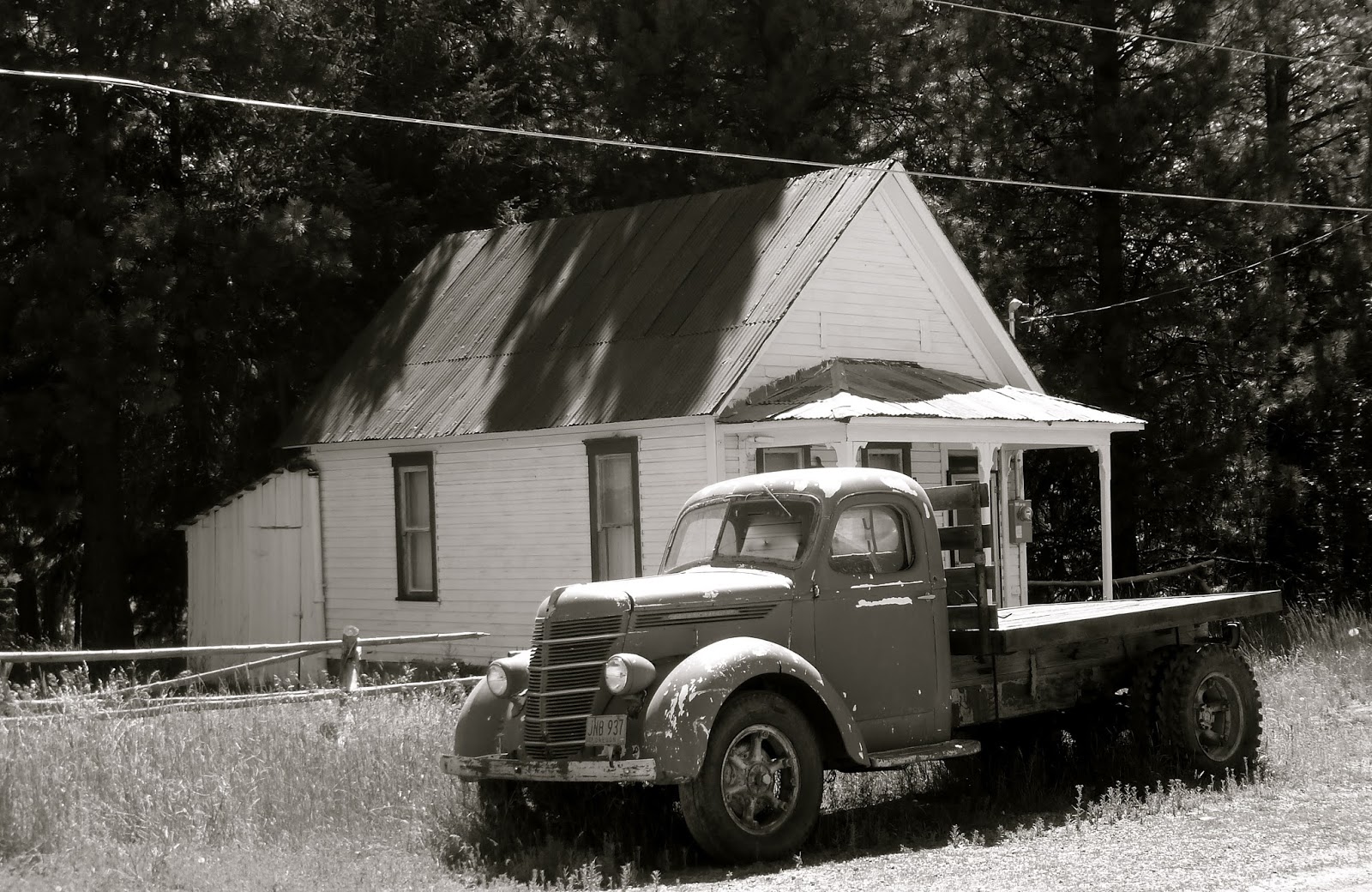
…perhaps boarding in town for a night or two…
…spending an idle moment wandering about and wondering a bit... 
...what it might be like to live here and not work the hands quite so much.


Remnants remain with their stories.  Adjacent to this Quonset post – the whole town is façaded Quonsets except for the abandoned church – 
- is a trading post in that church clerked by a woman who works winters as an instructional aide for special needs students. 

Her autistic son, she told us, gave her all the experience she might need to be qualified for the job.  Her husband had died in a traffic collision some eighteen years back and she hadn’t the wherewithal or desire to move back to “the city.”  So she clerks in the summer and works the school the rest of the year, unless the snow makes the road impassable.

The recent drought has dried up the land, and with it, one of the final vestiges of this part of the plains: the cattle industry.  Trucking in feed is just too costly.  And water?  Way too much one year 
and then none for three.  Even with 21st century technology, success rests with someone or something else’s whim.

Still, every fifty to eighty miles, there has to be a Sinclair station where you can fill up and maybe take some extra home in a drum.  These little bergs support community parks that invite a softball game or a mid-afternoon nap on the lawn.   
And they find a space to preserve some element that defines who or what they once were. 
Some dress up the old brick bank turning it over to a non-profit who’ll run a museum or refurbish the narrow gauge.  And hope for the tourist trade.
Others maintain the 120-year-old outpost geographically positioned right where the hungry traveler will pass and, maybe pause, mid-morning to late afternoon.
Other businesses fail because that’s the order of things with change.


Still, it is fascinating to reflect for a moment – maybe visiting with a local – and gain and impression of how things might have been sixty or eighty years ago. 

Because in many places on the northern plains... 
...sixty or eighty years back is now.

© 2013
Church of the Open Road Press

Wednesday, August 7, 2013

BEARTOOTH PASS, WYOMING – RIDING TO THE ROOF OF THE WORLD


impressions of a trip through our northern plains
…fourth in a series…

and dedicated to all of my boys named "Cody."


As a life-long educator, there are kids – because of their quirks or characteristics – whose names you wouldn’t pick for your own offspring.  For some folks it may be Kyle or Stephen or Bree or Adolphus.  Or even David.  For me “Cody” is one of those names.  Attention to details like… well…  the rules or organization or planning challenged many of the Codys I’d had as a teacher or principal.  So on this trip through the northern plains, I hoped to drop into Cody, Wyoming and see if there might be a dot or two I could connect.

Unfortunately, or luckily, in Red Lodge, MT, a great degree of roadwork caused through traffic to detour a block or two away from the US 212 main drag.  Somewhere in the orange cones and caution signs, I missed the one that said, “Cody, that-a-way.”


Several miles out of town, I found myself entering a deepening canyon.  The route didn’t appear the way my mind had rendered it.  It appeared better.

I stopped for a moment to refer to the map, deciding then and there not to correct my error.

US 212 weaves between Montana and Wyoming on its route from Billings to Yellowstone and beyond.

Along the way, sinews of pavement rise continually, causing the rider to reflexively gulp with each new expansive view.

Motorcycle jockeys from all over seek this route that I’d known nothing about because, like many of my former students named Cody, I wasn’t paying attention.  At a popular turn out, I pull in next to a phalanx of Harley Davidson’s each sporting an Aussie flag.  “What do you gents ride at home?” I asked.  “Why these,” came the reply.

Traveling up in elevation is like traveling north in latitude.  The air gets cooler, the growing season shorter, and the plant life more stunted and distinctive.

While each turn invites the rider to see what’s next, each new perspective demands a stop for a photograph.

Riders, regardless of marque, grin and chat and are willing to take your picture if you’ll take theirs.  An Albertan on a beautiful green 1500 Gold Wing insisted on taking mine.

With each pause and dismount, someone you passed below, passes by.  I think these are a couple of the gents from Down Under.

Just as you feel you are reaching the crest, you round a turn and find the summit yet further away.  When hiking the high country, this can become a frustration.  When riding, however, it simply seems like a gift you continue to eagerly unwrap.

Then there’s that little letdown when you finally achieve the pass’ 11,000 feet.  As things unwind, will the spectacularness fade?

I pause for a final look to the east.


To be sure, the route down the hill didn’t evoke the awe that ride to the roof of the world had brought.  Summer in the high country, like the growing season, offers only a short time for roadwork and there was roadwork aplenty going on west of the pass. 

I stopped in Cooke City, a berg just east of Yellowstone, for some butt rest and a sandwich.  I harbored a concern that the famous park would be a let down after the morning’s run over Beartooth.

But, I found as I descended into Yellowstone, there are many definitions of spectacular.

Some are subtle and delicate.

Some are not so subtle, but just as delicate.

Some take wing on an evening breeze.

And some simply flow.


All in all, this had been a great day riding, despite my Cody-like planning prowess.

© 2013
Church of the Open Road Press

Monday, August 5, 2013

DUSK IN THE WESTERN DAKOTAS


impressions of a trip through our northern plains
…third in a series…

After two days wandering across the high plains’ rise and fall, we arrived at the ranch house outside of Custer, SD about 4:00 PM.  Our immediate goal was to freshen up, catch a quick nap, then venture into town to secure supplies.  Just as a century and a half ago, on the list were flour, salt, bacon, raw meat, and whiskey.  In short: grub.

I had ridden north and east from the Sacramento area.  My riding partner hailed from Seattle.  Our spouses flew into Denver, rented a car and were expected at any time.  Our mission would not be postponed.

Under a slightly ominous sky we remounted riding through a cloudburst, which might have been refreshing had it not been for the previous hours of saddle time and the fatigue associated therewith. 

The mercantile had everything we needed and, perhaps, more than we could cram into the panniers without some deft engineering.

Fortunately, with our saddlebags laden with supplies for four for a couple of days, the clouds had scurried south and our ride back was over dampened pavement and dirt, but under clear skies.  With degrees of relief, and after a 300-plus-mile day, we parked the bikes in the “stable,” set not to re-employ them for several days.


An evening storm gathered – bigger than the last – as I worked the grill outside.  I harbored grave misgivings about tending to a marinated tri-tip with a sixteen-inch set of metal tongs as lightening fired up in the area, but I’d drawn the short straw this evening, and my life insurance, set to lapse this coming November, was paid up.

While setting the expanded metal table on the porch for al fresco dining, the storm snarled and spat prompting us to retreat indoors.  A stray from the neighboring property, who’d been hanging about close to the grill and the beef, divining our change of heart, asked to be invited in from the impending fury.  He wasn’t.

Upon finish our indoor evening meal along with a bottle or two of serviceable red, we dispatched a scout to the porch to reconnoiter the weather and report back.  The fury, it seems, dissipated just as quickly as it had formed.  We would take advantage of the cool evening to enjoy some fresh air perfumed by the moistened hay stacked in the field a few yards away.  Nothing smells so sweet as after-the-storm.

To the chagrin of our spouses – who by now have come to expect nothing different from their men – we cracked open a bottle of Jefferson’s Reserve (in honor of Thom, whose face graces the mountainside only 16 miles to the north) and lit up a pair of Flor de las Antillas purchased at Stogies, a day’s ride back in Billings, MT. 

With the men downwind – the men always seem to be downwind, with or without cigars.  Why is that? –  the four of us watched the storm retreat and the sky evolve.

As the angry behemoth subsided, the sun dipped through the Ponderosa Pines and behind the hills immediately to our west.

A full moon rose illuminating those receding clouds from behind; within their midst lightning coursed in greater or lesser flashes. The Big Dipper was revealed, as was Alpha Centauri. Soon, everything faded to black.

Or perhaps it was the whiskey.

© 2013
Church of the Open Road Press

Friday, August 2, 2013

ON HALLOWED GROUND: THE LITTLE BIGHORN BATTLEFIELD


impressions of a trip through our northern plains
…second in a series…
  
America’s northern plains is a limitless steppe, nothing but rolling hills and knee-high grasses for as far as one might be able to see.  The Sioux saw something here.  The Americans didn’t, but it didn’t matter.  Monroe’s Doctrine of Manifest Destiny, although gauntlet laid down to prevent other European powers from colonizing North America, presumed for us right to lands across the continent regardless of who might already be there.


Rolling out of Billings, Montana, I was eager to check a location off my bucket list: that of the Battlefield along the Little Big Horn.  Clipping along I-90 at posted speed, it was difficult to see what all the ruckus might be about.  Then we arrived.

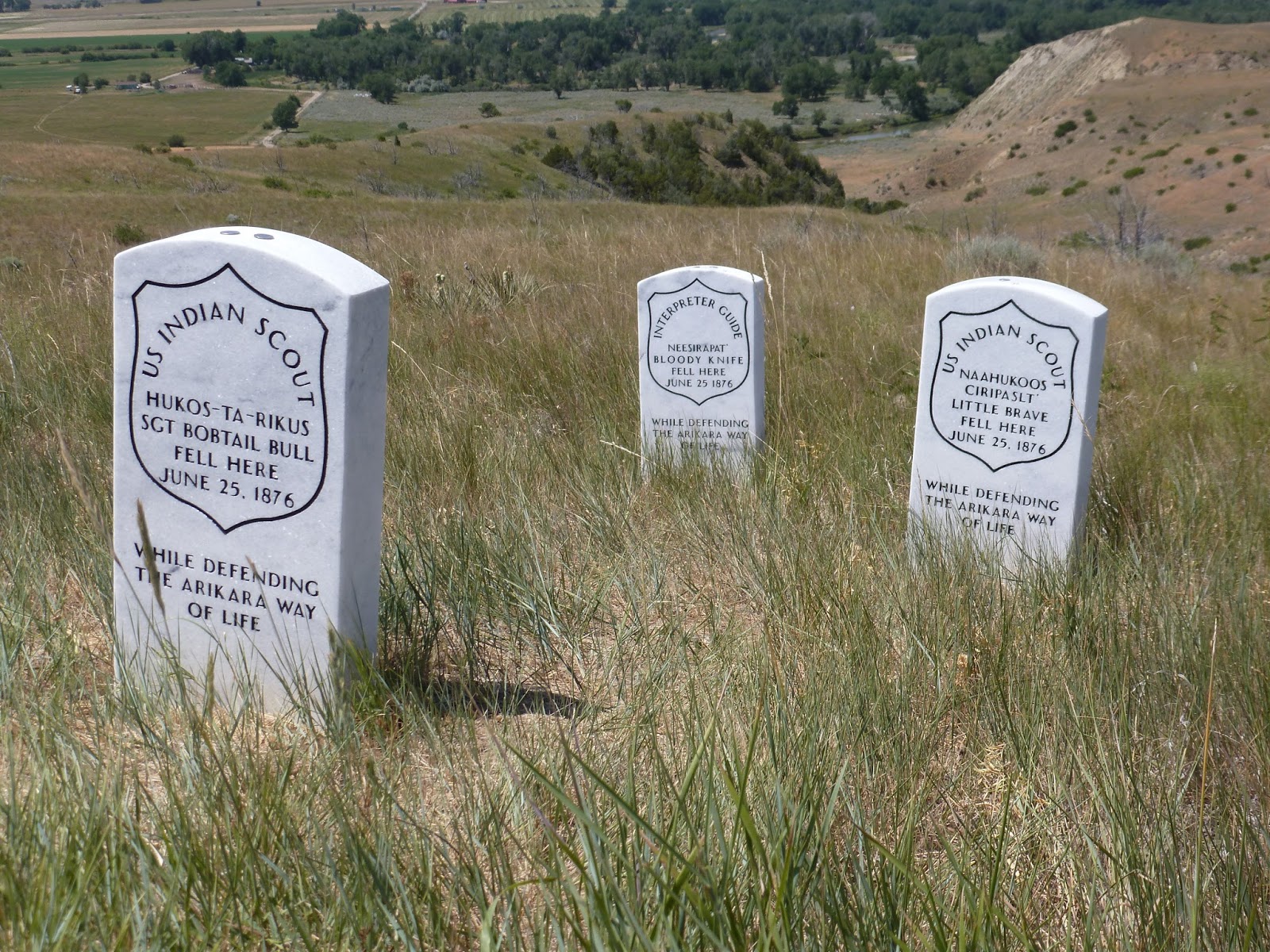
Idling up a rise off US 212, we entered, parked the bikes and began to explore.  With each step, something grew.  I think it was reverence.  Stones mark the location where soldiers fell. 

Stones mark the locations where some of the Indians fell. 

A cavalry soldier’s mount may be his most trusted friend.  A stone memorialized the horses as well.


Decades ago, I bought a copy of Dee (Bury My Heart at Wounded Knee) Brown’s book, The Fetterman Massacre.  (University of Nebraska Press, 1962.) This historian outlines the missteps and terrible fate of an over-zealous junior officer stationed at Fort Phil Kearney.  “The Fetterman Massacre,” Brown writes, “was the second battle in American history from which came no survivors.”

We’d rocketed past Fort Phil Kearney this trip, neglecting to stop.

John Byrne Cooke – son of Masterpiece Theatre long-time host Alistair Cooke – composed a brilliant trilogy of historical fiction called The Snowblind Moon, (Tor, 1984) chronicling the ten years between Fetterman and that which hallowed the ground upon which we were about to tread.  (My copy was autographed by the author as we enjoyed a burger on the Fourth of July a couple of decades back.)

At the Battlefield bookshop, I picked up a copy of Crazy Horse, a Life, a biography by Pulitzer Prize winning novelist Larry (Lonesome Dove) McMurtry.  (Penguin, 1999.)  There’s something that a novelist brings to history that, in turns, brings history to life.

Sitting Bull suggested that white man simply wanted to exploit the resources of the Lakota.  President Grant said that our efforts were intended to civilize and Christianize the Indians.  And it is said that those victorious write the history.

As we approach a century and a half since the events on the high plains took place, perhaps there is small solace in the fact that our more recent literature reflects not only the actions of those fulfilling Monroe’s vision, but also the bravery, courage, character and loss of those whom we overwhelmed.  Therein lies the lesson.


Among the best things about the road are those from which we learn: those flashes of truth that change our viewpoint, broaden our perspective and enrich us.   

Coupling solemn walks along hallowed paths with the literature that recounts the events of the past make a ride through seemingly forgettable prairie meaningful and rich.

© 2013
Church of the Open Road Press