Showing posts with label Product Review. Show all posts

Saturday, March 14, 2020

BUILDING THE MODERN CRICKET STOOL

…I take a stab at making furniture…

Growing up, I recall that we had a little cricket stool in the house.  It was nothing like this…


It was constructed of maple and finished to look like all of the other wood furnishings Mom and Dad (well, probably Mom) had picked out.  Sixty-five years ago, the little sitter was just my size.  I recall, many, many times, tipping it over and pushing it around the braided rug until Mom caught me.


I found myself thinking of that little stool when I ended up with two scraps of Central American Parota, left over when craftsmen finished a new mantel for our rebuilt fireplace.  “You want me to save the excess?” the craftsman asked.  “Sure,” I said, but I didn’t know for what.


After the mantel was installed, the two scraps of exotic sat taking up space on the workbench.


One piece was about three inches thick and a little more than an odd-shaped foot square.  The other was 3 x 3 x about 10, with a nice array of grain and a pleasant little curve to it.

Perhaps if I sanded them down a bit, I’d get inspired.


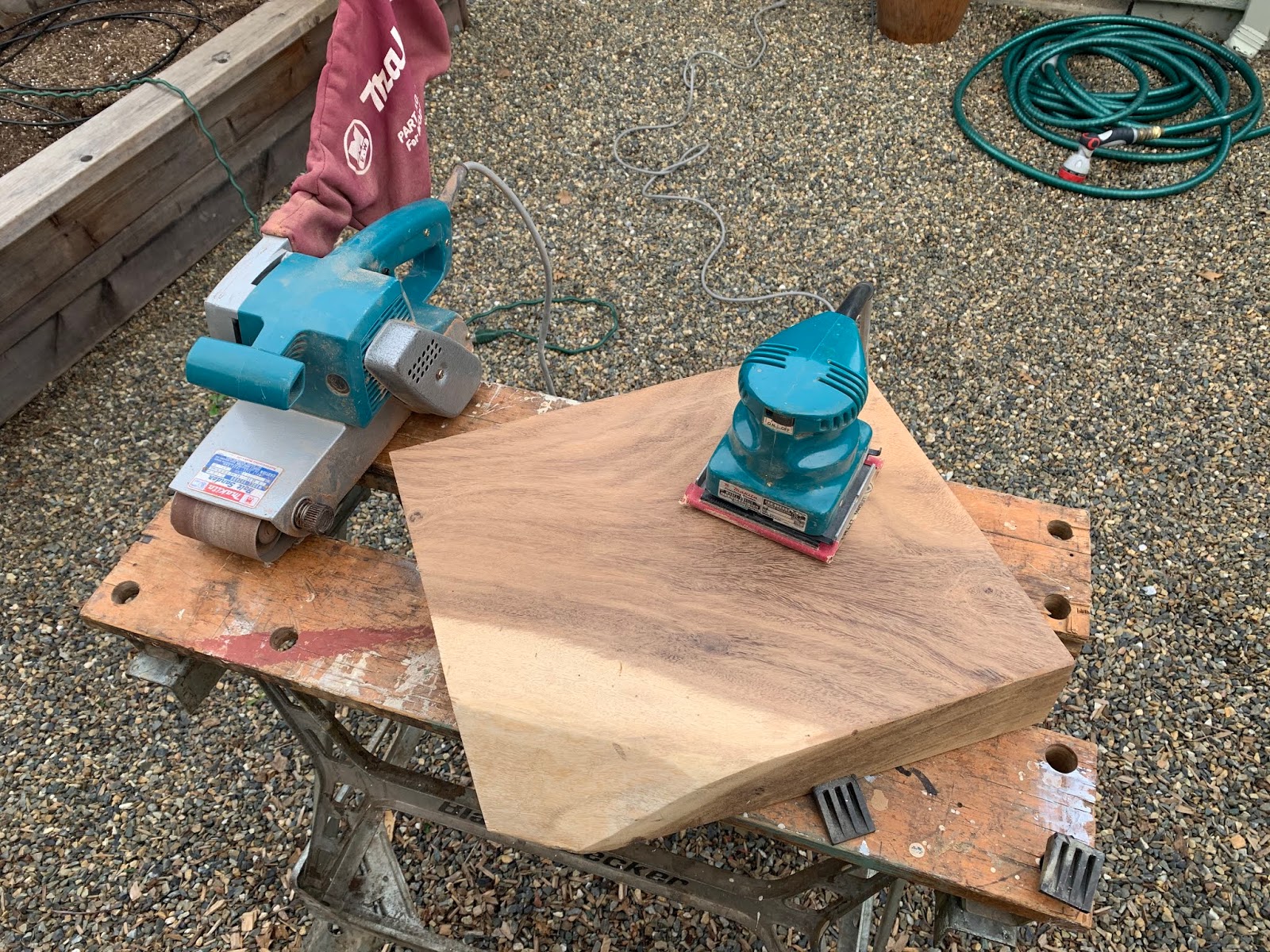
In my forty years of owning a Makita belt sander, I’d never mastered its use. The helpful hardware man down at Ace offered a brain-dead simple tip and I was off to the races.

I learned what a dowel-screw or a screw-dowel was.  I purchased one.  Now I had 65 cents invested in this – for lack of a better descriptor – wood sculpture.  Now it had better work out!


Twisting the post-like piece into place, it became clear that, with two other legs I could have me a milking stool – or better yet – a cricket stool!

I applied a first coat of teak oil – because that’s what I had on the shelf – and watched the grain pop into strata of dizzying earth tones.


Getting three legs to be just so for this project was going to be a challenge, so I looked up the outfit in Portland that fabricated some picnic table legs for me a while back.  Their website offered exactly what I needed.  


Four weeks and a hundred and twenty-four bucks out of pocket, the UPS man delivered ‘em yesterday.
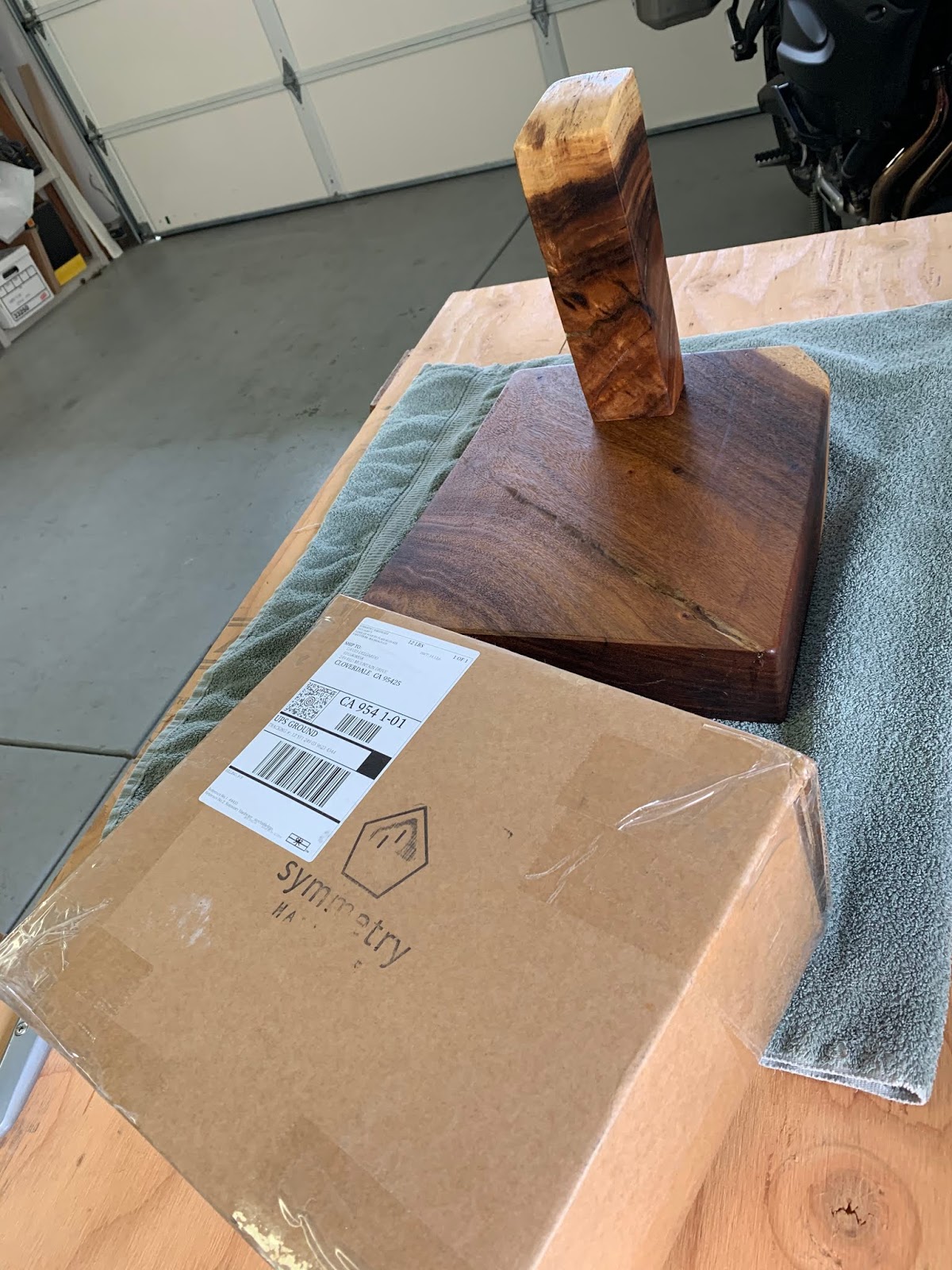

In the meantime, I’d added a second soaking of teak oil.


I didn’t want to use the galvanized hardware provided, so I high tailed it down to Ace and bought five bucks worth of black machine screws and washers.  After all, this was to be fine furnishing. Right?


Assembly would be easy.  (I used my magic Phillips screwdriver.  Note how it stands up on its own. Magic!)


The finished product turned out rather nicely standing on its own two (or three, depending on how you count them) feet.


It weighs about thirty-five pounds, however – much more than that old maple cricket stool of yore.  It’ll take a brutish two-year-old to push this thing around the house.

I took one final shot of the project – in use – but only for illustrative purposes so the reader could get an accurate perspective on size.


Again, strictly for illustrative purposes.

o0o

Notes:  Petaluma, CA boasts a great business called Heritage Salvage.  One could spend a good long time just perusing their collection of hand-hewn oak timbers from 140-year-old Amish barns, or derelict redwood staves from the old water tank that served Tahoe City.  And slabs not only from redwood trees but from a root-rotted stump of a tree planted by Mariano Vallejo nearly two centuries ago.  They custom mill, cut and finish the piece you can’t live without and don’t seem to mind folks like me wandering through…. https://heritagesalvage.com

Symmetry Hardware in Portland, Oregon fabricates and finishes steel legs.  I’ve used their services for a couple of my projects.  A small business that will consult with you and does excellent work, it feels really good to use this source rather than a big-box store.  Plus, I got exactly what I needed for this little project.  Check ‘em out: https://steeltablelegs.com

© 2020
Church of the Open Road Press

Thursday, July 26, 2018

FIRST RIDE IN A COOLING VEST

… product test at 100-plus degrees

I was advised by a friend that, before our August trip to Hells Canyon in Eastern Oregon, I should get a cooling vest.  Because I always take this guy’s advice, yesterday, I purchased one to wear under my riding jacket. Today, with temperatures predicted to top out around 105, I figured I try the thing out.

Here’s the lowdown:

Step one is all about soaking the garment.  Initially, I placed it under the kitchen faucet.  After a few seconds of watching the water roll away, my wife suggested, “How about submersing it in the sink?”  Bingo.

Dry, the vest weighs about 14 ounces.  Soaked, it’s like carrying around a bucket of water.

Step two involves wringing it out.  It takes some pretty hefty twisting.  As I squeezed and twisted, I found myself momentarily thinking of Romeo, our house cat who, again, this morning awoke me at 5:00 AM wanting to go outside.  The thought disappeared; replaced with: Had I wrung this out in the shower rather than the kitchen, there’d be no extra time spent mopping up floors and counters.

Step three finds the vest draped over my shoulders, zipped closed and waiting for my Dianese mesh jacket to cover it.  The initial feel is that of extreme perspiration: wet, clammy, and odd.  But anticipation of riding in 100-plus-degree air prompted me to think this clamminess is going to be a good thing.


And it was.  North on US 101 at speed, I was immediately impressed with the temperature differences between my cooling-vest-laden upper body and my exposed-to-the-furnace-blast arms. It was almost too cool.  Almost.

Twenty-five minutes up the road, it was easy to forget about the ambient temperature.  I felt more as if I was riding on a spring day.

I stopped in Ukiah at Mendocino Book Company to look for a copy of George Orwell’s 1984 which I was going to ship to President Trump as a gift, but they were sold out. Sitting in 103-degree (according to the time and temperature sign at the Mendocino Savings Bank on State Street) downtown traffic, I felt my mind stewing about the stop and go and my body stewing because my personal space was so humid.  Perhaps this bit of technology has a drawback or two.

I headed to the east side of the Russian River Valley finding Mendocino County’s River Road for a relaxed fifty-five-mile-per-hour cruise around lazy curves, through oak studded foothills and past picturesque vineyards toward Hopland.  Were it not for the heat, this was a Chamber of Commerce stretch of roadway.  But, delightfully, the cooling properties of the vest had returned.  I could really enjoy this ride this day.

In an effort to gather some data, I stopped at a wide spot to snap a photo of the air temperature as measured by Enrico, the Yamaha’s, computer system.  The bottom number in the photo tells me it’s 104.

My little test loop measured about 70 miles and, with stops, took about two hours. Taking the cooling vest off to hang in the laundry room, I figured it now weighed about as much as a half a bucket of water.

I thought for a moment of the up-coming trip to north eastern Oregon and surmised that this item may well take a little bit of the hell out of Hells Canyon.

At a cost of about fifty bucks, I’m thinking it will be fifty bucks well spent.

o0o

Waterproof Cooling Vest marketed as Bilt (Cycle Gear) and – I think – Hyperkewl (Revzilla).  Constructed in China, they look exactly the same except for their branding labels.

© 2018
Church of the Open Road Press

Wednesday, July 4, 2018

LIFE WITH A CHEVROLET BOLT – AFTER 14 MONTHS

Never thought we’d own a GM product 
– but dang!  This is a good little car!

Our 2017 Chevrolet Bolt is a fully electric vehicle with a claimed range of 238 miles.  By offering $6,000.00 at closing we obtained a 1,000 mile per month lease for about $350.00. Having held true to that mileage, a monthly report from GM estimates we’ve NOT used about 50 gallons of fuel each month. Although not for certain, it appears our electric bill has increased by around $20.  Those are the facts as I see ‘em.


Now, how do we like the thing?

Performance and Handling. The electric drive system is pretty hot – and by that, I mean cool.  We can easily reach freeway speeds about half-way up the average on-ramp.  On-board gauging lets us know how much electricity we are using (measured in kilowatt hours) as we cruise at highway speeds in traffic.  A graphic on the infotainment screen illustrates power flow from the motor to the wheels and it is gratifying to watch that flow go the other direction when the brakes are being used as they regenerate electricity.

As a front-wheel drive vehicle and with the battery’s weight riding low, the Bolt eats up curves. With the wheels pushed to the corners of the car, it sticks nicely to nice pavement.  It is, however, little more than a short-wheel-base econo-box – just one without an internal combustion engine – therefore, when the pavement is poor or chunky, the driver is informed.  Also, know that the low-slung battery means there's not a lot of ground clearance.  We've scraped bottom a couple of times on unpaved roads.  It'd be a good idea to avoid those - save 'em for the Subaru.  Still, coupling its crisp handling with its zesty acceleration (even when not in sport mode) the drive is engaging and fun.  

Occupant Comfort.  The press gives the Bolt low marks for its relatively small and relatively under-padded seats. This is not fake news. The seats could use some additional bolstering, but, given its purpose – an electric car aimed at pollution free daily commutes – the accommodations are more than tolerable for the drive to work and back.  The rear seat is roomy but positioned near the rear axle so bumps in the road are easily transmitted to bumps in the bum.  That said, as a six-foot-four occupant, I don’t mind hanging out back there and letting someone else ride shotgun.

Fit and Finish.  There’s a groan that pronounces itself, we think emanating from the rear hatch, if the car is wallowed over uneven pavement. Other than that, the thing is as sound as any Japanese or European vehicle I’ve ever owned.  The closure lines on the doors, hood and hatch are remarkably even.  Nothing on the exterior has rattled off as of yet or shows any signs of wiggling loose.

Inside, the trim on the driver’s side A-pillar snapped loose.  Not wanting to push on the thing and risk screwing up or discharging the airbag covered therein, I returned it to the dealer for a two-minute fix. (Interior trim covering air bags need to be secure enough to not fall off, but loosey-goosey enough to fall away in the event that the bag needs to deploy, I was told.)  Other than that, with the exception of a rather dumb brushed chrome strip unnecessarily highlighting the front dash with blinding reflections of sunlight at times, the largely plastic interior is handsome – not outstanding – but serves the purpose well.

Range.  Our first major test of the Bolt’s range came a month back when we headed from our house in Cloverdale over to a B&B in Mendocino via the steep and poorly paved Orr Springs Road.  Orr Springs Road crosses a section of the Coast Range climbing steeply out of the Russian River drainage just north of Ukiah.  Our hearts began to sink as we watched that graphic.  We depleted over 50 miles of range in the first twelve or fifteen miles up to the ridgetop.  Damn! Will there be a charging station in Comptche (population about two dozen)?  Not likely.  The forty-plus mile descent through that little berg and out to the coast revealed something we hadn’t counted upon: Power re-genned to the battery as we coasted, gradually winding from high pastures, though oak woodlands, along the south fork of Big River, through Montgomery Redwoods and out to State Route 1. By the time we reached the coast highway, indications were that we had MORE juice in the battery than when we’d left Ukiah fifty-five miles earlier.  SHAZAM!


Would we buy or lease another one?  

Our contract on the 2017 Bolt expires in less than two years.  So far, we have been impressed with the quality of the car and the savings on fuel.  (If we move forward with plans to put solar on the house, an argument could be made that we’d be driving the thing for free.)  We were encouraged to lease this first generation electric Chevy because by the time the lease is up, there’s a good possibility that technological improvements will be in the offing.  I had a chat with the Chevy salesperson with whom we had dealt.  He confirmed that the Chinese-owned Swedish carmaker, Volvo, would be upping the ante on electric vehicles world-wide and that their product might be one to watch when renewal time circles around.

Here’s what we’re thinking: If major improvements in the electric vehicle segment don’t surface by the time our lease expires, we would give strong consideration to negotiating a price for a purchase of the Bolt we have (many will be coming off lease at that time, so residuals may be depressed) or simply buying our next electric vehicle outright.  Given the experience we’ve had thus far, I wouldn’t be surprised if that next EV is also a Chevy.

© 2018
Church of the Open Road Press

Monday, January 29, 2018

KLIM "LATITUDE" THREE (OR FOUR?) SEASON RIDING JACKET


Seasonal Affective Disorder be damned!

The new Klim Latitude Jacket arrived on the perfect January day.  Four or five days of thick, drippy tule fog, and my Seasonal Affective Disorder (SAD) was kicking in.  Enrico, my Yamaha Super Tenere, was probably feeling about the same as me.  We both knew that the cure for SAD was a trip to some high ground somewhere above the fog.

The parcel from RevZilla arrived exactly as scheduled; the contents were just as advertised.  I donned my new Klim Latitude and marched around the house, past the mirror several times, adjusting the jacket to fit my girth and the sleeves to my spindly arms.  (Fifty years ago, pulls-ups in gym were not my friend.)  Given my odd shape, I was curious as to whether the jacket could be snugged just so.  Walking around the house was fine, but the real test would lay inside that blanket of moisture.

Thumbing the starter on the Yamaha through my winter gloves, it was as if Enrico's exhaust note was grumbling, “It’s about time!”

A block away from the house, I felt a draft that I knew was gonna bug me.  But the tabs on the Velcro® closures at both the elbow and the wrist were easy to manipulate even with those clumsy gloves on. 

A mile from home, I entered the 101 freeway and headed south at the speed limit.  Moisture collected on the face shield of my Shoei and I fingered it away; but even after twenty minutes at speed through this pea soup, nothing seeped through the Latitude.

Sunshine, if there were to be any today, would be found near the crest of the Maacama Mountains.  Heading east out of Santa Rosa, a twisty Mark West Springs Road is a delight when dry.  In January its curves can be more challenging when wet, especially considering the erosion caused by the rains that followed the area’s recent devastating fires.  I hoped not to try out the jacket’s impact protection.

North of Calistoga, I coursed further north on CA 29 as it climbs out of the Napa Valley on a six mile stretch that recalls Stelvio Pass.  Somewhere in that section, I broke through the fog.  The temperature rose from mid-40s to nearly 60.  Not enough to remove a layer or open a vent, but while having coffee at an outdoor table in Middletown, I fiddled with all of the zippers and closures, pleased with so much of the design of this unit.  I’m gonna like this a lot!

The coffee warmed my insides and on the 55-mile return ride, the jacket kept my outsides dry and snug.  Returning to the garage, I know Enrico was happy with the outing and I was happy with the bike, the jacket, the roads and the past three hours. 

Seasonal Affective Disorder be damned!

Thursday, November 16, 2017

RAIN RIDE, NEW BAGS


Enrico gets fitted for the road…

I took Enrico, the Yamaha, on an eighty-mile round trip this morning in a light rain as his new Givi panniers had arrived and he was scheduled for a fitting at Factory Powersports of Santa Rosa.  They’re proving to be a REALLY GOOD dealership. 

Why do this today?  Well, the bags came in and I was eager, but…

…I make it a yearly practice to take a ride during the second real rain of the season.  I pass on the first storm’s precip as the winter’s earliest showers tend to dredge up oil and dirt from summer’s long-dry pavement making for extra slippery and rather treacherous riding conditions.  Who’d want that?

This annual voluntary rain ride is one wherein I reacquaint myself with critical wet weather skills so necessary for times, on long road trips, when one gets caught in a cloudburst.  It happens in Montana, Oregon, Wyoming and damned near everywhere west; and, I’d opine, that it pays to have developed some damp weather confidence before the deluge.

On the wet pavement, I practice moderate speed, moderate lean angles, moderate braking, increased clearance behind the vehicle in front and, as was the case today where an unanticipated half inch of water was sweeping across US 101, a few “Hail Marys.”  Hydroplaning on two wheels?  Yikes!

Then again, that’s why I do this.

The panniers purchased, Givi ‘Dolomitis’ are constructed of thick aluminum. 

Tie downs are incorporated onto the lids to accommodate a duffel of extra cargo. 

One key fits locks on both and both close snugly, sealing rain out quite effectively.  A paperback copy of an Easy Rawlins mystery (Charcoal Joe) I’d been reading while waiting at the dealership, experienced no soggy pages from the rain on the thirty-plus mile ride home.

Top (as opposed to side) loading and easily mounted and removed from the bike, they fit securely to the Super Tenere and do not require a rerouting of the exhaust and silencer, as did the Jesse system I’d purchased for the BMW ten years ago. 

And, to me, they are attractive, in a rather industrial sense.

Factory Powersports matched the best on-line price I could find.


So Enrico and I are ready to suit up, rain or shine, as the newly outfitted Yamaha looks good in the garage, but better on the road.

o0o

Notes:  Link to Factory Powersports in Santa Rosa (Yamaha and Suzuki dealer): http://www.factorypowersports.com/

© 2017
Church of the Open Road Press

Monday, September 18, 2017

IT’S A YAMAHA!


First Impressions of the Yamaha Super Tenere

My foray into cruiser motorcycling is over.  The Triumph Thunderbird is gone, not so much because she wasn’t a relatively competent and very cool looking machine – although there were some bugs in her that shouldn’t have been – but because I guess I’m a fickle rider.  While I generally keep a machine for six to eight years, the T-bird lasted less than two.  It seems my experiment on a heavyweight bike with loads of chrome and torque gave way to a longing for crisp handling, long distance capability, lighter weight to push around in the garage, a collective record of dependability, a comprehensive dealer network, and a shaft drive system.

After conducting some on-line research and chatting with guys on the road who loved this particular mount, the Yamaha Super Tenere rose to the top as the chosen successor.  It has become the first non-BMW, non-Moto Guzzi, non-Triumph, non-European primary motorcycle I’ve owned since I was about 24.  Forty years past that age, I suspect I found that, for me, cachet has succumbed to something else.

900 miles in, this scoot appears to have that something.

The Yamaha Super T recalls my BMW R1200GSA with its tall seat, commanding view, rugged go-almost-anywhere suspension and ability to strap on a week’s worth of gear before heading out.  With a smaller fuel tank, however, ready-to-roll it is lighter and easier to pad around in the garage much like the Guzzi Breva or the Kawasaki KLR.

Enrico Caruso, tenor 1873-1921


 At idle, the exhaust doesn’t burble like the T-bird, rather it sings a smooth tenor note similar to the Breva or maybe more similar to Enrico Caruso.   

Sitting on the Tenere, rather than in it, at speed, the miniscule windscreen deflects the blast from my chest, but even when adjusted to the high position, blows a good torrent of whistling air past my helmet.  Plenty of aftermarket windscreens are out there.  I’ll do a bit of research with an eye toward upgrading that.

And only that. 

Everything else on this machine feels as if it were engineered specifically for me.  The seat is high, wide and comfortable making a ninety-minute or even two-hour runs quite reasonable.  The switchgear seems standardized – that’s good – but I have yet to take the five minutes it’ll take to figure out resetting the trip meters. 

The fuel tank packs premium and gets me a couple of hundred miles down the road and I now get better mileage on a bike than my brother-in-law gets in his Prius.  Noted is that the range function is pretty optimistic until it isn’t optimistic any longer.  I was cruising along with 60 miles listed when all at once it hopped down to 32, then 21 then zero, when it mysteriously began counting single miles up, one… two… three… and me still about sixteen miles short of the next Chevron.  When I, with a sigh of relief, filled Enrico up, he only took about 4.6 gallons in his 6.1-gallon tank.

Something a little more saddle time will help me to understand.

The Super Tenere handles 65 to 75 mile-per-hour jaunts on the freeway portion of US 101 with ease, although the windblast makes slower speeds winding through the redwoods more enjoyable.


Of all the gin joints, in all the towns...
Not as classically good looking as the T-bird or, say, Ingrid Bergman, it does garner comments, one from a Harley rider who’d accompanied a pal on a GS, saying, “It’s sort of a shame to see a Triumph Tiger with no dirt on it, ain’t it?”  To which the GS rider (a former Tiger owner, it turns out) responded: “That’s not a Tiger.  It’s a Yamaha that’s like a Tiger only with a dealer network.”

Enrico was, indeed, rather clean that day.  He only had 456 miles on him at the time.  And my intention is to use the bike as a paved road tourer recalling the sinking feeling I got trying to singlehandedly pry my GS upright from laying on her side in the gravel on many a remote forest service road.  Don’t want to do that anymore.

The break-in trip midway up the Oregon Coast (recounted here: http://thechurchoftheopenroad.blogspot.com/2017/09/up-to-bandon-and-back-again.html) proved to be a delightful introduction to the possibilities the Super Tenere holds for me.

I hope Enrico and I will enjoy a long, steadfast and, perhaps musical relationship.

© 2017
Church of the Open Road Press

Friday, May 12, 2017

TWO WEEKS IN WITH A CHEVROLET BOLT


You don’t see many of these in the wild…
…yet.

I never considered a Chevrolet, what with GM’s checkered history on quality.  I never considered not owning a pickup, given that pickup ownership and masculinity go hand in hand (even if the pickup is a compact Nissan).  And I could never consider a plug-in electric car given the range anxiety inherent in having to plug the thing in every 90 miles or so.  Granted a Tesla will go nearly 300, but I could never consider putting a hundred large into a car of any kind that didn’t have a stallion on its badge.

But continuing to pour gasoline into the tank and hydrocarbons into the air formed an equation that seemed not too right for my grandchildren’s children.  That, coupled with the fact that pretty much any projects I might have and any dump runs I might make are becoming less and less frequent.  Why drive from here to there in an empty ¾ ton truck returning 20 miles per gallon, when an electric car uses less than a fifth the energy?

Range anxiety?  The evolution of electric car technology began when Elon Musk envisioned his first Tesla.  Now the Tesla III is about to hit the market with a 250-plus mile range per charge and “Range Anxiety” will return to its rightful definition: the emotion Billy Crystal felt when confronted by the Jack Palance character in the first “City Slickers” movie.  Musk’s III was to be the electric car made affordable to all except GM beat him to the punch.

So now we have this Chevrolet Bolt.  The pickup went to a nice young man who paid cash and the Subaru pouts in the driveway, longing for the good old days when there was room for her in the garage.


The Bolt is a nice looking small car similar in style any of a number of econo-boxes.  A huge and probably very heavy battery rests beneath the flat passenger compartment floor.  Wheels are pushed to the corners of the vehicle making for a well-planted ride.  The electric motor offers enough torque to beat a Z-1 Corvette off the line up until about 18 miles per hour.  By then all you’ll see is the Vette’s taillights peeking through a cloud of dust and road debris, but the little Bolt wastes little time rocketing up the freeway on-ramp and merging into unforgiving traffic.

A 120-mile loop out to the coast proved that the car could more than make the distance handling four-lanes, highways, county roads, sweeping turns and hills.  Going up, it is appalling to watch the KWH meter ramp northward.  Descending, however electricity usage almost disappears.  Touching the brakes reverses the flow of energy.  There’s a graphic on the info-screen that shows when this is happening. 

The dash has all kinds of animation and the touch screen is a bit more intuitive than in previous cars we’ve owned.  The seats seem substantial and nicely are detailed for a commuter car.  There’s a way back with room for Edward, our lab mix, but he’s happier when we flop down at least one of the split rear seats so he can join in our conversations up front.  We did want to get out after an hour or so as the spacious interior may seem to shrink a bit over time.

On the road – out in the wild – we’ve yet to see too many Chevy Bolts, however today, when we did, a throwback moment occurred.  Recall the VW bugs of the sixties?  Recall when driving one, someone driving another would wave at you and you’d wave back.  Yeah.  That happened in the Bolt today.  So, cool…

Electric car buyers benefit from incentives from the feds, the state and our local utility.  A $7500.00 incentive from the feds went toward a buy down of the initial lease payment.  With a simple application, we are awaiting a $2500.00 check from the state thanking us for reducing our carbon footprint.  And although a 220 volt charging station costs the user around $800.00, our local utility offers them for free – pay only shipping and sales tax – to owners of electric vehicles.  With installation, the “Juice Box” set us back about $270.00.

The car can be programmed to charge at off-peak hours and we are anxious to see the increase in our electric bill as we appreciate the decrease in the tab we pay to Big Oil and its Washington and Wall Street minions.  We leased the vehicle with the expectation that in three years, something more efficient might come onto the market and market forces might be at work to decrease the current initial costs.  So as far as out-of-pocket savings, we’ll probably not experience much this time around.


We found that we had put an inordinate number of miles on our relatively new Subaru with around town and over to the next one driving, so the main purpose of the Bolt will be to spare the Sube for longer adventures.  That being our goal, the initial impression of this little GM electric is that it offers a pleasant and sometimes exhilarating ‘charge’ for such a wonderfully small car. 

At this point in ownership, we’d get another.

© 2017
Church of the Open Road Press