Showing posts with label Capay Valley. Show all posts

Tuesday, March 24, 2015

WALKING THE FULL BELLY FARM WITH DR. BENJAMIN BLOOM


I never was too impressed with the term “organic.”  Like “new and improved,” “lite,” “authentic,” “life-time,” “limited,” and now, “gluten free,” the term organic seemed tagged to a product simply as a marketing ploy.  At least that’s the way I saw it.  My spouse would buy organic vegetables and fruits and eggs, paying a little more, but when I went to the store, because of my built in cynicism and the fact at chemicals hadn’t killed me yet, I didn’t.

Recently, we ventured up California’s State Route 16 into the luscious Capay Valley.  It seems the first weekend in spring, or thereabouts, the Full Belly Farm has an open house. Berkeley friends are subscribers to a program called Community Supported Agriculture (CSA) wherein Full Belly offers neighborhood delivery of fresh organic produce to customers in the Bay Area and Sacramento.  We plan a rendezvous with our friends at the farm.

Springtime in the Capay Valley is what God must have had in mind when Eden was created.  Rolling green hills are dotted with blue oaks and mantled in poppies and lupine.  Row upon row of blossoming stone fruit trees - almonds, peaches, plums - provide spring's signature fragrance while, against an azure sky, the sun plays hide-n-seek through puffy, fair weather clouds.

The highway twists through farmlands and pastures and into and out of bergs with populations that can be enumerated with merely two digits.  


I’ve ridden the road many times in all seasons of the year, always wanting to linger longer and dig deeper.  This day, I’d get to.


The Full Belly Farm is roughly 400 acres backing up to Cache Creek.  Salvaged from an aging almond orchard in the ‘80s, its four partner/owners employ 60 people year round.  Almost unheard of in agriculture, this employment model is only one of the enlightened possibilities availed by the philosophy of the ownership group: sustainability.   The walking tour with co-owner Paul explains it all.

We stroll past an apple orchard where Fujis are in blossom. “Other apples do better in this heat,” we are told….

…and a strawberry field.  Paul lifts the deer fence to let the children crawl under.  “Grab yourself a strawberry, but please be careful not to step on the plants”…

…on the way to a seven-acre plot of garlic.

“Small, diversified croplands,” he says.  “We can produce so much more and care for the land so much better.”

A flock of hens is penned by a temporary fence.  Inside the enclosure is a rolling hen house.  The hens scratch at the land by day repairing to the henhouse at night.  At regular intervals the fence and henhouse is moved to a new plot leaving behind the natural fertilizer than chickens produce.

In another area, sheep graze down tall grasses using their natural digestive processes to return nitrogen and other nutrients to the soil.

Beyond the rows of garlic, a field of lettuce varieties grows uniformly.  Seeds are planted between furrows.  When weeds sprout, “we smother them with dirt keeping the non-favored plant from getting sunlight.”

Natural oils are used to discourage some pest insects, but swaths of land with lush growth are reserved as insect havens.  “If you stop and look, you’ll soon see a lot of movement, hear a lot of sound. 

“Too many in agriculture treat honey bees like farm workers – and we shouldn’t treat our farm workers this way.  Traditionally we’d use the bees in the almonds, then put ‘em in a box and ship ‘em to the next job."

Paul points to a section of tousled, knee-high weeds and grasses.  “Here, we don’t have honey bee hives, but honey bees and other pollinators live here because we’ve set up environments in which they thrive.”

Among the mixed tangle of weed-like plants grows a variety with blue flowers.  “Flax,” we are told.  “We are experimenting with growing the plant for its fiber.”

And about that year-round employment?  “Because of how we do things - planting, harvesting and planting again, spring summer and fall, we have to have people here all the time.”  Then he adds: "Bees, too."


As we walk along, I begin to think of Benjamin Bloom (1913-1999) a preeminent educational thinker of the mid-twentieth century.  His taxonomy of learning processes is something we all studied as teachers. 

But finding examples of his theory actually put into practice are elusive.  Alongside farmer Paul, I suddenly realize I am walking alongside a real, live Benjamin Bloom. 

The success of this organic endeavor rests squarely in the farmer knowing how to employ Bloom’s hierarchy of thought.  Here’s what I saw:

Recall (or knowledge): The farmer knows the soil.  He knows the seed, the water, the exposure to sun, the heat, the cold, the seasons.  And the market.

Grasp (or understanding): The farmer understands what crops will be successful in which corner of the property.  He understands the strengths and weaknesses of a plant or variety.

Application: The farmer makes decisions about what goes where in concert with that grasp.

Analysis: The farmer gathers data, which may be as simple as measuring the yield of a particular product on a particular plot.

Synthesis:  The farmer marries what he’s learned about yields with what he’s learned about the natural benefits of sheep grazing and chicken scratching or reserving space for insects or allowing weed cover to mature in order to conserve moisture to enhance the chances for greater results in subsequent efforts.

Judge or conclude:  Experimenting with new combinations of exposure, water retention, micro-climates and poop, the farmer allows less productive practices to slip away to be replaced by those practices he judges to be more successful.
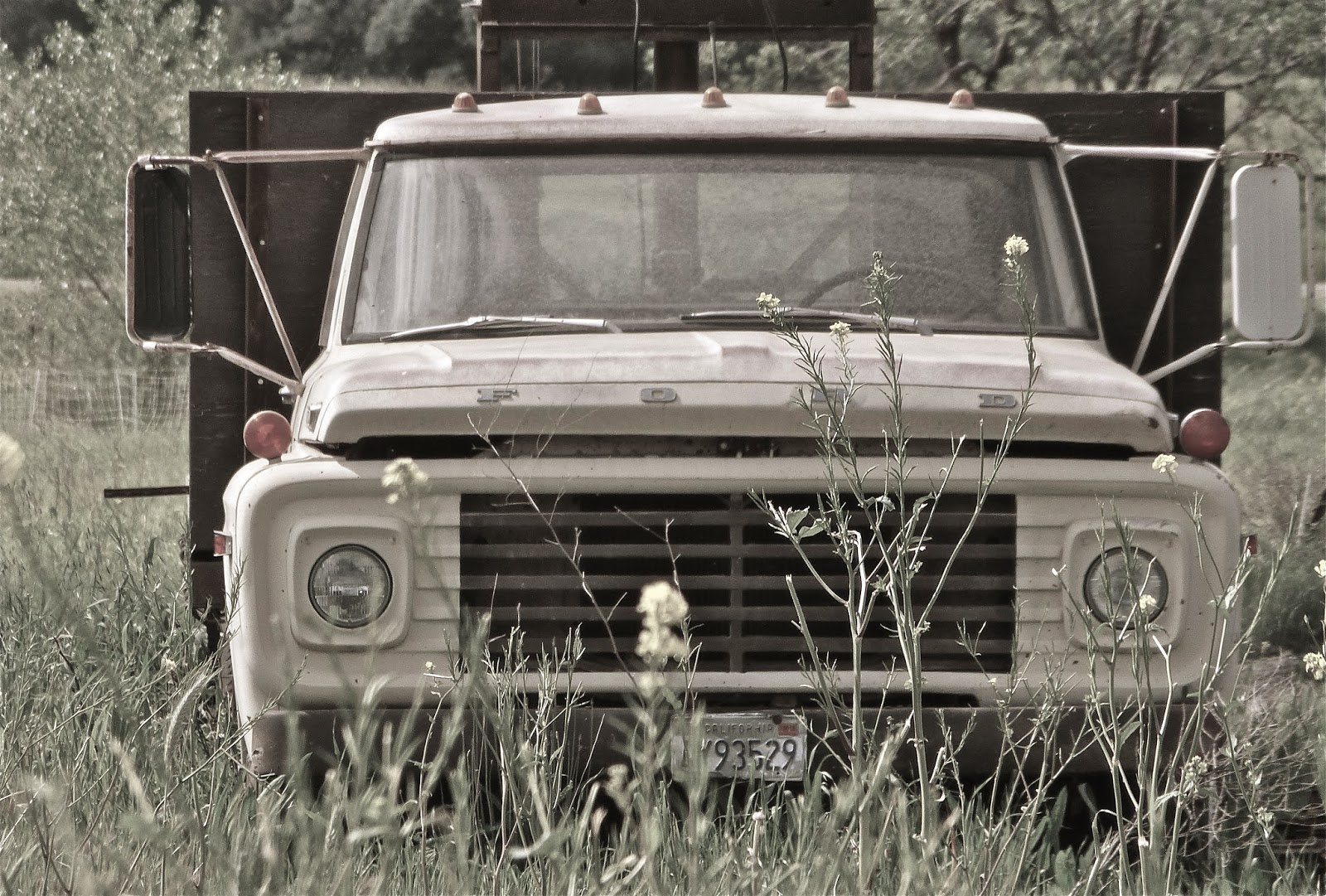

Perfunctory Old Truck Picture
Walking back to the farmhouse, I tell Paul he should be a teacher “…you know, if this farming thing doesn’t work out.”  Clearly there’s educational practice stuff he gets, I’m thinking. 

He chuckles, offering a very modest reply and then says something to this effect: It’s relatively simple to engage in all of those levels of thinking when you’re working with your hands in the soil day by day.  Our livelihood depends on it.  “Schools, I suppose, can’t do this too effectively because of cost, logistics…”

He’s right, of course.  Our students could receive a much more hands on – much better grounded – experience if schools could somehow be more like farms.  They would graduate with a less sterile but far more heightened sense of how things work and how those things work together.

It’d be organic.

o0o

Full Belly Farm is located just on County Road 43, off Highway 16 about a mile and a half north of Guinda.  They are open to the public on select days (see their website) and offer organic produce and fiber through farmer’s markets and their Community Supported Agriculture program.

Internships are available, school field trips are encouraged and there’s a summer camp for kids.

Check out their website for coming events and to learn more: http://fullbellyfarm.com/

© 2015
Church of the Open Road Press

Friday, December 28, 2012

2012: THE CHURCH OF THE OPEN ROAD’S YEAR IN REVIEW

…in pictures


Click on any picture, and SHAZAM! it expands.
Third Runner Up for Picture of the Year:  The quintessential theme of the “Church” is “the Open Road.”  This shot typifies the feeling of distant horizons and miles left to go.

January calls us to stray relatively close to home.  The Sacramento Valley offers nearly year round riding. 

The Cosumnes River Preserve is a nice destination with miles of paved trails through bottomlands populated with migratory fowl.

February of a dry rain year:  Let’s see what had been inundated with the construction of Folsom Dam.  This old bridge once carried traffic from the El Dorado side to the Placer side.

Fourth Runner Up for Picture of the Year: Stuck in the mud, a more recent artifact may be this slipper.  One wonders the tale it has to tell.

March’s longer days invite us to revisit old friends like the Capay Valley on SR 16 passing old farm houses…

…and, beyond where 16 intersects 20, a great old derelict truck.  There seemed to be a lot of great old truck photos this year.

April found us exploring the Grand Canyon, having left the bikes at home.  Stunning photos of this wonder abound, but there was this maiden sitting atop a rock wall awaiting the sunset.  Unless she shows up every day about the same time, I’m thinking this is a pretty unique shot.

The warmth of May demands more saddle time.  Taking turn-offs to places we’d passed by saying “maybe next time” – like Fiddletown (Amador Co.)

 Or revisiting places we’ve come to cherish: Malakov Diggins State Park...

...via Edward’s Crossing…

And Dutch Flat where the Big Four contracted with Theodore Judah (in this very house) to engineer the first rail crossing of the Sierra…

…where this critter served as my guide-about-town.  (He shows everybody around town, I am told.)

June: the old stompin’ grounds north and east of Chico…

…including the near-mythic Humbug Valley…

…and circling home under Robber’s Roost.  There are "Robber's Roosts" everywhere throughout the Sierra.  This one is just east of Humboldt Summit (Plumas Co.)

A July family vacation to Colorado prompts me to think I must return on two wheels.

August sees a return to Modoc County via the in-flames Feather River Canyon…

…to visit an old friend…

…and enjoy a bit of prairie shared with horses.  Nice spot in Modoc, perhaps, the most western of all California Counties.

North from there found us crossing MacKenzie Pass outside of Sisters, Oregon.

Staying close to home in September: the high country gold rush era skeletal remains of Graniteville…

…returning home via the delightful Relief Hill Road.  (This is the area from which rescue parties staged their attempts of save the Donners.)

In October, we broke into Canada, creating an international incident by having left the passport at home.

Kootenay Lake on the Selkirk Loop in BC offers some nice sweeping curves and crystal clear views of the Canadian Rockies.

Returning over WA SR 2, the high grasslands and wheat fields allow lovely panoramas and glimpses of days gone by including this old schoolhouse…

And (second runner up for picture of the year) this great old Chevy.


As 2012 closed, time claimed yet another of what Tom Brokow titled “The Greatest Generation.”  The Church’s Picture of the Year is an attempt to record the strength folks of that generation tried to pass unto us. 

Most interesting this year was the discovery that the gentle man who is subject of this photo, while clearly leaving this plane, isn’t really all that far away.

© 2012
Church of the Open Road Press

Monday, March 5, 2012

RETURN TO THE CAPAY VALLEY – AGAIN AND AGAIN

California State Route 16

TWO THINGS: Great roads and near year-round riding weather. Finding a new place to ride isn’t easy after one’s been riding a while. Revisiting a great road, however, makes up for it. So many elements are at play while in the saddle: Time of year, time of day, direction of travel, weather. Each of these elements make tomorrow’s ride on yesterday’s road different from the passage before.

State Route 16 through Yolo and Colusa County’s Capay Valley is one of those roads one cannot get too much of. It had been quite a spell since my last trek up this way and the early March weather report called for highs in the mid 70s. Any questions?


As ever, clicking on any picture will expand electrons.
PICKING UP 16 off I-5 north of Woodland, this abandoned farmhouse has always captured my attention. It wasn’t until this trip that I pulled over to take its portrait. Rising out of the valley floor amid row crops, with boarded up windows, the luster of its elegance is long lost. It stands like a haunted monument to the stature of some century-ago landowner. Nearby, someone is living in a mobile.

Across 505 (Winters Cut-off between Interstates 80 and 5) the little town of Esparto provides some commerce at the mouth of the Capay Valley. The train station stands as vacant as that Victorian farmhouse a few miles back, but a new banner suggests restoration might be in its future.

SR 16 is more heavily used this past 15 years since, up in Brooks, the Cache Creek Casino has taken root and flourished. The hamlet of Capay lies along the way. Its Chamber of Commerce sign indicates that there are old time things to do in the area – things folks enjoyed before the gambling and nightclub scene sprouted.

The little valley is home to small farmers – some totally organic – who raise vegetables for local markets as well as almonds and stone fruits for wider distribution. Having traveled Umbria some five years ago, with the exception that oldest buildings here are about a thousand years younger than those in old Italy, the Capay region is quite reminiscent of that temperate Mediterranean area.

Tiny roads lead left and right off the main artery, but most dead end not too far up the eastern or western slope of the ridges that texture the horizon.

The old school stands empty – there is no banner promoting its restoration. Set at a little crossroad, I can only imagine that the community got together and constructed this edifice on a donated corner of farmland. I wondered if the product of this institution graduated prepared for that which they would confront throughout life. Then, peering at the verdant hills and rich farmland concluded that its students did right well here.

The Guinda Store is a must stop. Meat counter. Sundries. Snacks. Local wines. And a pleasant bench upon which to sit and watch the world slowly pass by.

I’d never stopped in Rumsey before although I’d always admired their community hall: neat as a pin, cared for, loved.

A plaque tells the story of the town that once was.

Unlike the Victorian farmhouse, the depot or the old school, this beautiful old building is still finding reason.

Across the way, a local has collected artifacts of the valley’s agricultural heritage and placed them just out of reach on his private corner. I suspect that by judiciously pouring a little low octane into this devil – maybe after changing the spark plugs – she’ll fire up ready to pick up where she left off seventy-five years ago.

Highway 16 rises out of the valley and courses along Cache Creek, then Bear Creek for the rest of its run. The redbud tells us spring is here.

Between the BLM and Colusa County, several primitive camp, picnic, pit toilets and access points dot the route. Good timing if one stopped for too-much-of-a Dr. Pepper back at the Guinda store. Across the way, it looks as if an old cowman’s house has seen far better days.

And the fence board here looks like a huge piece of petrified linguine.

Bear Creek settles into what, for this area, is considered a high mountain meadow. The deep blue water is a mere reflection of a deep blue late-winter sky.


THE COAST RANGES in California are oft overlooked – particularly their eastern flanks. They are overshadowed by the ocean and the redwoods to the west and the snow corniced Sierra far to the east. Highways and lesser roads in this region are delightful to explore and, outside of that stretch up to the Casino, very under-trafficked. It is difficult to imagine a better place for a relaxing traipse into yesteryear.

o0o

Local Capay Valley booty
TODAY’S ROUTE: I-80, north on I-5; west on SR 16 past Woodland. SR 16 through Esparto (right turn into town, left out of town at depot), Capay, Brooks, Rumsey; follow Bear Creek to “T” at SR 20. Watch for sand and slide detritus on the pavement as you carefully enjoy sweeping turns along Bear Creek! Return: Either east on 20 to Williams; south on 5; or West on 20 – 675 yards, right on Bear Valley (gravel) Road. Head north. Explore. But carry a good map.

© 2012
Church of the Open Road Press