Showing posts with label Western Pacific. Show all posts

Sunday, October 27, 2024

ABOARD THE CALIFORNIA ZEPHYR (FINALLY!)

 A life-long dream come true ~ maybe

The California Zephyr has always been mythic to me. Winding like a silver ribbon up the Feather River Canyon, occasionally, we’d be lucky enough to see it as we drove California’s Route 70 in our ’54 Ford toward Quincy and Bucks Lake. Crisscrossing the canyon, if we were really lucky, we’d be crossing the river on a bridge as the train crossed above us, switching sides of the canyon. The silver beauty was always on the other side ~ always just a bit out of reach.  


The Zephyr ran from San Francisco to Chicago under the combined efforts of the Western Pacific, the Denver, Rio Grande Western and the Burlington Route. It had always been my dream thunder across our vast western expanse on this train. Alas, come the early 70s, service ended. As did my dream.  Or so I thought.


But along came Amtrak, the Federal government’s attempt to keep rail traffic alive. More successful along the eastern corridor of the United States, cross-country routes would enjoy less ridership. Yet, the Zephyr was revived. Now, however, using the historic Donner Pass Route initially carved by the Central Pacific, silver streamliners no longer grace the Feather.


 We board the Zephyr in Sacramento.


From the Sacramento Valley Station, the route winds and twists up the western slope of the Sierra with pauses in Roseville, Colfax, and, following the river courses of the American and the Yuba, cresting the Sierra on the highest trackage anywhere in the States. We enjoy a view of Donner Lake…


…before descending into Truckee for a twenty minute fresh air and, ironically, smoke break.


The route traces the Truckee River through the rain shadowed environs of the east slope of the Sierra. Conifer forests begin to give way to brittle sage and autumn’s golden grasses.  


East of Reno, we begin to get a feel for the vast and vacant high desert. Miles of that sage and mineral wealth (I suppose.)


Our rail journey will take 50 hours, several of those spent lightly sleeping in our rocking accommodation. But, as night falls, I snap this haunting image of a western sunset and wonder about the Shoshone and Paiute peoples who, for centuries, came to an understanding of that whole living in harmony with nature thing that we successors to this space don’t quite get.


Sunrise finds us coursing along the Gunnison River.


Rolling into Grand Junction, CO on the historic Denver and Rio Grande Route, we see one of many grand old stations left to decay.


A few miles of browning hills relentlessly shaped by river and wind…


…and we rumble into our first glimpse of the Great Plains.  I write ‘rumble’ because, to my untrained train butt, the Burlington Northern / Santa Fe right-of-way east of Denver seems a bit less well maintained than the UP to the west.


Lots of flat. Lots of grain ~ amber waves of it ~ mainly, it seems, corn. And lots of endless vistas. One can fly over this country, which we did on our return to California, and not grasp the distances, the vastness and the towns that look like nameless grids or checkerboards from 36,000 feet. We slept through all of Nebraska. 


Here’s Burlington, Iowa …


… and an aging Burlington Northern Pullman, Railway Express car and vintage loco. Glad these rolling stock examples are being preserved.


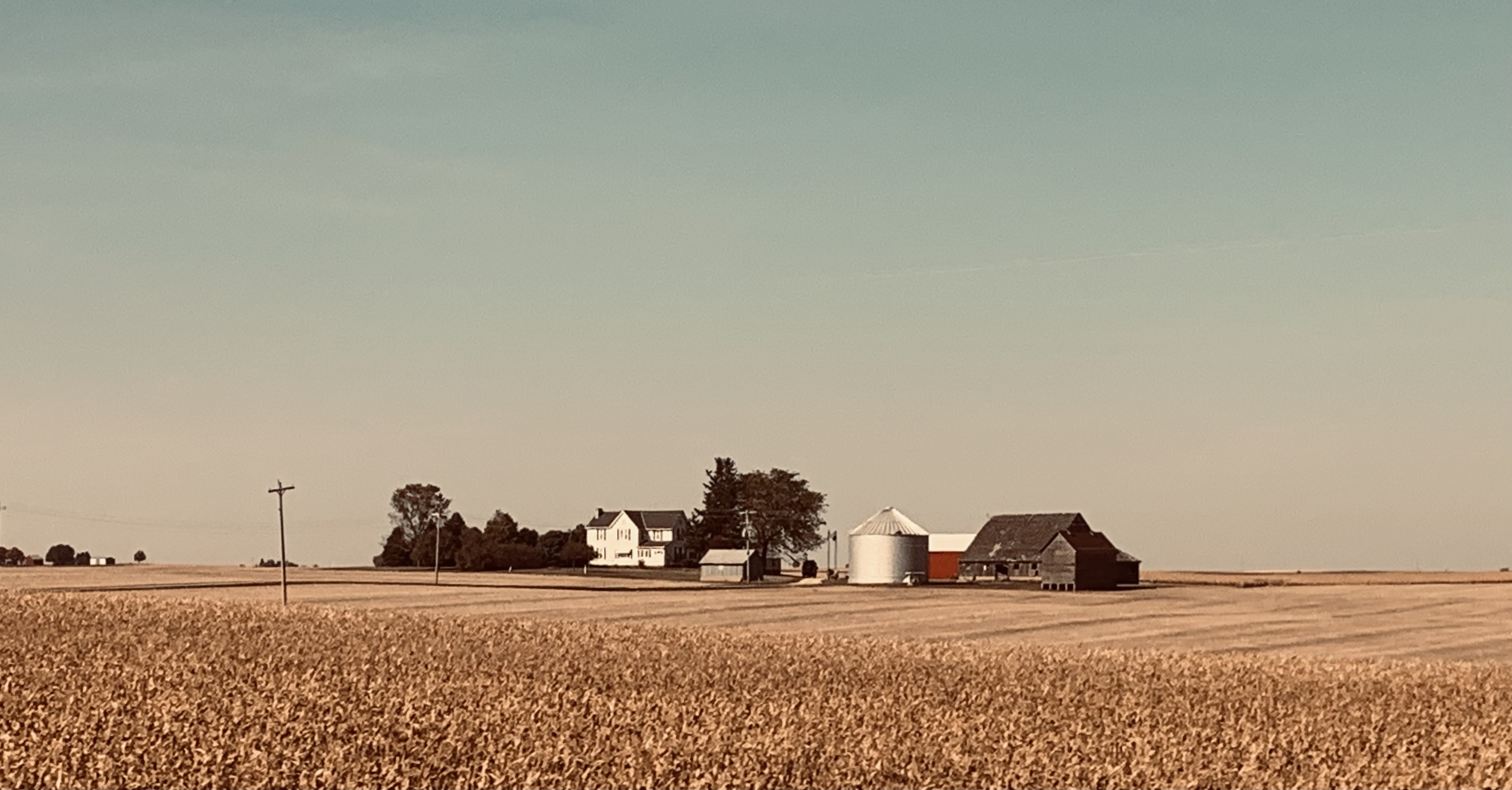
An hour or so further and an hour or so short of Chicago, this solitary farmstead captures a contemporary way of life we don’t experience on our western seaboard. And, while not wishing to wax political in this post, I believe I can understand why folks in these parts may see things differently than I do.


Chicago would be our literal end of the line. It’s where the Zephyr has always terminated. Chicago: with the ‘El’; the commuter lines to the suburbs; lines to the stock yards, steel and other industries; and the historic Union Pacific; Burlington Route; Chicago and Northwestern; and several other routes. We are informed that within the Windy City’s confines exist more miles of rail line than in the rest of the continental US combined. Rolling the final twenty minutes into Union Station, it’s a claim that’s hard to dispute.


After fifty hours on the train, I ask myself, “Did my long held dream of riding on the California Zephyr come true?”  


I recall myself in Dad’s ’54 Ford waving at passengers on the Zephyr as it wound through the Feather River Canyon. I question whether some little kid traveling up Highway 70 in the back seat of his dad’s current day SUV might be missing the opportunity to form his own romantic dreams about boarding this silver wonder and seeing where it takes him.


Resource: The Story of the California Zephyr, by Karl Zimmerman. Quadrant Press. © 1972.  Nice historic photo and narrative about the early days of the original Zephyr. (Good luck finding a copy. You might want to check out your neighborhood model railroad shop as they often have these kinds of books.  Plus, model trains are kinda cool.  They bring back the little kid in many of us.)

© 2024

Church of the Open Road Press

Friday, May 20, 2011

TIME TRAVEL ON THE CALIFORNIA ZEPHYR

CALIFORNIA STATE ROUTE 70 (FEATHER RIVER CANYON)

[2005] POSITIONED JUST SO, with the BMW behind me, I wait for the UP freight to wind down the canyon and through the series of tunnels. Its approach is announced well before its arrival by the high pitched singing of its chorus of brakes. Steel flanged wheels twisted slightly against the teed rim of the equally steel rails…


…A BOBBING HEADLIGHT first. Then, out of the darkness, the silver and orange loco, b-unit and loco.

It’s the Zephyr! The California Zephyr! Look Dad! Look Mom!

(c) Robert Morris Photography
Starting in Chicago, who knows how many days ago, this silver snake has crossed the northern plains of the Dakotas, the Colorado Rockies, the beastly intermountain basin of a barren Nevada and up over the Beckworth Summit to find its way into a sublime Feather River Canyon, seeking Oakland and the Pacific shore and the promise that is California.

The Feather River Route was finally opened in 1909, following the inscriptions of a black Virginia trapper and mountain man name of Jim Beckworth. Beckworth had grown up in the Shenandoah Valley and as young twenty-something, left for the adventures and that promise of the west. This was before the west was tamed enough to suggest a black mountain man was any different or any less deserving, or intelligent or savvy survival-wise, or any less insightful than a mountain man of some other pigmentation.

HistoryCentral.com
Beckworth followed his nose over the Sierra finding a low pass that would have been much more merciful than the one chosen by the Donners some forty years before. More merciful, also, than the route mapped by Theodore Judah for Huntington, Stanford, Hopkins and Crocker and consummated at their meeting in Dutch Flat, California in 1862 – the route to be carved by the Central Pacific at the cost of the lives of thousands of Chinese and, in the end, old Ted Judah his-own-self.

Scaling a mere 6800 feet, the Beckworth Pass Route was the one that should have been opened to rail traffic first, but the Big Four wouldn’t hear of it. Their hardware business was grounded in Sacramento, not Oroville or Chico. Thus, the Beckworth / Keddie Route (William Keddie was a planner for the WP) was opened fastest, but opened last - an ironic tribute to the stubbornness of the moneyed.

The Chicago and Northwestern now owned the eastern third. The Denver and Rio Grande had the middle. And the WP took the scenic final run from about the Utah / Nevada line across the desert and down this splendid canyon.

(c) Robert Morris Photography
So today, one 1963 day, this aluminum clad marriage of technology and grace spirited Midwesterners three quarters of the way across the country in a matter of days.

This was the Zephyr. A shining tribute to man’s artful triumph over the power and solidity of nature. Shimmering in the mid-canyon sun, the Zephyr awaiting a still photo op.

Mom and dad had stopped along the river to catch a gleaming glance.

We didn’t hear the roar of the Electro Motive Division diesel-electric FP-7s [built by General Motors – yes, that General Motors], just the singing of those brakes and the rumble of those wheels as each passed over randomly spaced joints in the rails. And the occasional bawl of its whistle as it entered a tunnel.

Dad held his Kodak Signet at the ready.

(c) RailwayShop.com
I waved at the engineer, or the brakeman or the fireman, or whoever it was whose elbow caught the breeze out the window of the open locomotive and had lifted a hand to wave back. Then I waved at the lucky people who had paid their fare and were dining or drinking or just looking out the coach window back at those of us who’d pulled off the highway to look at them. Like an attraction at a zoo with iron rails instead of iron bars.

Seven or eight stainless coaches traced the far canyon wall. Two or three of them sporting observation domes. “CALIFORNIA ZEPHYR” was scripted on the side of each coach: “CALIFORNIA ZEPHYR.” “CALIFORNIA ZEPHYR.” “CALIFORNIA ZEPHYR.”

“Dad?” I asked, “What’s zephyr mean?”

Dad was snapping closed the leather case on the Signet. “I think it means breeze.”


THE BREEZE SLIPPED down the canyon and, by 1970, was gone.

***

RESOURCES:

Jim Beckworth blazed quite a trail across North America during his days as a trapper and explorer. Starting from the Shenandoah Valley of Virginia, traces of his life can be seen in museums throughout the west. Some details may be found in many places on the web including: www.d11.org/bristol/Bristol_Wall/1860/front_1860_beckwth.htm and www.historycentral.com/Bio/ant/beckwourth.html

Robert Morris Photography offers a collection of vintage (like from when I was a kid) and current railroad shots.  His collection of stunning photographs capture the marriage of grace and power that is railroading.  His work is available for purchase through http://www.snowcrest.net/photobob/


The Western Pacific Railroad Historical Society and Feather River Rail Society maintain the fabulous Western Pacific Railroad Museum in Portola, California. Easily visible from State Route 70, the museum has a collection of memorabilia and rolling stock and (get this!) at the WPRM they will actually rent you a locomotive to drive!!! The Church of the Open Road intends to do this and will report back. The WPRHS may be found on-line at http://www.wplives.org/


Books:

Holmes, Norman W., My Western Pacific, Steel Rails West Publishing, Reno, Nevada, 1996.  Holmes takes a look at the WP from the unique perspective of one of the Feather River Route's engineers.

Zimmerman, Karl R., CZ: The Story of the California Zephyr, Quadrant Press, New York, 1972, 1996.  Zimmerman recounts the history of what was once America's most romantic journey with text, photos and diagrams of rolling stock.


© 2005, 2011
Church of the Open Road Press