Showing posts with label Montana. Show all posts

Tuesday, August 6, 2019

SUMMITTING BEARTOOTH PASS ON A ROYAL ENFIELD HIMALAYAN

This one is not to be missed!

The task was daunting.  Ride my Yamaha Super Tenere from California to Red Lodge, Montana, cross the glorious Beartooth Pass and return home all within seven days.  Or…


...Rocky Mountain Motos is a new (circa 2019) Red Lodge outfit that rents motorcycles – but not Harleys or BMWs or any of a number of other major makes.  No, owner Richard Barnett has a half dozen new Royal Enfield Himalayans to let at a very reasonable price.  Intrigued, I e-mailed: “Would a 24.5 horsepower mount haul my 220+ pound carcass over an 11,000-foot pass?”  

“You’d be amazed.”

We’ll see.


Beartooth Pass is recognized as one of America’s great scenic motor-routes.  Having done it once on a GSA, I was eager accompany my riding buddy on his first ascent.  I picked up the black RE and took an orientation spin up out Montana Route 78 toward Roscoe.  Finding a graded, gravel secondary road, I tooled over washboards mightily impressed  with how effectively those bumps were absorbed by the little machine’s suspension.

Regaining pavement as I circled back toward Red Lodge, I opened the throttle and easily achieved 65+ miles per hour.  Then came a rise in the pavement.  Here I discovered that 410cc Royal Enfield will go 65 mph and it will go uphill, but it won’t necessarily do both at the same time.  At least, not when carting me around.  The true test would be tomorrow.


Montana Route 212 out of Red Lodge is a predominately uphill run for about 35 miles.  But it is not an autobahn speed route.  Guide books tell us to plan on at least three hours for the 63 miles from Red Lodge to Cooke City near Yellowstone’s northern gate.  I did some mental math.  I’ll do fine on the Himalayan.


The highway quickly climbs out of Rock Creek Canyon.  Looking west, the “U” shape of the valley below and sharp, saw-toothed aretes on the horizon verify the canyon’s rugged history of glaciation.  Carving the switchbacks up this canyon wall using only 1936 era prowess… er… dynamite, must have been a monumental effort.


Pausing at a viewpoint/rest stop about 18 miles in, I encounter my first “issue” with the Royal Enfield: everybody wants to ask me about it!  Even those on big V-twin cruisers.  I tell ‘em it’s a rental but that I’m really smitten with it.  


Then, just before I thumb the starter, I warn the crowd to stand back because “this thing’s gonna make a little noise.”  They cautiously back away as the motor putters to life.


The highway leads us through several forest zones from cottonwoods and oaks at the bottom to alpine meadows carpeted with July-spring wildflowers and blotched with snow.  From top of the Beartooth Plateau strings of paternoster lakes reveal where glaciers crept down the mountain pushing debris, then melted back, only to push down again, though not as far.  Four, five and even six icy ponds may be found in any of the canyons carved into the plateau.  


At the summit, a marvelous skyscape of fair-weather clouds is almost close enough to touch and although this isn’t Iowa (apologies to ‘Field of Dreams’ fans) it does feel a lot like heaven.


West of Beartooth rest the Absaroka Mountains, a collection of volcanic peaks and fields that invite further exploration.  At our feet, the highway (now in Wyoming) lays before us like a ribbon just torn from a holiday present, twisting past outcrops and shallow lakes and acres of green meadow grass that may never see summer.


Automobiles snake along, motorcycle rumbles are lifted by the breeze and every half-mile or so, there’s a turn out for pictures.


Lunch would be in Cooke City where I come across that same group of bikers from two hours before.  Sheetmetal workers, it turns out, from New Jersey and Pennsylvania.  Their boss, himself a rider, organizes an annual trip, stuffs a dozen motorcycles and a bunch of gear into the company semi and leads the group to someplace challenging and beautiful for a week.  I wanna work for that guy.


We have a choice for our return: take the Chief Joseph highway, Wyoming 296 to Cody and loop back to Red Lodge or retrace our steps over the pass.  Given that every road driven the other direction is a different experience, we head back over the pass.


The long descent from the summit is a relaxed unfolding of light and shadow, rock and wildflower and waves from oncoming riders.  The Royal Enfield hums along and I realize I’m having just as great an adventure on this little machine as I had on the big BMW years ago.


Pausing for a second time at the rest area, and again getting caught up in conversation, I find myself with two wishes: One, that this ride could go on forever and two, that a Royal Enfield Himalayan might one day end up in my garage.

Had I been amazed?


Boy Howdy!

o0o

Note:  Rocky Mountain Motos is run by enthusiast Richard Barnett.  Each in his collection of Royal Enfields runs flawlessly and possess all the power, nimbleness and durability needed to explore this section of the Rockies with confidence. Richard knows the area and can point customers in the right direction.  (There may be no wrong direction, come to think of it). If one is pressed for time – or even if one is not – the Himalayan experience is too good to pass up.  Check Rocky Mountain Motos out at  https://www.rockymountainmotos.com

© 2019
Church of the Open Road Press

Sunday, August 11, 2013

SMALL TOWNS IN OUT-OF-THE-WAY PLACES: HISTORY, ROMANCE AND MYSTERY


impressions of a trip through our northern plains
…fifth in a series…


Pretty much every aspect of riding on the rural open road is compelling. 
Whether it is a far-off vista, or a set of exhilarating turns, or the aroma of freshly mown hay, or the view from whatever you’ve found yourself summiting.

Among those pleasures are the secrets hidden in the small towns most of us either fly over or fly through.  From the air, they may not show up or they may look only like crossroads. 
From the ground, though, they must be the repositories of stories – little histories – untold, unique and critical to somebody at some time, I’m sure.

Little towns are places where we can get a glimpse of life before the digital revolution made things happen so fast.  Times past when we gathered for entertainment, rather than downloaded it…
Times when we didn’t need to accumulate much stuff in order to have enough stuff…
Times when all the news we needed to know we received with a cup of coffee and a plate of scrambled eggs.

In the northern plains, places harken back to days of physical labor and poor pay...
...and success being dictated the range fire that didn’t happen or the river that didn’t overflow.

And when the crop came in, the market dictated what the farmer might receive...
...irrespective of how many early mornings, stillborn calves or working Sundays before goin’ to meetin’ the old boy invested.

An outpost in the hinterlands might be “town” until one could cobble together the time to really go somewhere to trade…
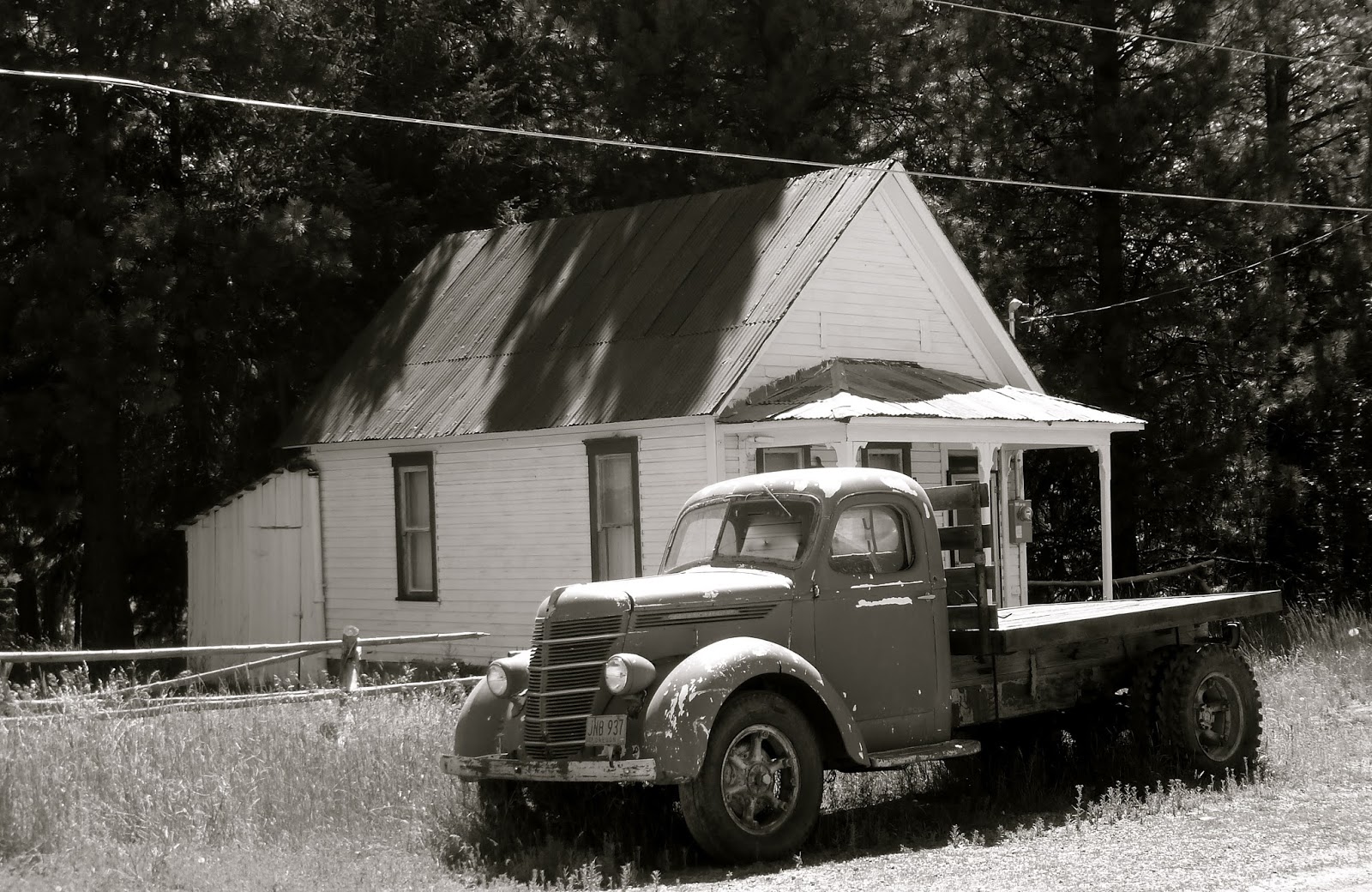
…loading up the buckboard and hitching it to plough horses, or fire up the Dodge or the Diamond Reo, laden with whatever came from the garden…
…perhaps boarding in town for a night or two…
…spending an idle moment wandering about and wondering a bit... 
...what it might be like to live here and not work the hands quite so much.


Remnants remain with their stories.  Adjacent to this Quonset post – the whole town is façaded Quonsets except for the abandoned church – 
- is a trading post in that church clerked by a woman who works winters as an instructional aide for special needs students. 

Her autistic son, she told us, gave her all the experience she might need to be qualified for the job.  Her husband had died in a traffic collision some eighteen years back and she hadn’t the wherewithal or desire to move back to “the city.”  So she clerks in the summer and works the school the rest of the year, unless the snow makes the road impassable.

The recent drought has dried up the land, and with it, one of the final vestiges of this part of the plains: the cattle industry.  Trucking in feed is just too costly.  And water?  Way too much one year 
and then none for three.  Even with 21st century technology, success rests with someone or something else’s whim.

Still, every fifty to eighty miles, there has to be a Sinclair station where you can fill up and maybe take some extra home in a drum.  These little bergs support community parks that invite a softball game or a mid-afternoon nap on the lawn.   
And they find a space to preserve some element that defines who or what they once were. 
Some dress up the old brick bank turning it over to a non-profit who’ll run a museum or refurbish the narrow gauge.  And hope for the tourist trade.
Others maintain the 120-year-old outpost geographically positioned right where the hungry traveler will pass and, maybe pause, mid-morning to late afternoon.
Other businesses fail because that’s the order of things with change.


Still, it is fascinating to reflect for a moment – maybe visiting with a local – and gain and impression of how things might have been sixty or eighty years ago. 

Because in many places on the northern plains... 
...sixty or eighty years back is now.

© 2013
Church of the Open Road Press

Wednesday, August 7, 2013

BEARTOOTH PASS, WYOMING – RIDING TO THE ROOF OF THE WORLD


impressions of a trip through our northern plains
…fourth in a series…

and dedicated to all of my boys named "Cody."


As a life-long educator, there are kids – because of their quirks or characteristics – whose names you wouldn’t pick for your own offspring.  For some folks it may be Kyle or Stephen or Bree or Adolphus.  Or even David.  For me “Cody” is one of those names.  Attention to details like… well…  the rules or organization or planning challenged many of the Codys I’d had as a teacher or principal.  So on this trip through the northern plains, I hoped to drop into Cody, Wyoming and see if there might be a dot or two I could connect.

Unfortunately, or luckily, in Red Lodge, MT, a great degree of roadwork caused through traffic to detour a block or two away from the US 212 main drag.  Somewhere in the orange cones and caution signs, I missed the one that said, “Cody, that-a-way.”


Several miles out of town, I found myself entering a deepening canyon.  The route didn’t appear the way my mind had rendered it.  It appeared better.

I stopped for a moment to refer to the map, deciding then and there not to correct my error.

US 212 weaves between Montana and Wyoming on its route from Billings to Yellowstone and beyond.

Along the way, sinews of pavement rise continually, causing the rider to reflexively gulp with each new expansive view.

Motorcycle jockeys from all over seek this route that I’d known nothing about because, like many of my former students named Cody, I wasn’t paying attention.  At a popular turn out, I pull in next to a phalanx of Harley Davidson’s each sporting an Aussie flag.  “What do you gents ride at home?” I asked.  “Why these,” came the reply.

Traveling up in elevation is like traveling north in latitude.  The air gets cooler, the growing season shorter, and the plant life more stunted and distinctive.

While each turn invites the rider to see what’s next, each new perspective demands a stop for a photograph.

Riders, regardless of marque, grin and chat and are willing to take your picture if you’ll take theirs.  An Albertan on a beautiful green 1500 Gold Wing insisted on taking mine.
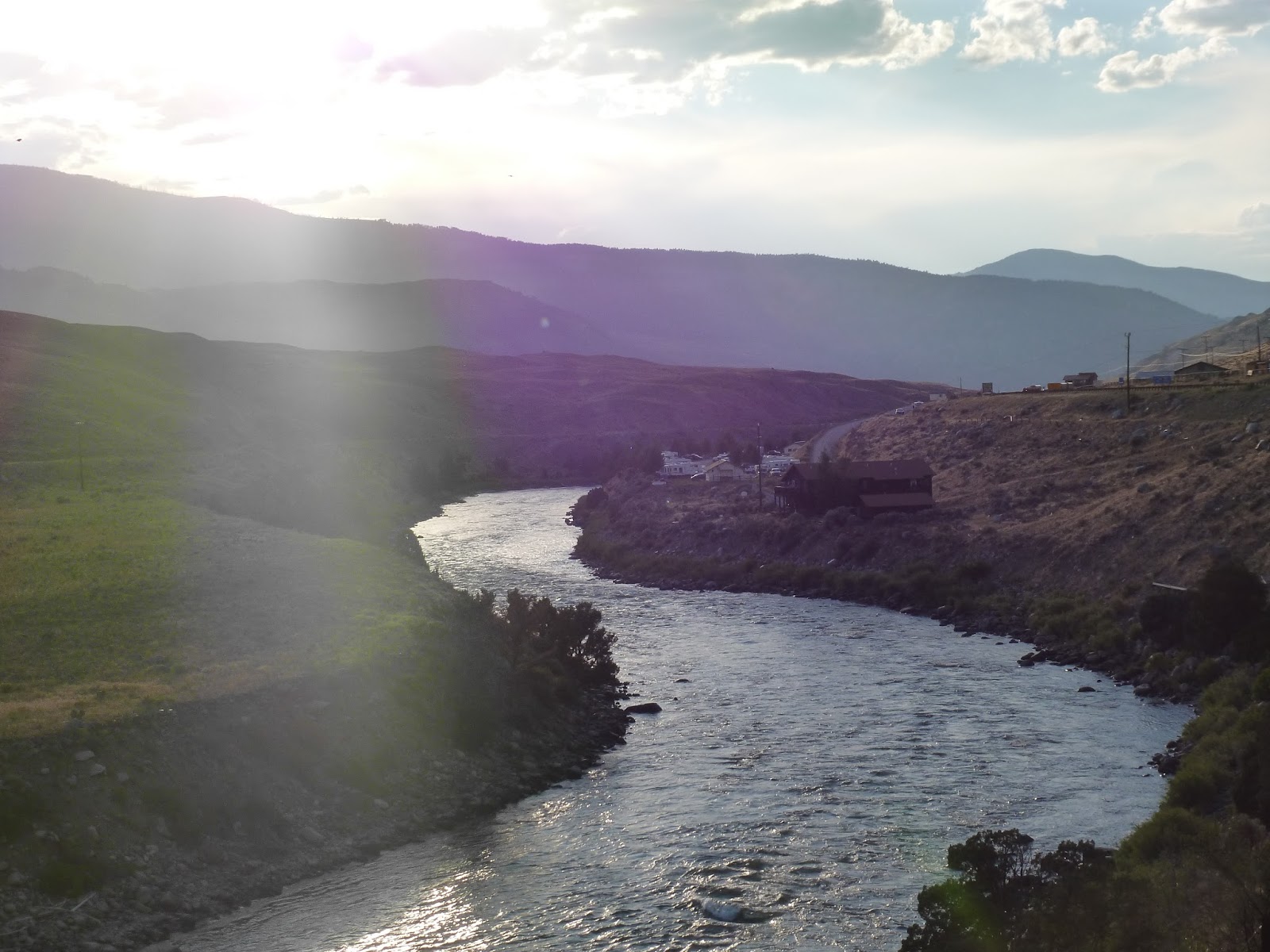
With each pause and dismount, someone you passed below, passes by.  I think these are a couple of the gents from Down Under.

Just as you feel you are reaching the crest, you round a turn and find the summit yet further away.  When hiking the high country, this can become a frustration.  When riding, however, it simply seems like a gift you continue to eagerly unwrap.

Then there’s that little letdown when you finally achieve the pass’ 11,000 feet.  As things unwind, will the spectacularness fade?

I pause for a final look to the east.


To be sure, the route down the hill didn’t evoke the awe that ride to the roof of the world had brought.  Summer in the high country, like the growing season, offers only a short time for roadwork and there was roadwork aplenty going on west of the pass. 

I stopped in Cooke City, a berg just east of Yellowstone, for some butt rest and a sandwich.  I harbored a concern that the famous park would be a let down after the morning’s run over Beartooth.

But, I found as I descended into Yellowstone, there are many definitions of spectacular.

Some are subtle and delicate.

Some are not so subtle, but just as delicate.

Some take wing on an evening breeze.

And some simply flow.


All in all, this had been a great day riding, despite my Cody-like planning prowess.

© 2013
Church of the Open Road Press