Showing posts with label Fire Lookout. Show all posts

Saturday, August 21, 2021

Memory of the Mt. Harkness Lookout


Crossing Paths with Edward Abbey


“Trudge” or “Trudging.”  It is the word that I didn’t get right in the fourth-grade spelling bee at Rosedale School.  What a stupid word, I thought, ranting to myself: Who’d ever use the word trudge?  I’ll never use the word trudge!  (Curiously, in ninth grade, I would hold similar concerns about the entire concept of “algebra.”)

         In August of 1966, I found myself trudging up the trail that led from Juniper Lake to the top of Mount Harkness in Lassen National Park.  We’d been camping at the lake for nearly a week, and this was the first day that it wasn’t raining.  Dad got us on the trail.  “The view at the top will be spectacular,” he said.

         Mom had somehow forgotten her fancy Vasque hiking boots at home, so with her feet swaddled in Keds and socks with plastic Wonder Bread bags slipped over the socks to serve as waterproofing.  She made it about a mile up the hill before she grumbled, “Enough!” and sat down on a rock in the sun.  Brother Beebo, as I recall, stayed with her while Dad and I soldiered on.

         The trail was rocky and muddy.  Rainwater and snowmelt often filled the path.  Frequently, after tiring of slipping and slogging through the muck, I’d try walking through the ankle-deep green grasses at the side of the trail where the footing was even worse.  The leather boots I wore I’d about grown out of, and they weren’t waterproof. I felt huge blisters forming on my cold, cold feet.  But Dad prodded me onward.  The meaning of that word from the fourth-grade spelling bee was becoming clearer and clearer with each step.

         At a fork in the trail, I paused and looked at Dad.  I remember peering down upon Juniper Lake and thinking, if not saying, “Okay, we’ve gotten to a nice view.  Can’t we turn back?”

         Dad pulled a trail guide from his pocket and, as he pointed up the trail, he read:  The last section of the trail switchbacks up a cinder cone… “Don’t you want to hike on a cinder cone?”  “No.”   Hikers can feel the grasshoppers dance at their feet…  “Don’t you want to feel the grasshoppers dancing at your feet?”  “No.”  Once on top of the slope, the trail continues to the fire lookout.  The fire lookout is staffed in the summer months and hikers are welcome to visit and learn about fire monitoring. “Don’t you want to learn about fires and stuff from the ranger?”

         That sounded interesting, and I was off.

         As a kid, I was not a big fan of switchbacks.  Wouldn’t it be easier to simply climb straight up the hill?  And on the north-facing glade on Mount Harkness, that’s what I did, short-cutting two or three of them.  The combination of the slope and the elevation squeezed the breath out of me pretty quickly.  Panting, I waited for Dad to catch up, taking in the view of Lassen Peak to the west, a promontory called the Cinder Cone to the east and a number of lakes that dotted vast reaches of forests. A pair of gray birds that squawked like blue jays zoomed in and out of the scrubby trees that grew nearby.  And there were flowers.  It was like springtime in August.


The fire lookout atop Mount Harkness appeared like a great rustic lodge constructed of reddish-black boulders and rough-hewn timbers.  The closer I got, the more magnificent it became.  Only two stories in height, the thing seemed to loom over the mountain’s top.  The lower level was made of those boulders, quite possibly gathered from this very mountaintop.  A steel door was centered on one face of this basement, and I don’t recall if there were any windows.  A wooden staircase climbed up one side leading to a catwalk that circled the outside of the structure.  From the ground, I could see that the entire top floor was framed in great windows, offering a view of, well, everything.  

         I stood at the base and looked up.

         A slender man with a thin beard appeared through a door to the upper level.  He looked at me, then glanced to see Dad several yards back.

         “Okay if he comes up?”  Dad must have nodded, because the next thing I heard was “Come on up, kid.”

         I climbed the stairs and circled the lookout on the catwalk.  Mount Lassen was close enough to touch.  Juniper Lake seemed directly below us and Lake Almanor, on the opposite side, almost as close.  This may have been the first time I understood the concept of ‘seeing forever’ that Robert Goulet sang about on the radio and Dad sang about in the bathtub.

         The inside of the lookout was dominated by a table placed in the middle of the tiny space.  Atop the table was a map with a weird looking sighting devise I learned that was used to pinpoint the location of a “smoke.”  The interior was rustic and spare.  Under the windows was a wire-spring bed, a tiny refrigerator, and cooktop, some primitive cabinets and shelves filled with canned goods and books.  Mostly books, and a flute – which seemed out of place – just like the one Helen Sweet played in beginning band back in Seventh Grade.  All the woodwork was painted a pale green, about the same color as the Park Service trucks and Jeeps I might have seen earlier.

         “Candy, kid?”  The ranger dug into a drawer and pulled out a butterscotch round.  “Is that your mama you left down on the trail down there?”  He pointed.

         “Uh huh.”  Not only could he see everything from up here, but he also noticed everything.

         “Was that you I saw short-cuttin’ up the switchbacks?”

         I gulped.  He noticed everything. “Uh huh.”

         “Well. I’d like you not to do that on your way back down.  It causes erosion because wears out the vegetation that protects the mountain side.  If the mountainside goes, so does my house here.”  He made a circle with his hand as he said this.  “So please just trudge on down the trail like a good scout on your way back to camp, when the time comes.  Understand?”

         “Uh huh.”

         The ranger’s hair was long and messy and his beard untrimmed.  He wore heavy green trousers and a khaki shirt.  He had a badge pinned to his chest which meant he was the authority.  A shine or a twinkle in his eye told me I wasn’t in much trouble for having left the trail, but I knew I wouldn’t do it again.

         “You have any questions?”

         My mind raced.  How do you get groceries?  Ever see a fire?  Ever see a bear? Do you stay here all year?  Does it get cold up here?  Does anyone ever come to visit?  What do you do in your spare time?  What do you do when you do see a fire?

         “When you have to pee, what do you do?” 

         The ranger laughed.  Dad, by now, was standing in the door.  I’m sure he was embarrassed.  Come to think of it, I probably was, too.

         “Well, kid,” the ranger said.  I’ve got real limited facilities up this way.  Down over to that stand of pines they built an outhouse.  A privy.  But I don’t use that when I have to…” he looked at Dad. “…urinate.  Out around this way,” he pointed, “there’s some rocks I use most of the time.  Sun shines on it and evaporates most everything.  Wind blows any stink away.  And then, you want to know what’s funny?”

         I nodded.

         “Around dusk the deer come up this way and lick the salt off the cinders…”


The late Edward Abbey was one of the west’s great environmental voices of the middle part of the 20th century.  His novel The Monkey Wrench Gang became a classic of the movement.  Other works are clearly based on his experiences in various back-country domains, including Black Sun which centers on the despair of a solitary lookout stationed on the rim of the Grand Canyon.

         Having read almost all his work, the last book of his that I picked up was his journal called Confessions of a Barbarian.  On page 203, it reads:


September 13, 1966 – Mount Harkness: The deer – bony scrawny starving things, like giant mice, stare at me in motionless fascination when I play my flute for them – not amused or amazed, or puzzled or frightened, but simply… fascinated: silent wonder.  They gather around the lookout and in the crater below in herds, as many as fifteen or sixteen at a time, counting fawns.

         Giant vermin, they’ll nibble anything for a taste of salt – they even lick up my urine from the cinders…


© 2006, 2021

Church of the Open Road Press

Monday, September 5, 2011

FIRE LOOKOUTS AND LITERATURE

I like fire lookouts. From every last one, there’s always a great view.
-- Mr. Brilliant


Duncan Peak - Placer County
THE LIFE OF A FIRE LOOKOUT seems solitary and romantic – almost idyllic. The gentleman serving at the Duncan Peak lookout appreciates the bears that wander by at dusk, the deer that laze in the grasses a few hundred feet from his tower, the marmot that whistles “good morning,” and the ever changing lighting and skyscape. “But,” he adds, “when those thunderstorms roll through and you can count 115 strikes in less than an hour…” I picture a midnight bright as mid-day and don’t hear the rest of his thought.

Although most of these installations now stand dormant, the folks I’ve met who staff the few remaining active towers talk about what they like to read or that screenplay they’re working on. While visitors are welcome, I get the feeling that the peace that comes with solitude is cherished.

What follows is a short list of books that seem to marry the romance and grit of those in service to our environment…


North of Foresthill Road
EGAN, TIMOTHY. THE BIG BURN. Mariner Books, 2009. Egan recounts the shared dreams of Teddy Roosevelt and Gifford Pinchot who struggle with a recalcitrant and corrupt Congress to create an institution to protect and preserve America’s great natural resources. Just as the fledgling forest service takes root, the most massive wildfire in US history sweeps across the Bitterroots bringing with it incidents of heroism and cowardice. It is a recounting of history that, at times, reads like a thriller.

Mosquito Ridge, Placer County
Coming full circle: We are often told of the Native American population’s understanding fire’s role in the ecosystem. (I suspect that the lack of hoses, ladders, Pulaskis, big red trucks and aerial tankers back then may have contributed to this “understanding.”) In contrast, our quest to preserve all forests from fire has contributed to the devastating huge fires we have seen of late. Egan notes how the Forest Service has evolved to sanction fire as a tool for maintaining healthier forests.


Grouse Lakes, Nevada County
MACLEAN, NORMAN. YOUNG MEN AND FIRE. University of Chicago Press, 1992. Maclean writes about the disastrous Mann Gulch fire in which 15 smoke jumpers parachuted into a remote draw only to be almost immediately consumed by flames. Maclean’s book has become a text used by those in many industries and institutions seeking to examine leadership, communication, decision-making and the consequences of doing a shoddy job of any of those. Maclean also wrote A RIVER RUNS THROUGH IT.

An interesting connection exists between a 7-year-old Norman Maclean and one Elders Koch, a forester who rose through the ranks of the service only to turn down the opportunity to head up the agency in Washington DC:

“[He] preferred to stay in Montana, with his summers at Sealy Lake next to the family cabin of Norman Maclean, and a few steps away from some of the best fly-fishing waters in the world.” (Egan, page 268.)

The Bitterroots or DC? Good call, Elders. Good call.


ABBEY, EDWARD. THE BLACK SUN. Capra Press, 1971, 1981. The author of THE MONKEYWRENCH GANG, Abbey takes a stab at the baleful romanticism of being perched on a mountaintop. Bittersweet and perhaps a bit sappy at times, the reader does gain insight into the solitary mind of at least one of the fellows who keeps watch over the forest.

Mt Harkness. (c) National Park Service
Another connection: Quite by accident, as a 14-year old, my path crossed Mr. Abbey’s at the Mt. Harkness Lookout above Juniper Lake in Lassen National Park where he stood watch in about 1966. He regaled my brother and me with all manner of tales including one of deer coming to lick where he’d regularly urinated on a rock just: “down slope over there,” [he pointed] so as not to over fill the outhouse. It wasn’t until I read the same story in his memoir CONFESSIONS OF A BARBARIAN (page 203) that I realized I’d met the man whose books I would later devour.


Little Bald Mt., Placer County
STEWART, GEORGE R. FIRE. Random House, 1948. One of dad’s favorites, Stewart, always the teacher, combines the drama of an advancing wildfire with lessons about physical geography, meteorology, (fires create their own weather) and forest biology. Although he claims the locale is fictitious, I could swear I’ve walked the area he talks about. Easily, he could have been writing about Duncan’s Peak in the Foresthill district of the Tahoe. A student of the west, George R. Stewart’s many works can provide a bedrock understanding of the interface between man and nature.

© 2011
Church of the Open Road Press

Saturday, September 3, 2011

ANOTHER NICE RIDE ‘N’ HIKE COMBINATION

Robinson’s Flat to Duncan Peak LO (Placer County, CA)


THE OTHER DAY I took a copy of Timothy Egan’s The Big Burn up to the fellow manning the lookout on Duncan’s Peak. Two reasons: 1) Egan’s book presents a compact history of the early days of the US Forest Service along with its earliest great challenge, and B) any day one gets to ride a Beemer or Guzzi (or a KLR) up Foresthill Road from Auburn to Robinson’s Flat is going to be a really good day.

I tossed some hiking shoes into the Jesse’s on the GSA, leaving the Breva home in case I was tempted to ride the gravelly mile and a half from Robinson’s Flat up to the lookout. I wasn’t. The walk would be a good one and watching the scenery unfold at my feet never ceases to steal my breath.


FORESTHILL ROAD departs I-80 just east of Auburn; just a short jaunt up the hill from Sacramento. It crosses the North Fork of the American and traces the high ridge into Foresthill. These 17 miles are gorgeously engineered and heavily patrolled.

Climbing above Foresthill, the road creases through mixed forest as it gains elevation. Eight or ten miles further on, a side road leads to Sugar Pine Reservoir, thence off to Iowa Hill and Colfax back on 80. Continuing east, one rides through the yellow pine belt past little dirt tracks that lead to gold rush era locales lost to history.

The last ten miles of pavement lack a centerline. Through stands of forest and clearings, the shoulder drops off inviting the rider to pay close attention in and through the wondrous twisting curves. [Click on Foresthill Hill Divide in the “tag” section to learn more about this magnificent route.]


File photo from my KLR days
AT ROBINSON’S FLAT, I rest the bike on its sides stand and change footwear. A nineteen-teens era guard station has been resurrected and sits as a monument to the early foresters who watched over the resource.

A stroll to the nearby high forest meadow and a few cranks on the hand pump there, rewards me with some of the world’s purest waters. Good to remember on a day when, hiking at 7500 feet, the temperature may touch ninety.


THE WALK TO DUNCAN PEAK can be accomplished via trail or via road. I choose the gravel and dirt extension of Robinson Flat Road for the climb, opting for Little Bald Mountain Trail for the return. Either way, the final two hundred yards to Duncan Peak is a delight, as the entire world seems to unfold at my feet.

Once there, a nice conversation with John, the ranger on duty, ensues. He points out area promontories and talks about the various hikes he’s taken on his off days.

“See that outcrop?” About a mile north, a small white dome rises above the forest. “That’s the site of the original lookout.”

I’d been up this way easily two dozen times and didn’t know there had been a former lookout anywhere in the area.

“Seems they built the thing, had a great view of everything except what lies beyond this ridge right here.” He pointed at the ground below the current tower.

“Wouldn’t they have figured that out before they built the thing?” I asked.

We shook our heads in concert and both said, “Government work.”


I WALKED A BIT of the Little Bald Mountain Trail, because that’s what I planned to do. Along this ridge east of the peak, views stretch to the south and southeast. French Meadows Reservoir lay at my feet and the ski runs at Mount Rose are visible about 25 miles off.

Fire had devastated this area around thirty years ago. The short high country-growing season makes reforestation a long process.


HAVING RECEIVED DIRECTION from Ranger John, the hike over to the old site was an easy one. “Just turn right when you get to the cattle guard and park there.”

I had nothing to park.

The trail John indicated was actually a passable but unimproved dirt road. Keeping my bearings about me, I followed my nose and came upon the base of the dome.

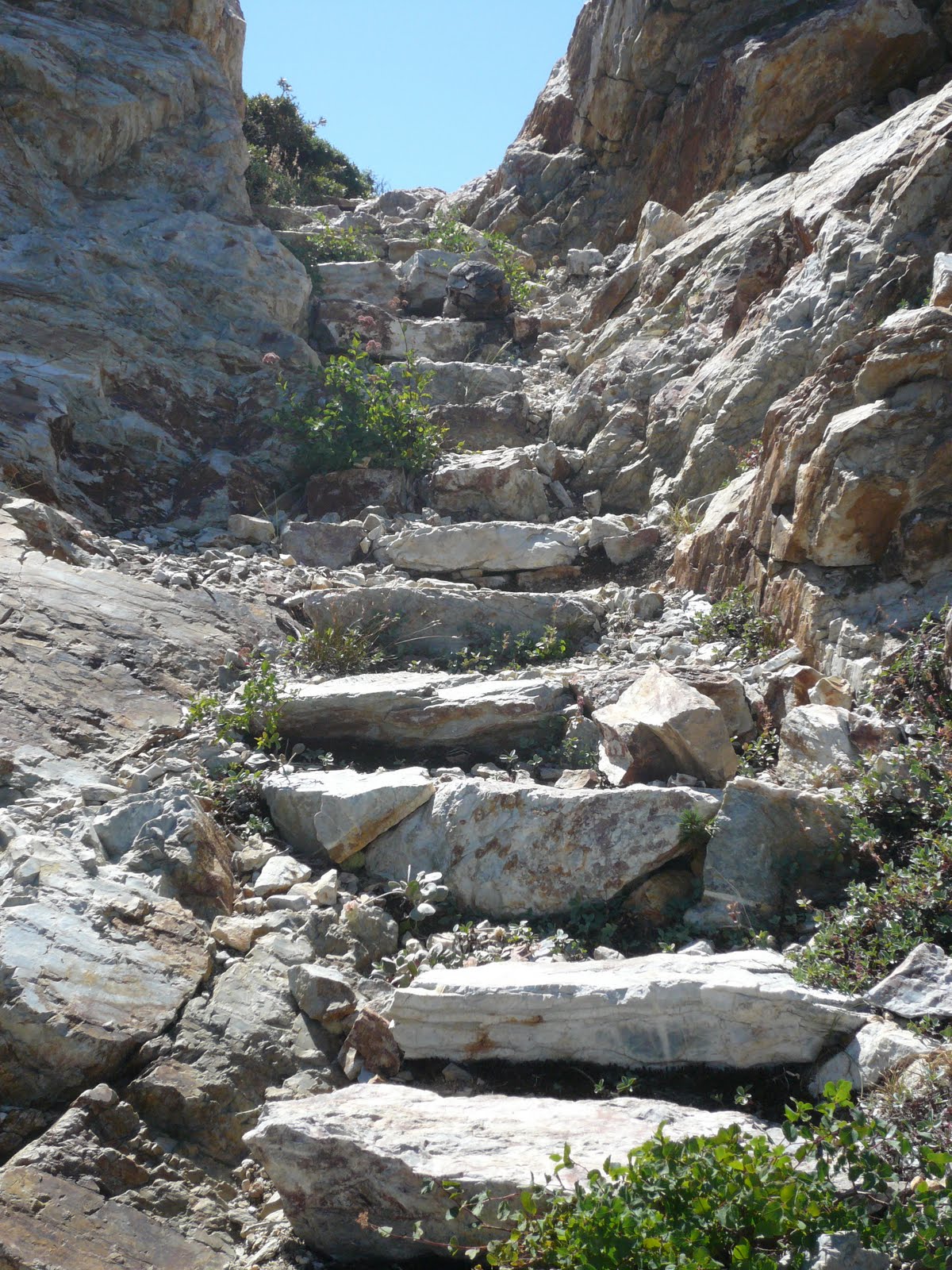
A trail coursed between the pine-mat Manzanita and climbed the slope. Long ago workers had hewn steps through a fissure in the granite.

A few out-of-breath minutes lead me to the remains of the fire lookout: A sixteen by sixteen foot splintery wooden platform perched atop solid rock.

One has to wonder how they got materials up here for this structure, and how they got them to stay grounded over the years of its use.

The view to the north included the abandoned tower at Grouse Lakes – some thirty miles away; and beyond that, another score or more, the tower on the Sierra Buttes appeared as a mere speck.

To the south, the current lookout gleamed in the mid-day sun. I stood next to the platform and waved for a moment or so, thinking Ranger John might like to know I’d arrived.

Lunch involved some dried beef and bottled water on a sun-silvered, splintery perch with a 360 degree view that most will never see. I took some notes and started back down.


BACK AT THE PUMP at Robinson Flat, I drenched my head before donning my helmet. As the vents carried the cool air through, I considered this a good ride, a good walk and a good new discovery. Therefore a really good day.


NOTE:

Photographer Keith Sutter offers some great shots of the Duncan Peak Lookout.  Find his work on line by Googling Duncan Peak Photos.

© 2011
Church of the Open Road Press