Showing posts with label Folsom Lake. Show all posts

Monday, February 1, 2016

ODE TO THE TRIUMPH THUNDERBIRD


And now for something COMPLETELY different

The autumn of my motorcycling career is about ten years off, but creaky joints tell me it’s coming.  Tossing my leg over the high seat of the dual sport equipped with panniers, on some mornings, is, at best, problematic.  And the scrunched seating position of the roadster is good for decreasing lengths of journey.  These two statements, of course, are blatant excuses.  Both the BMW and the Moto Guzzi are fabulous machines engineered for the long haul, eye catching and dependable. 

I just wanted something different.


Enter the Triumph Thunderbird.  Triumph introduced the Thunderbird model in the early ‘50s.  Purportedly for the American market, Triumph bored their standard 500cc motor to 650ccs.   Marlon Brando rode a T-bird in the 1953 classic “The Wild One.” A derivative the 650 engine became the backbone for Triumph’s signature Bonneville line.  Every kid I knew back then lusted after a Bonne.  But Honda came out with a 750cc four-cylinder bike.  Cheaper and faster, the 750-Four almost single-handedly crushed the British motorcycle industry.  BSA died.  So did Norton.  And in 1983, Triumph went into receivership and was shuttered.

The marque was revived in the mid-90s and Triumph was reintroduced to the US market.  Fast forward to 2016 and Triumph is again making motorcycles bearing some the old company’s most venerated models: the Speed Twin, the Sprint, the Tiger, the Trophy, the Rocket III (borrowed from BSA) and, yes, the Bonneville.  In 1994 the T-bird came ashore as a 900cc triple and was later discontinued.  Then, a few years back, Triumph reintroduced the Thunderbird as a big-bore cruiser.

And that’s what rests in my garage now.


The good folks at Santa Rosa BMW/Triumph made me an offer I could not refuse on a brand new last years T-bird.  I’d been eyeballing its long, low line and, a couple of times, dropped by the dealer to nestle my butt in its glorious seat and heft its eight hundred pounds to an upright position.  I’d sit on the thing, peer over the Plexiglas windscreen and sub-vocalize the roar of its massive 1700cc engine.  (My beloved ’71 Volkswagen had 1500ccs.)  Finally, because I wanted to reduce my motorcycle stable from two steeds to one, I took a test ride.  A quarter of a mile off the dealer’s lot, I knew this would be a change I’d be happy to make.

The Triumph Thunderbird is different from any motorcycle I’ve ever owned.  The folks at Triumph weren’t particularly interested in paring weight, nor did they scrimp on the chrome.  The exhaust note is deeper and mellower than what I’ve ridden before.  The thing turns heads when I’m cruising through town (as did the Guzzi) and those fellow riders on that big American bike offer their signature low-five as we pass (not that that matters.)


The first full day of ownership found me making a 120-mile loop from the Alexander Valley, over the Hopland Grade, into recently fire-ravaged Middletown.  With a twist of the throttle on the on-ramp, the bike’s torque feels as if someone has placed a hand in the small of your back and is pushing you and doesn’t want to stop.  On the “motorway” - as we Brits often refer to it - the T-Bird strums at a low gait while clipping along at seventy.  Then I engage the heel shifter – another something new for me – and click it into high gear.  The windblast over the windshield will take some getting used to, as because of my 6’ 4” height, my head is well above the bubble of still air.

The Hopland Grade, California State Route 175, is a combination of sweeping turns and tight twisting challenges as the road climbs to a crest offering views of the Russian River drainage as well as the Clear Lake basin.  On a crystal clear day, few vistas can beat it.  The bike likes sweeping turns on good pavement but I find it is less intuitive than my former BMW when the going gets tight.  Perhaps I am not one with the machine yet.

Dropping into Lakeport, I catch CA 29 and head to Middletown where, thankfully, my favorite coffee spot survived last year’s devastating fire.  Sipping some Joe on the sidewalk back of where the T-Bird is parked, two riders, heading north, eye the machine, flip a u-turn and pull in next to it for a chat.  One fellow, on a Triumph Speed Triple, comments that the Santa Rosa dealership is the best ever.  “I bought my first bike from them in the nineties and keep going back for more.”

CA 29 winds precipitously down to Calistoga, some seventeen miles south.  The big Triumph rushes through the straights and curves in a wide-ranging third gear, but I have to muscle it around when the highway becomes a series of tight corkscrews as it drops into the Napa Valley.  Again, probably due to my inexperience on the thing.  North on CA 128 the road is ideal for the T-Bird.  At fifty-five, the exhaust note is symphonic, the wind noise just right and I find myself able to enjoy coursing through the winter vineyards and gorgeous oak crowned hills.  Am I becoming one with the machine?

The first tank of regular petrol returned about 44 miles per gallon and as I park the big boy in my garage I walk away thinking that there’ll be some compromises in getting down to this bike for my one bike, but none of them are bad.  Just different.  I also think to myself, “I hope tomorrow is sunny.”

o0o

Note:  Santa Rosa BMW / Triumph is a small, family owned shop staffed by folks who take great strides to ensure you are satisfied.  They maintain a nice inventory of some beautiful bikes.  They regularly organize rides along scenic Sonoma County roadways. Know that two shop dogs will greet you in the parking lot with a demand that you rub their ears and say hello.  A visit is well worth your time.  Located in Windsor, CA (just north of Santa Rosa) you should check ‘em out at: http://www.santarosabmw.com/ or http://www.santarosatriumph.com/

© 2016
Church of the Open Road Press

Monday, February 3, 2014

THERE ONCE WAS A RESERVOIR…

The Lord raised his hands high over the course
of the American River and said “Dam it…”
…And they did.

 Impetus for the start of construction 
of Folsom Dam, 1952

The upside of an unseasonably warm and dry winter is the elongated riding season motorcyclists are enjoying in California.  The downside is drought.

Back in the early-fifties, Sacramento, located at the confluence of the American and Sacramento Rivers lay rife for a catastrophic flood.  One storm barreling up the American River complex could inundate the capitol, flood tens of thousands of homes, sacrifice countless lives and cause untold sums in damages.  The Folsom Dam, just east of Reprisa – site of Folsom Prison – would serve to protect the city, provide hydroelectric power, offer irrigation for valley farms and serve as a minor Mecca for recreation.

The story goes that upon completion, a three-year fill timeline was expected.  But an unexpected storm did, indeed, barrel up the canyon and the lake was filled in less than a year.

Through wet years and dry, the reservoir has risen and fallen at the command of those who mete out water satisfying the needs of farmers, city-folk, power companies and salmon.

Until now.


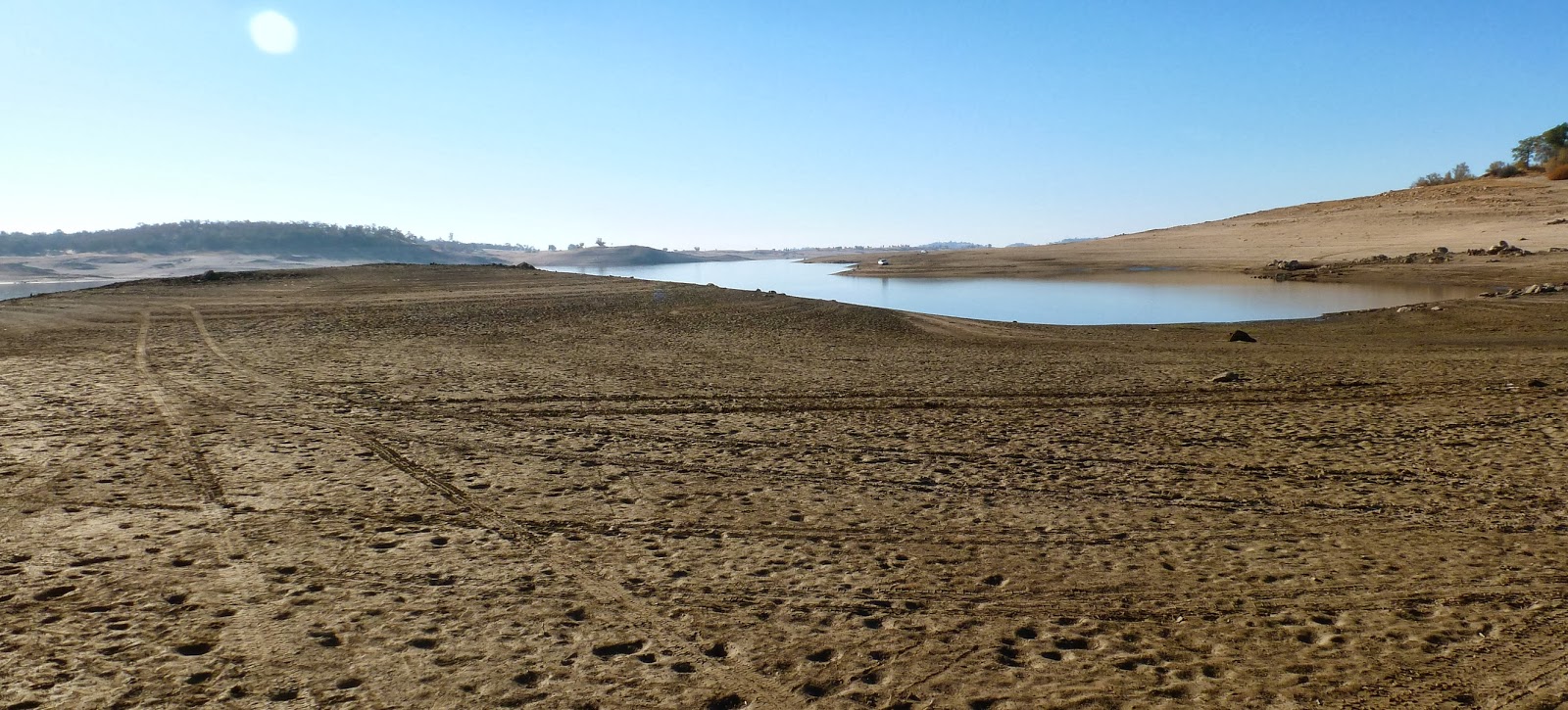
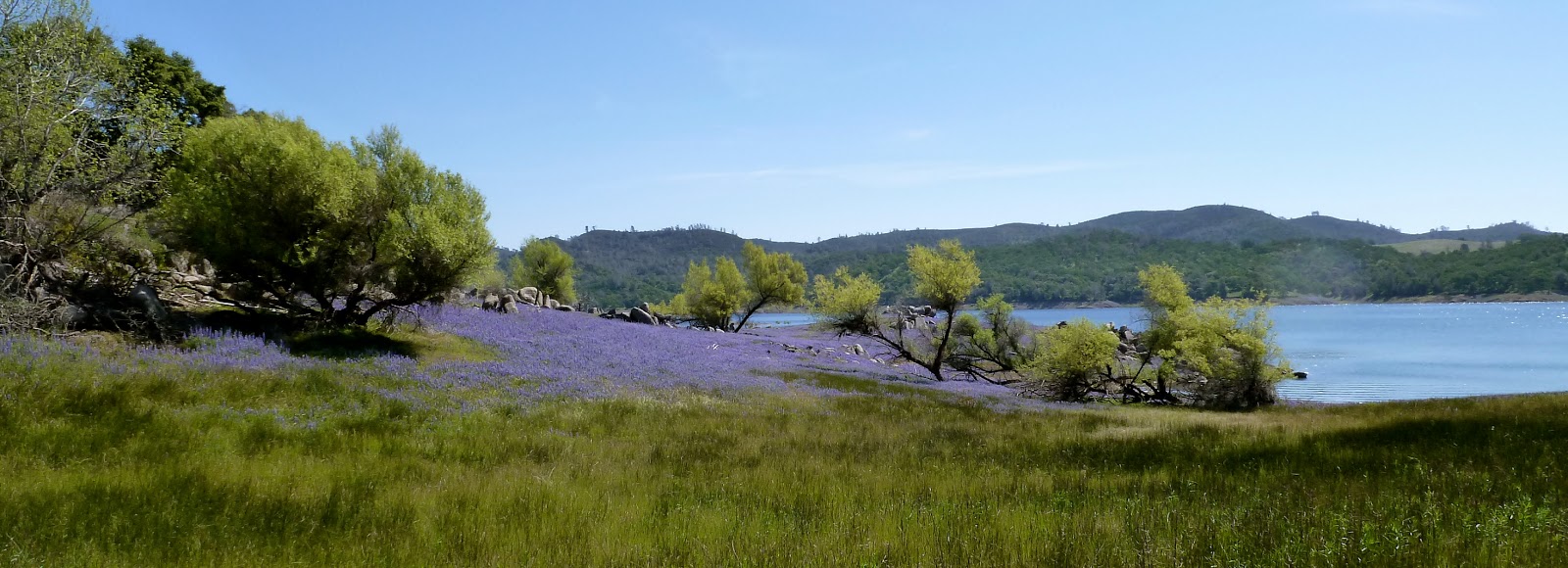
As recently as April of 2013, Folsom Lake was nearly brimming.  Along its springtime shores grew acres of Lupine.
Click on any photo to expand 'em all.

The Bureau of Reclamation makes commitments to interests down stream, and by September, the reservoir is drawn down ready to accept the upcoming runoff due to begin in October or November.

In preparation for its initial fill, the basin was denuded of plant life.  When the capacity is reduced, interesting evidence of our geologic past appears.

Boating access is stymied as the water level falls below the reach of the ramps.  But usually, not this far.

A larger than usual amount of lake bottom is exposed.  After decades under water, many of the soluble minerals have melted away.  Much of the granite that once graced the area has decomposed.

Rounded domes and outcrops remain in places – looking, perhaps, a bit more weathered than before the lake.

Some say it looks like a moonscape.  (I've not been to the moon, although I understand Alice might have.)

As the reservoir drains away, the American finds its old course slipping past gravel bars around sweeping bends.

Our history, of course, predates the dam.  And with the pool of water depleted it is easy to find artifacts of our past.  Water had been diverted into a canal on the South Fork.  A mechanism was installed to keep debris out.

Bent iron stock served as steps in the side of the dam that diverted water into the canal.

Some artifacts are easily dated.  Note that this can had both a pull-tab – outlawed some time ago – and a bar code – something relatively recent.

Others not so easy.  A busted obsidian point similar to this was spotted half buried in some decomposed granite.

Some are tricky.  A tin sign, neatly punch-lettered “Red Rock Mine” floated downstream from somewhere.  Perhaps a decade or two after the rush?

Close examination of the nails holding the sign to the log show that they are round-headed not cast square ones.  This tells us “Not quite so old…”

Whole communities lived in the canyon.  Foundations and walls, under the surface for six decades are again exposed.


And then there’s just the weird remains of those things natural and man made that set the mind to fantasy.  A Spielberg creation?

Neptune’s lectern?

Remnants of an alien craft?

A sea creature vanquishes whatever it’s vanquishing…

One wonders whether someday the old dam itself will be an artifact upon which people look back and, well, wonder.


As of January 31, the region has received 17% of its seasonal precipitation.  The lake stands at less than 15% of capacity.  Its drained carcass serves as a stark reminder that the west is arid land.  With the allure of majestic coastal vistas, verdant, fertile valleys, gold in the foothills, timber in the Sierra, winter sports and summer ones, too, it is easy to overtax Mother Nature. 

An argument could be made that we’ve done that.

Note:  If you are an east coaster with plans to escape the terrible winter you are experiencing by coming out west, please consider packing a bucket or two of ice that you can drop in the remnants of old Folsom Lake.  You probably’d be happy to rid yourself of it.  And we could really use the water.  Thanks.

© 2014
Church of the Open Road Press

Tuesday, April 16, 2013

THE LUPINE FIELDS OF FOLSOM LAKE


Click on any picture and they'll all expand.

A Sunday in mid-Spring and the dogs deserved a walk.  We headed to a nearby reservoir that had, only a week or so before, exhibited a deep and nasty bathtub ring.


Warm temps in the high country, however, had worked their magic on the snowfields and this day, the lake was brimming.

 
Parking at Beek’s (Joseph Beek being instrumental in development of the Folsom Lake Recreation Area) Bight ("bight" meaning a curve in the river or shoreline) we headed east.  [Thanks for the historic and linguistic research, Dr. Sazima.]


Impressive though the azure sky’s reflection in the pool might have been, more stunning was the acre-upon-acre veldt of blooming Douglas Lupine – Lupinus latifolius.  [Thanks former 4th grade student Scotty Campbell for the Audubon wildflower book you gave me at the end of the 1982 school year.  I still use it and think of you, pal.] 


Only a short way from the parking area, the trail finds itself splitting a field of the knee-high array.


Amidst them, almost every direction was awash in purple – although the Audubon folks call ‘em “blue.”


So dense is their coverage that it is impossible to photograph a single stalk.


The dogs enjoy this with Edward, the lab mix romping through them like a dolphin breaching the ocean’s surface over and over.  I can’t get a picture of him doing this, but we did settle him down for a group shot.


Jax the Dog, an aging Aussie and more conservative hiker, poses.


But that whole “sea” analogy begins to take hold.  Here, a wave of Lupine seems to break upon the shore and race up the embankment.


Around the bend, they encircle a granite knob turning it into a tiny island.


Next comes a Lupine lagoon.


Then there’s the remains of a miner’s flume, once used to transport water from an untamed American River to a camp or site where its power was harnessed to separate gold from sand or sourdoughs from caked filth.  Now the dissolving hull of that conveyance looks like a ship’s prow carrying eager immigrant, perhaps seas-weary Lupine to the waiting masses on the shore. 


Further on, a scene contrasts permanence with delicacy.


I wade into the middle of a stand of these things to picture them from the top and imagine, for a moment, that I am looking down upon a thick forest of purple conifers…


…while a pair of Canadian geese eye my actions and perhaps wish I’d just stick to the trail.

Returning after about two-and-a-half miles of trail, I look over my shoulder and snap a parting shot knowing that in about a week and a half, this will all be gone.


o0o

Today’s Route:  I-80 to Roseville, CA; exit Douglas Blvd.  East – but it feels south – on Douglas to Granite Bay entrance of Folsom Lake State Park.  Fee.  Continue east – now feeling east – through some nice oak woodlands to Beek’s Bight.  Give bicyclists the right-of-way.

© 2013
Church of the Open Road Press