Showing posts with label Bourbon Trail Tour. Show all posts

Tuesday, August 12, 2014

A VISIT TO ANOTHER CATHEDRAL – WRIGLEY FIELD


The grin felt welded into my jaw.  Muscles there ached, but I couldn’t release the smile.  I walked through the bowels of Wrigley feeling like a dope.  A dope with a big, beaming, uncontrollable grin.
 
Here was Grover Cleveland Alexander throwing junk.  And Tinkers and Evers and Chance completing yet another impossible double play.  Here was Ernie Banks yelling, “Let’s play two!”  And the curse of the Billy goat.  Here was a bespectacled Harry Carey leaning out of the pressbox and singing the Anthem during the seventh inning stretch.  And the Bartman incident.

“The Friendly Confines” turned 100 this year.  And thus far, never has a baseball championship been gained here.  Yet all of this is forgotten as one enters the stadium teeming with like-minded fans each imbued with short or, perhaps more accurately, forgiving memories.

I once was Mets fan.  It was because they were loveable losers.  Sure, it was easy to like the Dodgers or the Giants or the Yankees.  They were always in the thick of it, winning a pennant or ensuring that their rival did not.  But the Mets?  It was not until their seventh season that they turned in a winning record, and in their eighth, they went all the way.  In the process, they overtook these very Cubs during the last week of the season to win by only a game or two.  I was a senior in high school and no longer such a loser.  (Actually, I still was, but quite a number of blue and orange ball caps sprouted up on campus in October of 1969.)

I should have turned my attention to the Chicago northsiders right there and then.


Wrigley Field is the second oldest ball stadium still in use by major leaguers.  The oldest is in Boston.  Both are cathedrals.  And just as cathedrals in Siena and Milan and Rome are decorated with timeless frescos harbor centuries-old pipe organs calling us to bow down and revere, the soundtrack at Wrigley is organ music and the only true lyric is baseball.

Climbing the stairs and looking out on the hallowed ground, my jaw clamps tighter and my eyes wet.  Here is where the real believers worship – in spite of all evidence to the contrary.  Blue-hatted fans are friendly.  Their expectations are realistic.  Two weeks into any given season, they are heard to sigh and suggest, “Well, there’s always next year.”

Over the right field ivy-covered wall, bleachers perch atop apartment buildings on the other side of Waveland Avenue.  Even though tonight was not to be a sell out, souls dotted those seats a full eighth of a mile distant from home plate.  Believers.

A beer.  A dog.  Some chatter with fans in the row of seats behind us.  We all stood when former Cubs pitcher Milt Pappas (1970-73) led “Take Me Out to the Ballgame.”  Believers.


How the game was played didn’t matter.  Just as what might have been preached at the Sistine Chapel last Sunday didn’t really matter.  All that mattered was here we were: in a cathedral called Wrigley, surrounded by – shrouded in – baseball history. 

On this, my first and, perhaps, only, visit to Wrigley Field, the hometown boys won.  Yep.  I guess I shoulda turned by attention to the lowly Cubs back in 1970.  I’m sure their history would be different.  I’m a believer.

o0o

Notes:


© 2014
Church of the Open Road Press

Monday, August 11, 2014

LINCOLN IN KENTUCKY


A great road trip is a marriage of adventure, scenery, history and reflection coupled with good meals, sweeping curves and a visit to a local bookstore.

Travelling Kentucky’s Bourbon Trail found us in the boyhood country of Abraham Lincoln. Local history tells us that Thomas Lincoln owned farmland near Sinking Springs, where the future president would be born.  But records of the day were scant and the old man lost that property in a dispute with someone else.

Young Abe’s early home on the banks of Knob Creek reinforced those log cabin notions we grew up with.   

Scanning the pastoral draw, the National Park Service docent reports that Lincoln nearly drown in a swollen Knob Creek and that Lincoln’s infant brother Thomas was born there and died within days of his birth.

The pleasant mid-summer weather that greets us, opined the docent, belies the wicked winters that are common to the region.  One can only imagine the family of Thomas Lincoln huddled in the tiny cabin against the ice storm, praying the stores of firewood, grain and dried meats would last until the thaw.

Back at Sinking Spring, a memorial constructed on the site of Lincoln’s birthplace reminds us that from the humblest of beginnings, great individuals emerge.  The Park Service maintains Sinking Spring and the surrounding grounds.  Constructed inside a marble building similar to the memorial in DC is a replica of Lincoln’s cabin-of-birth. 

The memorial was commissioned on the hundredth anniversary of Abraham Lincoln’s birth, with signatories to the project including Theodore Roosevelt, William Howard Taft and Samuel Clemens.  The associated visitor’s center captures not only the essence of his frontier childhood but also the heart of his strength and character. 


Having assumed leadership roles during my education career, I could not avoid picking up Donald Phillips book “Lincoln on Leadership.”  A brilliantly readable text, Phillips provides context to some of Lincoln’s most sublime statements, ending each chapter with principles the President employed as he guided a tenuous ship of state through the most uncharted of waters.  His ability to translate a global picture into words easily consumed by the intended audience proved to be Lincoln’s essential gift to our fractured nation. 

We think of our times as tough.  But when we honestly reflect on the era in which Mr. Lincoln was raised and the issues with which he had to find resolution, we can’t help but regard our times as posh, in comparison, and our self-created issues and imminently solvable: if only we lifted the level of discourse to the heights touched by the young boy from Kentucky who nearly drowned in Knob Creek.

Resource:

“Lincoln on Leadership.”  Donald T. Phillips.  Business Press (a Hachette imprint – so don’t try finding it on Amazon.) 1992.  $15.

© 2014
Church of the Open Road Press
Friday, August 8, 2014

ON THE BOURBON TRAIL


Oh!  What I didn’t know about Kentucky!  What I didn’t know about Bourbon!

Annually, my wife and I get together with another couple intent upon exploring some area of the country we’ve never visited.  This year it was to be Kentucky.  “The Bourbon Trail is down that way,” said my buddy’s spouse, “and I know how much you guys like your whiskey.”

“Yeah,” I thought to myself, “but the south in the summer simply swelters, and no amount of hootch…” 


The origins of Bourbon predate the 18th amendment and the results survived it.  Unlike what I’d been told, Bourbon is not a product exclusive to the state, but it must contain a predetermined amount of a specific grain and must be aged for a predetermined minimum amount of time.  The grain is corn.  The time is four years.  But, the longer the aging, the more enchanting the result.

Now, my dad’s favorite Bourbon was Jim Beam.  He’d pedal home from the post office and pour a shot or two over ice and add an equal amount of Seven-Up.  In homage to Dad, we visited the James Beam American Stillhouse.  There, we rediscovered something we probably already knew: Distillers create many labels each made distinctive by the grain involved, the distillation process of which there are many, the charring of the barrel’s insides and amount of time in the barrel.  My go to, Knob Creek, is a Beam product.  So are some of the better brands I’ve squirreled away to mate with the appropriate cigar:  Bookers, Bakers and Basil Hayden. 

Owned by the multi-national Suntory LTD and based in Clermont, the grounds are lovely; the facility, massive; the tasting, mechanized; but the product is engaging.  Take notes.


We home-based in Bardstown, KY.  Nearby is the Willett Distillery, a much smaller operation that Mr. Beam’s.  A one-hour tour is conducted by an individual who has worked pretty much all aspects of the process, except for horsing full kegs from the distillery to the rickhouse.  Full, they weigh just a bit too much for her to push around. 

Willett employs about forty folks full-time and the overriding impression one gets is that these individual are all part of a family.  Production is a fraction of that of area competitors but the tour convinces one of the hand-made, craftsman-like efforts taken in order to ensure a unique and savory product. 

Again, Willett produces several labels including Willett Rye, a bottle of which I have in the cabinet, and Old Bardstown, a copy of which I bought when I realized we’d be home-basing in that town. 

High end (for me) and exquisite is their Pot Still Reserve.  Packaged in a French manufactured bottle shaped like the old pot still we’d toured past, this Bourbon is aged in charred barrels to citrus and honey noted perfection.  A shard of ice releases a rainbow of aromas and flavors.  Upon return to California, I hunted one down and have locked it away.


Bardstown was recently voted the most beautiful small town in all of American.  Perhaps by Bardstownians?  But an argument can be made that this little berg is hard to beat.  Bardstown boasts a quaint downtown mixing taverns and tourist shops with those day-to-day essential stores that keep the locals from straying too far for commerce. 

Dinner at the Rickhouse proved to be the best meal on the weeklong trip and two nights at the Beautiful Dreamer Bed and Breakfast could only have been improved upon had there been four nights.  Best accommodation we’ve enjoyed in years.  Across the street, at the Old Kentucky Home State Park, check out the live, open-air theatre production of Stephen Foster’s life and legacy.


Just as the fruit growing areas of Placer County, CA has its farm trail, and the wine growing regions of California, their wine trails, over the past five or six years, the whiskieteers of Kentucky’s nectar (or their marketers) have devised a route that passes travelers through hollows and pastures, over limestone enriched cricks and to distilleries both historic and modern.  Each has a pleasant setting.  Each invites pause and tasting.  Each raises Kentucky from my unjustified and negatively predisposed position of well-it's-just-the-south to a new and positive damn-this-is-good! 

I have resolved to examine my other negative predispositions – of which I have many – thanks to Kentucky.

o0o

Resources:

Bourbon Trail Details: http://kybourbontrail.com/ This site may be more marketing than substance – and, once in the area, be sure to check out those distilleries not listed.  This site does provide a nice overview of the history and process.


Bardstown Tourist Info: http://www.visitbardstown.com/

The Rickhouse Restaurant: http://therickhouse-bardstown.com/ Be sure to engage in a flight of whiskeys as part of your experience!

Beautiful Dreamer Bed and Breakfast: http://bdreamerbb.com/ The breakfasts provided by Dan and Lynell are beyond description.  Stay here!

© 2014
Church of the Open Road Press

Wednesday, August 6, 2014

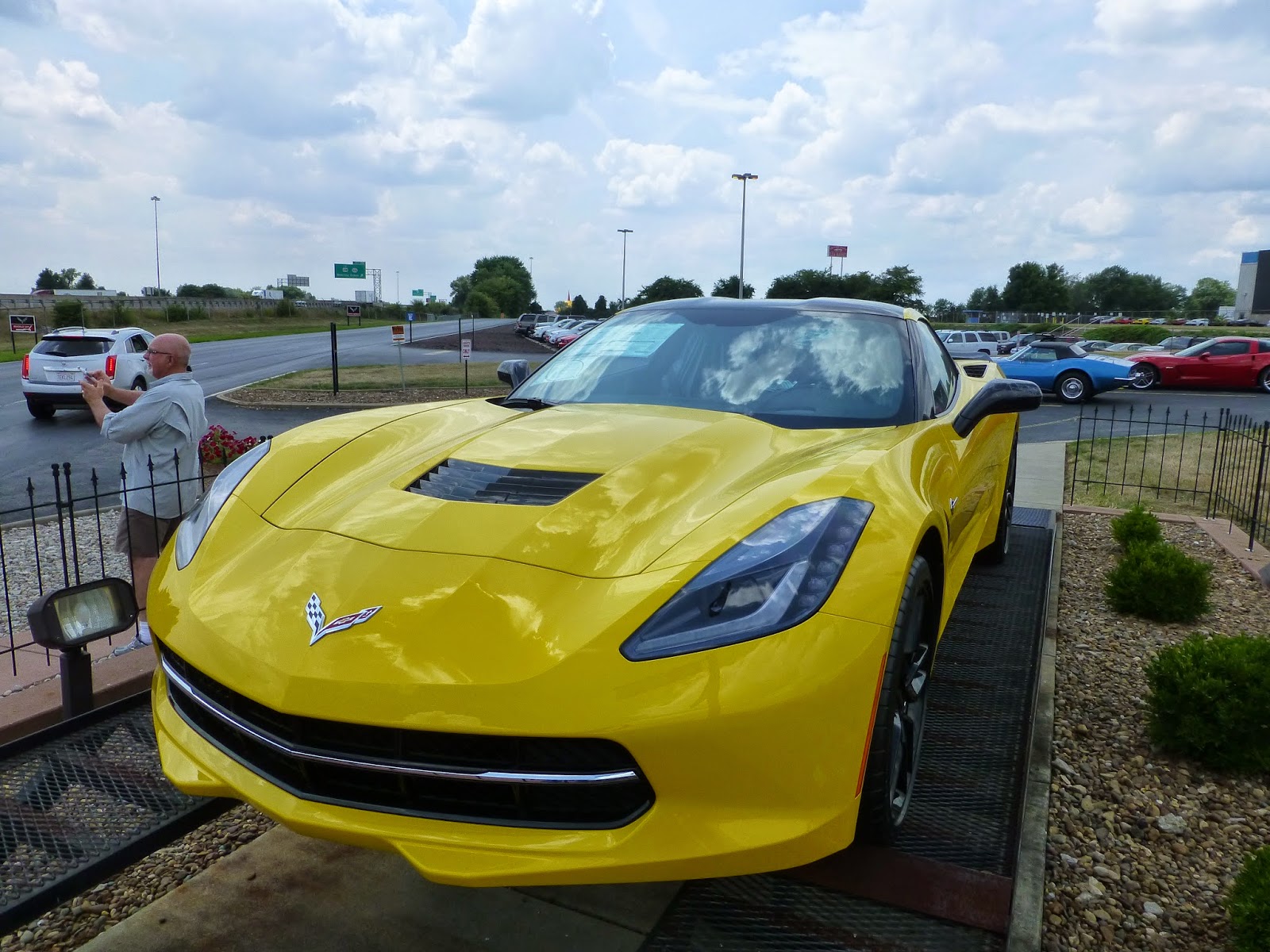
A VISIT TO THE CORVETTE FACTORY


Dateline: Bowling Green, KY.  Upon her retirement as a university secretary at CSU, Chico, Mom was presented with a two-week tour of Great Britain.  Off she and Dad flew, seeing sites and visiting places they likely would never see again.  Not Scotch drinkers – Dad, a practical man when he imbibed, embraced Jim Beam – they toured the historic Glenfiddich Distillery.  So enamored were they of the process that they somehow spirited a bottle of 12-year-old home on Pan Am.  Mom never touched the stuff and Dad still liked his Beam.  Vestiges of Glenfiddich may still remain somewhere in the house Mom has left for the grandkids to squabble over.

I’ve never considered myself a Chevy person.  

Not that Chevy’s aren’t terrific automobiles: I’d always eagerly watch the first episode of Route 66 just to see what next year’s Corvette would look like. 

But I never really wanted one.  We grew up with Fords and, later Toyotas.  I don’t consider myself a performance car guy, either.  Happy with a VW bug, a Mazda MPV, an Isuzu Trooper and now a Nissan Frontier and a Honda Civic, perhaps I inherited that “practical” gene from Dad.  So when the suggestion was proffered that while nearing the Bourbon Trail in Kentucky, we should stop into the Corvette factory, I thought, “What the heck.  It’ll only take an hour or two.”

Mere moments after I shucked down the seven bucks entry fee, my deep-seated attitude began to waiver.  After a short film, a young pre-education student from Western Kentucky U, ushered us into the factory admonishing us to refrain from picture taking and to stay within the yellow lines. 

Her play-by-play offered a concise description of that which we were observing: engines and drive trains being lowered into all-aluminum frames, painted bodies gently nestled into place, doors advancing toward those bodies in a preselected order to be installed by hand with hands that felt each grove for precise fit.  The young lady exposed how to determine whether the ‘Vette might be a fancy LR-5 (the color of the brake calipers) as opposed to an LR-1, neither being cheap, but one being a bit less costly.  Wheels and tires were added.  Seats dropped into place.  Windows installed and rolled up and down, up and down to ensure their proper function.

Musical cues sounded at various places along the line, tipping workers off to timing or a suspected problem, or – most of the time – the high degree of production success.  Workers don’t move from station to station except for in the room where the high performance engines are assembled.  In that unit, one employee follows the engine from parts to completion.

The whole operation seems a melding of technology and human touch.  Major assembly occurs by hand and is checked by hand.  And at the rate of a handful per hour, gorgeous finished products roll off the line to be inspected, driven in a wind tunnel, parked in a deluge to discover any leaks and finally wrapped in plastic to await delivery somewhere in the nation.


Nearby, the National Corvette Museum offers self guided tours for ten bucks. 

Housed inside is a collection of Corvettes dating back 60 years to the earliest version.  Stories of experimentation, design, racing, travails and successes are placed along the way.  Models I remember as new are on display – as new.  As are life-sized dioramas reminding viewers of days not so long past.

This is the place where, a couple of years back, water dissolved enough of the underlying limestone to create a sink hole in the worse imaginable place on the globe and eight irreplaceable vintage examples were swallowed.  A security camera caught the entire episode and not a single grown, male visitor passes this tape without either a gulp or a tear.

Buyers have the option of ordering a car from their dealer and picking it up from the museum.  Two were taking delivery at the time of our visit.  Another couple received the keys to a beautiful green convertible won in the month raffle.


In the span of two hours, my head was turned.  As my wife reaches retirement next June, and as our plans include doing a little road work – she’s not entirely comfortable on either the BMW or the Guzzi – a Corvette Sting Ray has risen to the top of the list of vehicles we wouldn’t mind touring in. 

Couple that with this:  Three days later, we are parking at the Shaker Village historic display outside of Lexington.  Up drives a couple with about ten years on us.  They park their ’14 ‘Vette in a slot.  Carefully they take the removable top weighing only sixteen pounds from the trunk and install it on the vehicle.  “Replaced my ’04 with this one last April.  The old one had 15,000 miles on it.  This one’s got 7,000 already,” the gentleman offered.  His wife added: “We have a Lincoln Town Car at home.  We never take in anywhere.”  Then he said: “Got 33.2 miles per gallon on the highway recently…”

My wife looked at me, dead in the eye.  Our Civic gets that on a good day.


Later this week, I’m going to trek up to Mom’s old house and see if I can find that old bottle of Glenfiddich.  With it, I’m going to sit down, crack it open and do a little thinkin’.

About a red one.

o0o

Resources:

Info on Corvette factory tours: https://www.bowlinggreenassemblyplant.com/
Info on the National Corvette Museum: http://www.corvettemuseum.org/

Note:  I realize that this tour is really a marketing ploy by GM, but it’s a darned good one.  The product is the source of fantasy for many children my age and younger, but the motoring press suggests that the price point makes it a fantasy within reach.  I’m glad I spent my two-plus hours this way and recommend the effort. 

© 2014
Church of the Open Road Press