Showing posts with label State Route 70. Show all posts

Sunday, October 27, 2024

ABOARD THE CALIFORNIA ZEPHYR (FINALLY!)

 A life-long dream come true ~ maybe

The California Zephyr has always been mythic to me. Winding like a silver ribbon up the Feather River Canyon, occasionally, we’d be lucky enough to see it as we drove California’s Route 70 in our ’54 Ford toward Quincy and Bucks Lake. Crisscrossing the canyon, if we were really lucky, we’d be crossing the river on a bridge as the train crossed above us, switching sides of the canyon. The silver beauty was always on the other side ~ always just a bit out of reach.  


The Zephyr ran from San Francisco to Chicago under the combined efforts of the Western Pacific, the Denver, Rio Grande Western and the Burlington Route. It had always been my dream thunder across our vast western expanse on this train. Alas, come the early 70s, service ended. As did my dream.  Or so I thought.


But along came Amtrak, the Federal government’s attempt to keep rail traffic alive. More successful along the eastern corridor of the United States, cross-country routes would enjoy less ridership. Yet, the Zephyr was revived. Now, however, using the historic Donner Pass Route initially carved by the Central Pacific, silver streamliners no longer grace the Feather.


 We board the Zephyr in Sacramento.


From the Sacramento Valley Station, the route winds and twists up the western slope of the Sierra with pauses in Roseville, Colfax, and, following the river courses of the American and the Yuba, cresting the Sierra on the highest trackage anywhere in the States. We enjoy a view of Donner Lake…


…before descending into Truckee for a twenty minute fresh air and, ironically, smoke break.


The route traces the Truckee River through the rain shadowed environs of the east slope of the Sierra. Conifer forests begin to give way to brittle sage and autumn’s golden grasses.  


East of Reno, we begin to get a feel for the vast and vacant high desert. Miles of that sage and mineral wealth (I suppose.)


Our rail journey will take 50 hours, several of those spent lightly sleeping in our rocking accommodation. But, as night falls, I snap this haunting image of a western sunset and wonder about the Shoshone and Paiute peoples who, for centuries, came to an understanding of that whole living in harmony with nature thing that we successors to this space don’t quite get.


Sunrise finds us coursing along the Gunnison River.


Rolling into Grand Junction, CO on the historic Denver and Rio Grande Route, we see one of many grand old stations left to decay.


A few miles of browning hills relentlessly shaped by river and wind…


…and we rumble into our first glimpse of the Great Plains.  I write ‘rumble’ because, to my untrained train butt, the Burlington Northern / Santa Fe right-of-way east of Denver seems a bit less well maintained than the UP to the west.


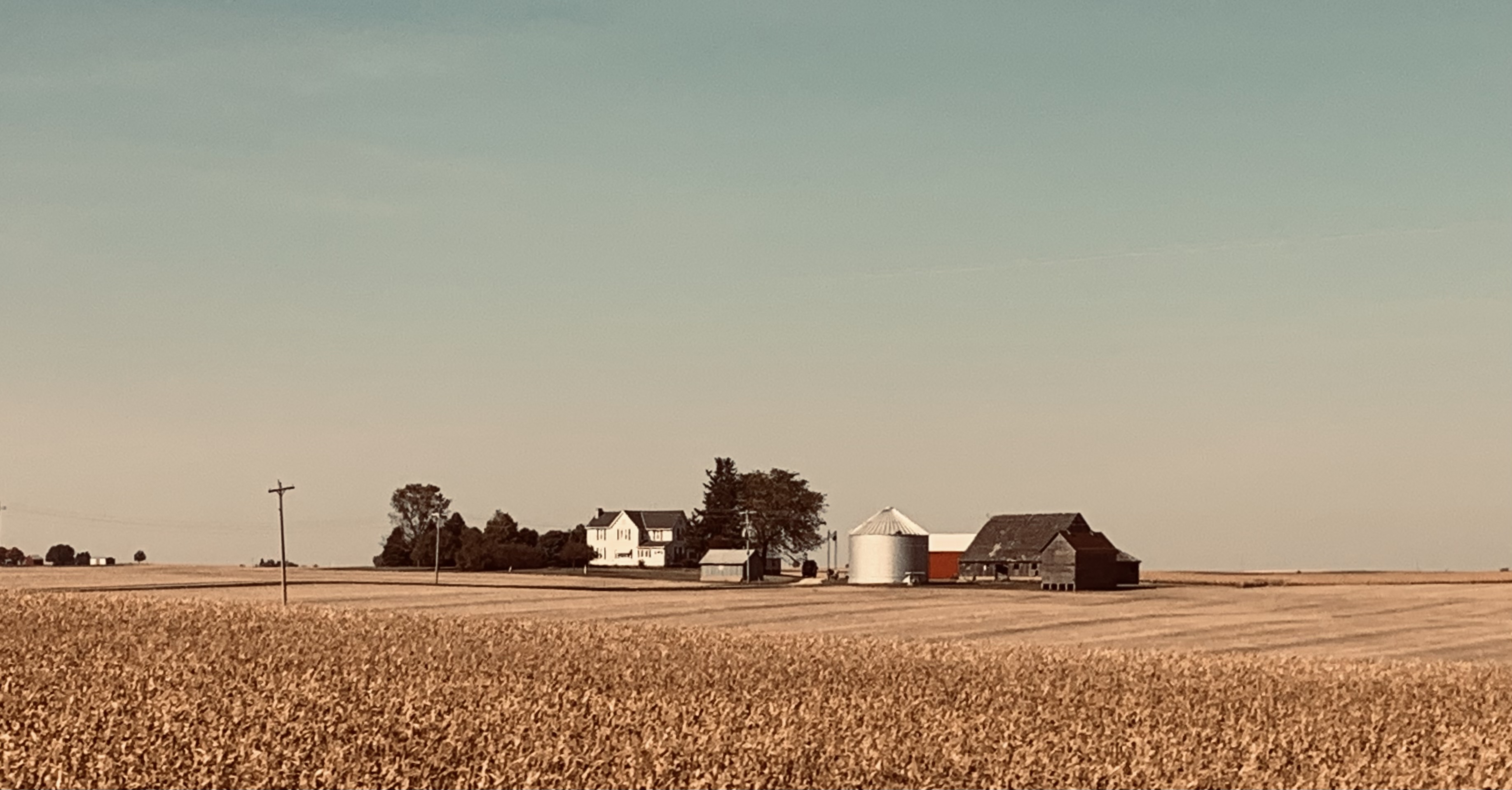
Lots of flat. Lots of grain ~ amber waves of it ~ mainly, it seems, corn. And lots of endless vistas. One can fly over this country, which we did on our return to California, and not grasp the distances, the vastness and the towns that look like nameless grids or checkerboards from 36,000 feet. We slept through all of Nebraska. 


Here’s Burlington, Iowa …


… and an aging Burlington Northern Pullman, Railway Express car and vintage loco. Glad these rolling stock examples are being preserved.


An hour or so further and an hour or so short of Chicago, this solitary farmstead captures a contemporary way of life we don’t experience on our western seaboard. And, while not wishing to wax political in this post, I believe I can understand why folks in these parts may see things differently than I do.


Chicago would be our literal end of the line. It’s where the Zephyr has always terminated. Chicago: with the ‘El’; the commuter lines to the suburbs; lines to the stock yards, steel and other industries; and the historic Union Pacific; Burlington Route; Chicago and Northwestern; and several other routes. We are informed that within the Windy City’s confines exist more miles of rail line than in the rest of the continental US combined. Rolling the final twenty minutes into Union Station, it’s a claim that’s hard to dispute.


After fifty hours on the train, I ask myself, “Did my long held dream of riding on the California Zephyr come true?”  


I recall myself in Dad’s ’54 Ford waving at passengers on the Zephyr as it wound through the Feather River Canyon. I question whether some little kid traveling up Highway 70 in the back seat of his dad’s current day SUV might be missing the opportunity to form his own romantic dreams about boarding this silver wonder and seeing where it takes him.


ResourceThe Story of the California Zephyr, by Karl Zimmerman. Quadrant Press. © 1972.  Nice historic photo and narrative about the early days of the original Zephyr. (Good luck finding a copy. You might want to check out your neighborhood model railroad shop as they often have these kinds of books.  Plus, model trains are kinda cool.  They bring back the little kid in many of us.)

© 2024

Church of the Open Road Press

Sunday, June 2, 2024

OLD HAUNT

 …first in a series of stories from a recent road trip


My pal and I powered up the roughly paved road to the Paxton Hotel about mid-afternoon.  It would be my first real visit in about 65 years.  Or would it be a visit at all?


         As we set our Moto Guzzis on their side stands, a furious looking someone steamed in our direction from a nearby cabin.  

         “Just the man I was lookin’ for,” I said before he could utter a word.

         “Huh?”

         “Yeah.  You run this place?” I asked.

         “Security and stuff,” he said.  “Who wants to know?”

         I’d unzipped my bike’s tail pack and slipped out a copy Eden, Indeed: Tales, Truths and Fabrications of a Small Town Boy.  [Available by special order through your neighborhood independent bookseller – or through that online company that starts with an A.]  “Here,” I said.


         Whatever steam he had boiled up began to dissipate.  “What’s this?

         “A book I wrote about growing up in Chico. There’s a story in there [starting on page 48] about the time Dad stopped in here for a beer ‘cause he was tired of hearin’ me and my brother squabble in the back seat of the car.”  

         Security and Stuff crimped an eye and began thumbing through pages.

         “The barkeep served up Dad’s beer and then scared the crap out of me with a story about a ghost woman who sat in a rocking chair all night.”

         The man grinned.  “That rocker’s right there on the porch.” He pointed.  “Go take a look.”  

         I climbed up the stairs and snapped a picture or two.  Frankly, the chair didn’t look exactly like or old enough to be the one in question, but I’d been seven at the time of my other visit and memories can be fuzzy.  


         “Would you like to see what they’ve done to the place?”  I wondered who ‘they’ was and how many ‘theys’ there’d been in the past six decades.

         The entrance was not as I remembered.  No shaft of light illuminated a tired wooden floor or tattered rug when he opened the door.  I didn’t see the upright piano or the moth-eaten American flag.  The filmy curtains were gone and the windows seemed to close, which they didn’t do before.  It seems a lot of work had been done and redone to freshen things up.  The bar was polished and clean – no cigarette butts filled ashtrays – and the kitchen looked commercial and modern.  

         “If you’ve got a minute, I’ll show you the widow’s watch.  You wanna see it?”

         “Sure!”  

         I was expecting to head upstairs, but instead squeezed through a narrow portal and clumped down a darkened set of stairs.  The walls had no interior plaster or sheathing, just rough two-by-fours with light slipping through cracks in the exterior planking.  The air smelled of dust and mildew aged a century or more.  

         As we clambered down, he explained: “Sorry to be so gruff up there.  This is private property and I just ran off five guys and a gal who seemed pretty high on something.  Didn’t understand the term private.  Got into quite an argument.  Made me kinda edgy.  Sheriff can’t respond too quickly in this neck of the canyon.  Distance and all.”

         We pushed through a narrow passage with a grubby, littered floor with poor footing.  Opening a door that he must have located by feel alone he said, “Here’s where they found that rocking chair.”  Then he pointed at a pair of windows that didn’t quite close.  “That’s where she was lookin’ out.”


         I stepped around a weary settee that might have survived a trip around the horn and peered through the dusty, wrinkled glass.  “You can’t see the tracks from here.  Aren’t they up the hill?”


         “Yeah. It doesn’t make sense, does it?  But this is where they say they found what they think was the old gal’s chair.”  I again wondered about ‘they.’  

         He opened a door and now sunlight flooded in.  We stepped outside finding ourselves at the basement of the grand old building.  The Feather River rushed by in the ravine a hundred or so feet below us, its current offering an age-old whisper.  Although we could see Highway 70, the old Western Pacific Line was nowhere in sight.


         He thumbed through the book.  “So you grew up in Chico?”

         “Yep.”

         “So did I.  Chico High.  Class of ’79.”  He offered a bit more bio.  Father was a lawyer.  He, himself, flew fixed wing transport until he retired a few years back and moved home.  Came to do this for lack of anything better.  Enjoyed the place and the job; not so much having to run folks off.


The Paxton Hotel is now used for special occasions like weddings and such.  Rooms aren’t available to passers-through, but we were told we could stop by any time.

         As my pal and I puttered down the road back to the highway, I wasn’t sure I’d seen the actual chair – at least it wasn’t the one I remembered – or visited the actual window where the ghost lady would rock at midnight “Waitin’, just waitin’ for her true love to return.”  

         But I was sure I’d visited an old haunt.


© 2024

Church of the Open Road Press

Friday, August 16, 2019

DESTINATION: BUCKS LAKE

…a glorious childhood haunt…

I wasn’t expected to show up.  Barbara was the last of the three great moms who cared for a bevy of neighborhood youngsters – myself included – in 1960s Chico.  The memorial gathering for her was to be held some four and a half hours away from Cloverdale.  But it was a summer weekend; Enrico, the Yamaha was due for a road trip; and the canyons and ridges, rocky outcrops and pristine lakes of Plumas County are to travel what whipped cream and a cherry is to a sundae. 

California’s highway 70 traces the rugged Feather River Canyon between Oroville and Quincy.  Pioneered by James Beckworth in the mid-1800s, it is the lowest of the Sierran crossings, though the last to see a railroad.  The highway and the old Western Pacific swap sides of the canyon as both routes pass small hydro facilities, historic whistle-stops and bergs all under gleaming granite cliffs and cool pine forests.


Bucks Lake, itself, is a high-country reservoir dotted with forest service cabins – a little known playground for residents of the northern Sacramento Valley and beyond.  


Kayaks and canoes co-exist with jet skis and fisher-boats while bald eagles and osprey circle above and black bear roam in the woods.  

The road I remember as graded dirt is now long-ago paved. Camping and day-use spots are abundant. The dam I once crossed on foot is now gated off.  I park nearby and walk back to the cabin I’d last visited decades ago.

Barbara, the neighborhood mom, had battled dementia for quite some time, but family made efforts to see that she would spend weekends at “the lake” almost until the end.  It was her happiest place.  

Looking out a picture window, I recalled splashing on the beach, the smell of Sea-n-Ski, sandwiches wrapped in wax paper washed down with Cragmont sodas, and my failure to master the sport of water skiing.  Barbara was laughing and splashing and skiing right along with all the kids.  Happiest place, indeed.


My return home would be a different route.  East of Quincy, a the LaPorte Road winds from Route 70, crossing a diminished Middle Fork of the Feather then climbs Buzzard Roost and Gibsonville Ridges, past the alpine head waters of the South Fork. Each turn offers another breathtaking view.  

August-spring wildflowers carpet the high, cool meadows and it feels as if I am riding through the ground floor of heaven.  

Further west, the LaPorte Road routes past historic mining and lumbering villages – some little more than place names.  Sixty miles on, I am driving through the dry, 95-degree grazing land of the Yuba foothills outside of Marysville, wishing I were back at Bucks Lake reveling in the cool breeze rising off the water.

The day before, when I had entered the cabin, I worried that I wouldn’t be able to identify the neighbor-kid-now-cabin-owner I hadn’t seen in perhaps forty years.  He stood and called me by name.  “Greg,” I said, a bit breathless from climbing the granite stairs to the house, “this still is among the most beautiful places in the world.”  Greg took my shoulders, turned me around to look out that picture window with the stunning view of water and forestlands crowned with fair-weather clouds.  Then he pointed to the hand painted sign above.  It read: “Welcome to the most beautiful place in all the world.” 

© 2019
Church of the Open Road Press

Friday, May 18, 2018

RELIVING HISTORY ON THE RAILS


A visit to the Western Pacific Railroad Museum
in Portola, Plumas County, California

The Western Pacific Railroad was organized on March 3, 1903.  The first spike was hammered in 1906.  On November 1, 1909, the last spike was driven on a steel bridge over Spanish Creek near Keddie, California. 

The WP became the all-weather transcontinental route cresting the Sierra at Beckwourth Summit some 2,000 feet in elevation lower than the Donner Summit Route chosen by the Central Pacific some forty years before.  According to Norman W Holmes in his book “My Western Pacific Railroad,” it is the route the Union Pacific would have selected as they built their line west had not the Big Four and construction engineer Theodore Judah chosen the Donner Route out of Sacramento for the CP.

Today, tracing the historic line of the WP along California’s State Route 70 offers the rider (driver) a spectacular journey up the Feather River Canyon – complete with granite cornices, tumbling water, picturesque trestles – out across glorious high-country meadows and pristine pine forests, and into the subtly beautiful Basin and Range.  From Belden to Blairsden (great pizza place in Blairsden) the route is dotted with quaint villages and towns.  If you haven’t driven Highway 70, do so.

And along the way, be absolutely sure to visit the Western Pacific Railroad Museum (WPRM) in Portola.  The museum is maintained by the Feather River Rail Society for the express purpose of keeping alive the history of the ol’ WP.


Here are a few shots of what you’ll find:


Volunteers have collected aging rolling stock some of which dates back nearly 100 years. 


What cargo may have passed through this door?


How many times did this hinge squeak open?

The collection of diesel locomotives is beyond expansive.  Many hold the fading livery of one of the WPs four paint schemes.  Others represent lines the WP purchased during its heyday like this Sacramento Northern road switcher. 


I recall watching this very engine roll up Main Street in Chico when I was a kid (often colliding with automobiles driven by motorists who mistakenly thought a 100 tons of locomotive and freight could stop any time soon.)

This yard unit spent its final years near Quincy working a short line associated with a lumber mill…


… but a close up look at the aging paint reveals that there is likely a bit more to its history.


Looks sorta like an interesting quilt square, now doesn't it?


Although the grade was only 1.2 percent or less, the WP used their Portola yards as a point where extra motive power was released after the pull up the canyon from Oroville.  A shop was built here early on but abandoned when maintenance operations were consolidated to Stockton.  Decaying with busted out windows and without power, the building came into the hands of the non-profit. 

Here, the volunteers have established displays including road signs…


…and cargo.


They also use the shop as, well, a shop.  Currently, a steam locomotive is undergoing restoration.

Staffed mainly by volunteers, one gentleman we spoke with gave new meaning to the term “Postman’s Holiday.” A three-trip-per-week engineer on the UP line from Sparks to Elko, he lives locally and spends his weekends and vacations working on the antique equipment and visiting with wayfarers ensuring that the history of the WP is not lost. 

Back out in the yard, this monster caught my attention…


…as did this remnant of the California Zephyr, the supremely elegant passenger service that, having earlier left Oakland, CA, snaked up the Feather River Canyon on its way to Salt Lake and beyond. 


I remember Dad driving us up the canyon simply so we could get a glistening glimpse at the Zephyr, always thinking, if only…


But my visit to the museum was about to get better.

Behind the old shop, we hear this electro-motive diesel freight unit roar to life.  A cloud of exhaust that, normally, one might avoid, this day smelled like a slice of heaven from by-gone days.


Inside, Charles, a retired steam-fitter is ensuring that all the controls – forward drive, neutral, reverse; brake lever, air horn (two longs, a short and a long when approaching a grade crossing), the bell switch, the forward light and the rear – are operating.


Then he motions me to the engineer’s seat, points down the line and says “Give ‘er two short blasts on the horn and start movin’ forward.”


I operated old number 917 (circa 1950) for over an hour.

If only happened.  I’m still giddy about it.

o0o

Notes:

The Feather River Rail Society, curators of the Western Pacific Railroad Museum, is a valuable resource worthy of our support.  Here’s their link to our digitalized present: www.WPLives.org

My Western Pacific Railroad, Norman W Holmes (Feather River Route engineer) Steel Rails West Publishing, 1996.  This volume contains a concise history of the WP.  The historic photos are fun – as are all old railroad photos to me.  The perspective of the author – a guy who actually ran the route – is unique in the world of rail fan publications.

Lastly, Gumba’s Pizza in Blairsden: http://www.gumbasfamily.com

© 2018
Church of the Open Road Press

Saturday, April 13, 2013

RETURN TO TABLE MOUNTAIN

While much of the country is just shaking off the mantle of snow and ice that is a rugged winter, out here on the left coast, we are about half way through spring.  An annual trek I take is to visit the display of wildflowers carpeting Table Mountain outside of Oroville in Butte County, California.  I’ve done it on every motorcycle I’ve ever owned beginning with that Honda Trail 90 back in 1970.  And I’m never disappointed.

This day, the road through Cherokee which “backdoors” the flat top of the mountain was dry and clear and travelled by a least a couple of motorcycle clubs as well as a group of vintage British sports car enthusiasts.  While it is said that the journey is as grand as the destination, it’s tough to suggest that the destination itself wasn’t pretty damned grand.

A relatively dry spring has rendered the creeklets across the top of the basalt mesa pretty impotent.  Yet they provide enough sustenance for a nice display of whatever these little white gems are that grow along the banks of the rivulet. 

Exploring the area, I find myself walking on a carpet of clover – clover abloom with dainty pink blossoms.  Each one I want to savor and not step upon.  Each one making me glad I stopped at this popular place to stretch my legs a bit.

Cattle country, this has become, since the gold played out 150 years ago.  Intrepid ranchers attempted to carve up the land by wire-fencing sections planting wooden posts into a basaltic hardpan that must have required dynamite in order to pierce.  Eventually the hand-hewn posts rot and the once-taut wire lies across the top of the mesa.

Underfoot, acres of lupine stretch in all directions.  Where the environment is just so, a cluster of owl clover may rear it’s beautiful head.

Poppies tend to seek the sunnier, drier locations…

…while a Monkey Flower has found a home in the middle of a seasonal stream course.

Atop the dry, chunky basalt, an alligator lizard hopes to be overlooked.

On this April Saturday, flocks of people enjoy this renowned locale.  The further one ventures from the parking area on Old Cherokee Road, the less dense the number of visitors.  Here a hiker and her companion explore a verdant hillside looking so much like someone you might spy in the amongst the heather in some Irish musical.

Through some sort of cooperative venture, the public is allowed to explore this rangeland.  Port-a-Johns are set up at a parking area from which trails branch out in all directions.  But no matter where one hikes, they are always beneath the watchful eye of a bovine sentinel or two.

Table Mountain affords a delightful display of wildflowers as well as a commanding view of the northern portion of the Sacramento Valley.  The best times to visit are from mid-February to mid-April depending on the season’s rainfall.  Folks traveling State Route 70 northeast out of Oroville would do well to plan on an hour’s saddle respite up this way.

o0o

Nearby Oregon City Covered Bridge
Today’s Route:  State Route 70 to Oroville; exit Grand Avenue.  East on Grand Avenue; left on Table Mtn. Blvd.  Right on Cherokee Road (a couple of blocks.)  Cherokee Road twists up through basaltic draws.  Six or eight miles on, a parking area is evident.  Return:  Continue on Cherokee Road to the old Cherokee town site – consider taking a stroll through the historic cemetery.  Continue north-northwest to State Route 70.  Left takes you back to Oroville.  Right leads up the incomparable Feather River Canyon to Quincy through the northern-most reaches of the Sierra.

© 2013
Church of the Open Road Press