Showing posts with label Home. Show all posts

Saturday, November 30, 2024

THE OLD UPRIGHT

 …tickling the eighty-eights? The tradition continues…


In about 1944 at age 22, Mom ran away from home which had been Houston, Texas. She planted herself in Glendale or Pasadena. Her first purchase of any consequence was a brand new Knabe ‘upright grand’ piano. “They’re the best made!” Mom said, and although the Steinway folks might disagree with her on this particular proclamation, Mom was never wrong.  So, I believed her. 

         Mom’s Knabe was hauled from pillar to post in Southern California, and ultimately to Chico where Brother Beebo and I would practice scales and etudes on it. Well, Beebo did. As a little kid, there weren’t too many hills I was willing to die on, but not practicing the piano would be one of ‘em. Mrs. Scotchler, first and later Mrs. Chamberlain both ultimately threw up their hands and told Mom not to bother bringing me back for lessons.

         Mom’s old upright probably weighed a ton and a half. Its walnut finish was nearly black and the keys were capped with real ivory. Although I wouldn’t actually play the thing, I did like opening the front and watching the hammers hit the taut harp wires inside as I ran my fingers up and down the keyboard. This was especially fun when I’d prop open the front and then put Susie, our Siamese cat, on the ivories and watch her rocket across them, leap to the floor and tear out of the room to hide in a closet somewhere.

I never really learned to play the piano. My stubbornness and stupidity won out (as it often does to this day). But I could pick out a tune by ear using my right hand for the melody while pounding chords with the left. That only works if I stuck with the key of C. No black keys necessary.

As Time Went By (apologies here to Dooley Wilson), I grew up, left the house, got married, got divorced and never had a piano. Occasionally, I’d stop by Mom and Dad’s and sometimes I’d sit down at the keys and plink something out. I’d turn and find Mom leaning in the doorsill and when she knew I saw her she’d say, “Don’t you wished you’d have practiced for old Doris Scotchler?”


Shortly after that divorce, and still wincing from it, I found myself at a dinner hosted by a local California Teachers’ Association chapter. Tables lined the so-called ballroom at the Holiday Inn and I sat in a folding chair next to and opposite other teachers, none of whom I knew.  

Across the table was, as I recall, a rather attractive woman, about my age, who opened the conversation with: “If you’re not really careful, I bet we’ll be playing footsie before this event is over.”

I was aghast. For two reasons. One: having married way too young, I never engaged in whatever footsie was. Two: fresh off failure, I was certain one thing leading to another would only leave the woman thinking “What’s up with this guy?” This presupposes that I had any idea of what ‘one thing leading to another’ even meant.  

I drew my size 14s under my chair and hoped whatever they were going to serve us would limit the need for small talk. But small talk ensued and as we chatted, I discovered she was ‘between relationships’ and that she was housing an upright piano that her former mate or boyfriend had rescued from the First Baptist Church on Salem Street just before they tore the building down. “I don’t play the damned thing. It’s huge and all it’s doing is collecting dust,” she reported.  

The old First Baptist Church housed the very Sunday School from which Beebo and I played hooky in our youth, so I said: “Would you take hundred bucks for it?”


Brother Beebo was a freelancer. He owned a trencher for digging foundation footings, chopped wood like Honest Abe and, best of all, moved pianos. And now I had a job for him.

         The house I bought after the divorce was on East Eighth Street, the inbound lanes to Chico of State Route 32. Footsie Woman, it turns out, lived on a cross street a couple of blocks away. Beebo, judging the effort necessary to load the old upright into his pickup for a two hundred yard transport had a better, more practical idea. Carefully lifting the treble end of the behemoth, he slipped his piano dolly under the middle and gently set it on the floor. Using two planks, he nursed the thing from her porch, across the walk and onto Alder Street. Finding the crest, he turned the unit and headed north toward 8th. When traffic was clear, he bulled the assemblage into the middle of the State Route, pivoted it, and pushed it the block-and-a-half down the highway to my address. Passing traffic slowed as many had likely never seen an old upright piano being manpowered in the middle lane of a major through-way before.

         Within about twenty minutes the old piano was resting in the new-to-me living room at 788 E 8th. Beebo hustled back to pick up his pickup. Meanwhile, I plinked out a tune with my right hand a feebly created chords with my left.  Shortly, Beebo arrived, cracked open one of my PBRs and said, “Don’t you wish you’da practiced when you were a kid?”


In the forty-plus years I’ve owned the piano, it, too, has moved from pillar to post: Chico to Soulsbyville; Soulsbyville to Sonora; Sonora to Roseville, then Rocklin then here. Early on, in an effort to strip and refinish it, I disassembled the cabinet finding remnants of color crayons, raffle tickets, and a tattered picture of the baby Jesus with some lambs opposite the words to “Jesus Loves Me” which I learned myself to play.

         Now, the old Baptist upright resides in my studio about five feet from my elbow as I type this.


Yesterday was Thanksgiving and after decorating the Christmas Tree, grandson Hudson – about 13 – pulled up a chair and began more than plinking on my piano. Apparently, he’d captured some music from contemporary movies or TV programs – tunes and melodies and musical literature I hadn’t heard before. His right hand and his left hand played beautifully in concert with one another from what I could tell. 

But then he launched into “Carol of the Bells.” I swiveled in my chair and watched him command the instrument until my eyes clouded with tears. That damned old thing had never sounded so good and I thought to myself:

         Don’t you wish you’da practiced when you were a kid?

© 2024

Church of the Open Road Press

Tuesday, May 5, 2020

MY SUNDANCE KID MOMENT

I needed cash.  
Fistfuls of it.
"You comin'?"
Nod.
We saddled up and headed to the bank - well - credit union.
Clouds gathered as we sauntered along.

At the great glass door, we paused.
"You comin' in?"
"Nope."
"Good. Keepin' an eye out?"
"Nope.  Social distancing."

A red bandana draped around my neck.
I pulled the cravat over the bridge of my nose and entered.
Thunder clapped as the door cracked open.
A sudden downpour chorused behind me.

Glancing this way, then that, I advanced on the teller.
I slipped my debit card from its holster and slid it across the counter.
"Cash," I snarled. "Twenties."
Her eyes met mine.
She knew I meant business.

In a twinkling, a wad of (5) twenty dollar bills lay in front of me.
The teller thanked me...
...and called me by name.
So much for the mask, I thought.

Exiting, I found my partner drenched.
"What in the heck happened to you?"
"Raindrops," she said, "fallin' on my head."

As we sauntered home, I wondered:
Would that teller have been so cordial to Butch or Sundance?


(c) 2020
Church of the Open Road Press

Saturday, March 14, 2020

BUILDING THE MODERN CRICKET STOOL

…I take a stab at making furniture…

Growing up, I recall that we had a little cricket stool in the house.  It was nothing like this…


It was constructed of maple and finished to look like all of the other wood furnishings Mom and Dad (well, probably Mom) had picked out.  Sixty-five years ago, the little sitter was just my size.  I recall, many, many times, tipping it over and pushing it around the braided rug until Mom caught me.


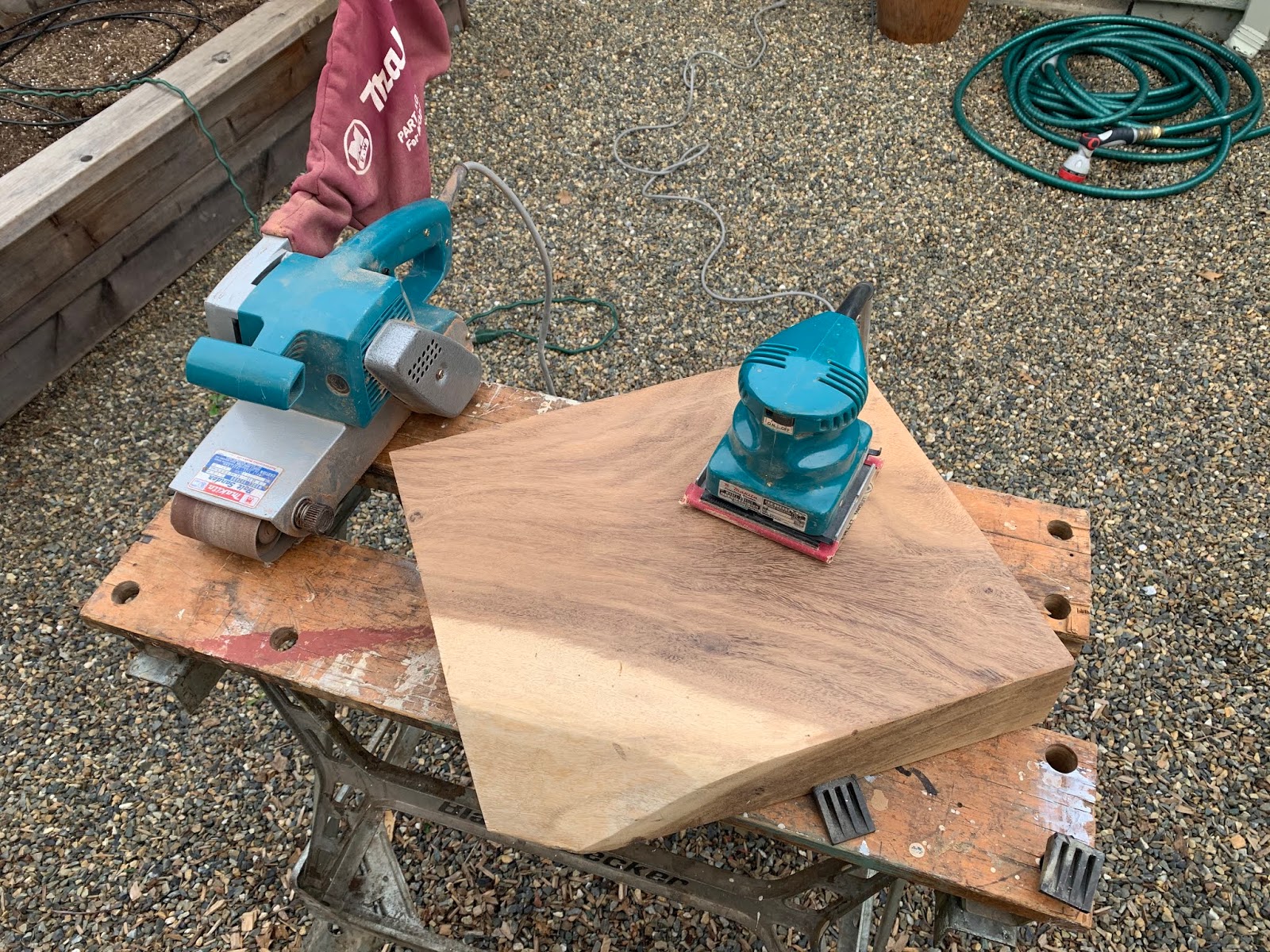
I found myself thinking of that little stool when I ended up with two scraps of Central American Parota, left over when craftsmen finished a new mantel for our rebuilt fireplace.  “You want me to save the excess?” the craftsman asked.  “Sure,” I said, but I didn’t know for what.


After the mantel was installed, the two scraps of exotic sat taking up space on the workbench.


One piece was about three inches thick and a little more than an odd-shaped foot square.  The other was 3 x 3 x about 10, with a nice array of grain and a pleasant little curve to it.

Perhaps if I sanded them down a bit, I’d get inspired.


In my forty years of owning a Makita belt sander, I’d never mastered its use. The helpful hardware man down at Ace offered a brain-dead simple tip and I was off to the races.


I learned what a dowel-screw or a screw-dowel was.  I purchased one.  Now I had 65 cents invested in this – for lack of a better descriptor – wood sculpture.  Now it had better work out!


Twisting the post-like piece into place, it became clear that, with two other legs I could have me a milking stool – or better yet – a cricket stool!

I applied a first coat of teak oil – because that’s what I had on the shelf – and watched the grain pop into strata of dizzying earth tones.


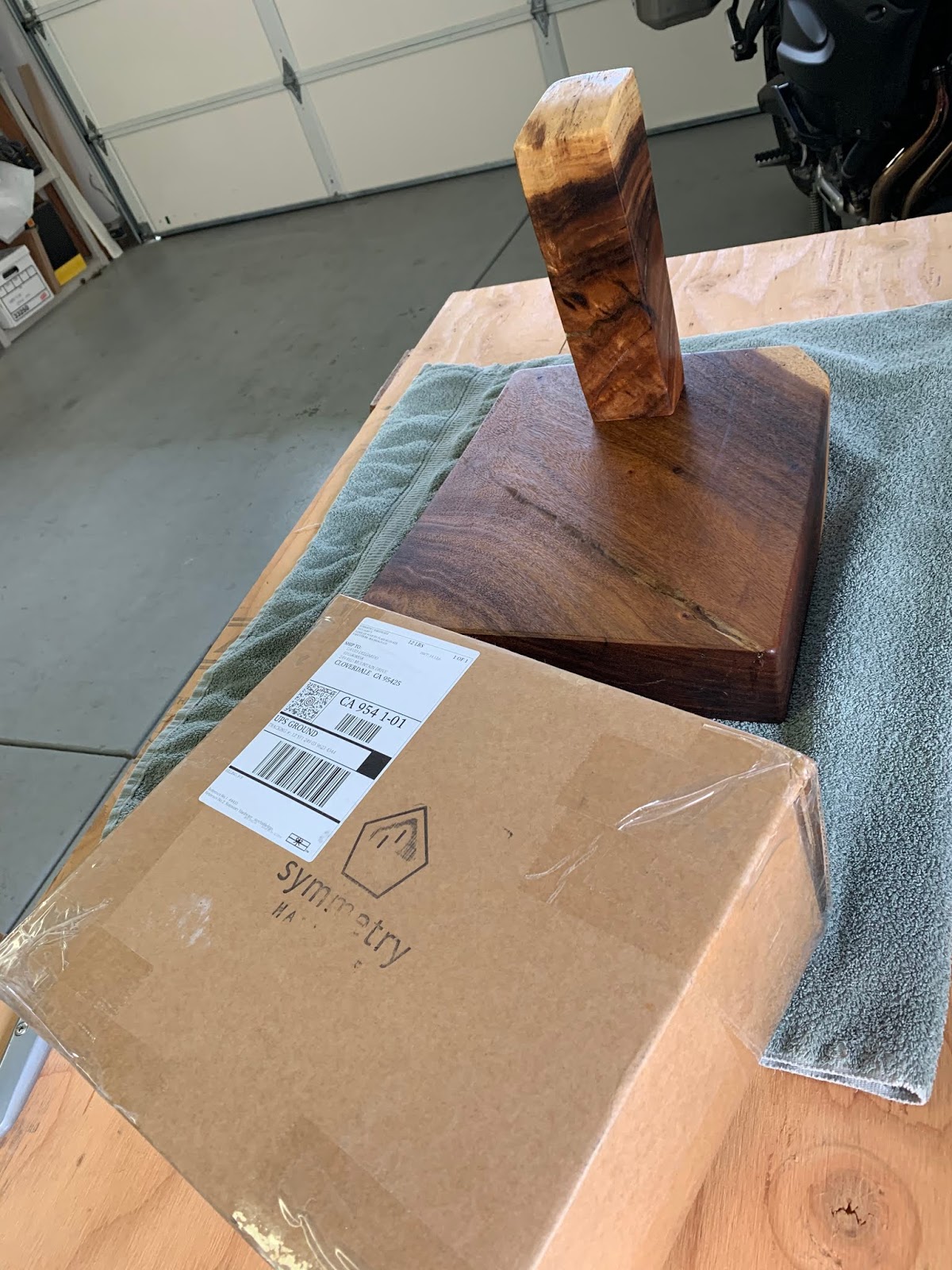
Getting three legs to be just so for this project was going to be a challenge, so I looked up the outfit in Portland that fabricated some picnic table legs for me a while back.  Their website offered exactly what I needed.  


Four weeks and a hundred and twenty-four bucks out of pocket, the UPS man delivered ‘em yesterday.


In the meantime, I’d added a second soaking of teak oil.


I didn’t want to use the galvanized hardware provided, so I high tailed it down to Ace and bought five bucks worth of black machine screws and washers.  After all, this was to be fine furnishing. Right?


Assembly would be easy.  (I used my magic Phillips screwdriver.  Note how it stands up on its own. Magic!)


The finished product turned out rather nicely standing on its own two (or three, depending on how you count them) feet.


It weighs about thirty-five pounds, however – much more than that old maple cricket stool of yore.  It’ll take a brutish two-year-old to push this thing around the house.

I took one final shot of the project – in use – but only for illustrative purposes so the reader could get an accurate perspective on size.


Again, strictly for illustrative purposes.

o0o

Notes:  Petaluma, CA boasts a great business called Heritage Salvage.  One could spend a good long time just perusing their collection of hand-hewn oak timbers from 140-year-old Amish barns, or derelict redwood staves from the old water tank that served Tahoe City.  And slabs not only from redwood trees but from a root-rotted stump of a tree planted by Mariano Vallejo nearly two centuries ago.  They custom mill, cut and finish the piece you can’t live without and don’t seem to mind folks like me wandering through…. https://heritagesalvage.com

Symmetry Hardware in Portland, Oregon fabricates and finishes steel legs.  I’ve used their services for a couple of my projects.  A small business that will consult with you and does excellent work, it feels really good to use this source rather than a big-box store.  Plus, I got exactly what I needed for this little project.  Check ‘em out: https://steeltablelegs.com

© 2020
Church of the Open Road Press

Friday, February 28, 2020

COUNTING THE UNSHELTERED AMONG US

…there is no singular, simple solution;  
but the solutions that exist involve all of us…

Forgetting, somehow, that the figure “5:30” could be followed by the letters “AM,” the Church of the Open Road participated this day – well, this dawn – in the Northern Sonoma County “Point in Time” count of unsheltered homeless folks.  This bi-annual census, mandated by HUD, gathers raw data that will be used when allocating funds to municipalities, counties and area non-profits.  Guided by Chuck, a homeless individual who lost his apartment when rent was ratcheted up after our local fires, we visited both camps (where folks are residing) and sites (where folks have been but are now vacated.) 

Four teams scoured our little town; each responsible for one of the town’s four voting precincts.  While, in our precinct, we were able to account for only four individuals, Chuck tells me that there are probably 40 to 50 living in our zip code.  That doesn’t include those couch surfing or staying in shelters.  Nor does it include minors living with non-parental relatives or family friends.


“Reach for Home,” an advocacy group out of Healdsburg facilitated today’s count matching volunteers, such as myself, with unhoused guides like Chuck.  The folks I met proved to be generous, funny, knowledgeable (Chuck identified both rock samples and plants as we hiked along the Russian River for a mile or so) resourceful and tough.  They share concern for one-another, and they embrace those new to being out of the fold.  They graciously accept the help offered from those of us who, many times, are not in their circumstance only by the so-called Grace of God.

The causes of homelessness are many and varied.  Folks on the street are not all on drugs, are not all criminal, are not all mentally challenged, and are not simply ne’er-do-wells.  Although the homeless population contains elements of each, mainly these are people who benefit from a hand up and are not asking for a handout.  There is no singular or simple solution; rather, the solution, the answer(s), the "fix," will involve all of us.


This side note:  A former mainstream Protestant minister coordinated our activities this day.  He left the ministry when he found it easy for his upscale Southern California church to raise funds for their building and congregation but balked at the prospect of needing to feed the 5000.  Since departing the ministry, he says, his work with the non-profit arena is much more fulfilling.

I would suggest that he still is in the ministry.

© 2020
Church of the Open Road Press
Wednesday, February 26, 2020

BACKYARD STANDOFF

…life in the wild kingdom…

It was a pleasant, early-spring afternoon and I’d decided to sit out on the back patio with a good book and a glass of what we’ll call lemonade.  Absorbed in whatever I was reading, my concentration was shattered by a pronounced thump over my shoulder followed by a furious whoosh of wing and feather swooping under and out of the patio’s overhang.  The thump, I recognized.  Another little gray bird had collided with our window, probably knocking himself silly.  Setting down the book, I set out to find his pulsating body somewhere figuring I’d end up unceremoniously depositing him in the compost bin.

Searching low and then high, in the branch of an overhanging black oak, I spotted a small raptor of some sort, head pivoting toward me, then toward something else: our shared quarry.  I moved behind the heavy stucco pillar.  The LGB wasn’t on the concrete or in the gardening shelves. He wasn’t in the planter, either.  Settling back into my chair, I could observe the rust-colored hawk shifting on the branch.  The LGB must still be near and the little hawk – with better eyes than mine – must know where.  After a time, I returned to my chair and picked up my book.  


Almost immediately, the raptor fluttered down from the oak and took up sentry on the edge of a raised bed planter.  The eyes on birds are located on the side of the skull rather than the front.  While this affords the predators a wider field of vision in order to spot a scurrying field mouse or errant sparrow, it means they must tip their heads one way, then the other, to see what’s directly in front.  Head tipping left, then right, the rusty hawk kept an eye on me, but also kept an eye on a bonsai hemlock hidden from my view by the pillar.  Investigating, I found the LGB had taken stock-still refuge in the dense foliage of the hemlock.

So, it was to be a waiting game.  The hawk – it turned out to be a Sharp-shinned, according to my Peterson guide – paced on the edge of the raised bed.  The little gray bird – birdbrain though he was – knew his best action would be no action.  Time ticked slowly by.  Patience… Life or death concentration…  More patience…

I don’t know what distracted the little hawk, but more focused than the hawk on the quarry was the quarry itself.  The exact moment was marked only by a rustling of the hemlock’s branches.  In a blink of an eye, the little bird was gone into the woods over the fence.  Confounded, the Sharp-shinned, flew up to his vantage point in the black oak.  And I’m sure I heard him mutter, “Next time.”

In the early 60s, Marlon Perkins, curator of the big zoo in St Louis, had cause one day to visit my next-door neighbor in Chico, California.  The neighbor had owned a small circus for a time and Perkins had stopped by for a chat about lions or tigers and to cool off with a mint julep or two.  Mr. Perkins grinned at me when I hopped over the fence.  He rubbed my red head and asked, “What part of the wild kingdom do you come from?”

I thought about this little exchange after the standoff in my back yard between the hawk and the LGB and realize that part of the Wild Kingdom exists right here in Clover Springs.

© 2020
Church of the Open Road Press

Saturday, February 2, 2019

THE SEARCH FOR EDWARD’S CROSSING

…a backyard adventure…

After an evening of drenching rain, a walk in the woods near our house seemed in order.

The brook, we find, has grown almost to creek size…


…and the trail – groomed though it is – is wet and slippery.


Bay leaves, accentuated by the moisture, offer their distinctive fragrance…


…and the madrone reach skyward, slick and shiny.


Sonoma County trail volunteers had recently widened and manicured the network of trails created by those of us who’d trespassed the area – even to the extent of adding stout and substantial bridges.


Now, I’m told by an acquaintance of mine who happens to be mayor – mayors are easy to meet in small towns such as ours – that the trails committee is seeking names for the paths and points of interest in the area.  

Edward and Candi chug up the trail, looking for that special place – the place Edward clearly enjoys – where he can wade and splash while we, the people in his entourage, try to negotiate a creek crossing on available rocks.


A section of the route clings to the edge of a wash-out.  One false step would surely be painful.


At last, Edward finds the old spot where he’s frolicked in the cascading rill – the place we’d named Edward’s Crossing – now bridged by a… well… bridge. I’m not entirely sure how he feels about this improvement.


To my acquaintance or the trails committee, I think I’ll suggest the appropriate name for this place whether Edward likes the new bridge or not…

© 2019
Church of the Open Road Press

Monday, October 29, 2018

OUR PERSONAL PATH TO SOLAR POWER

…energy for free and the ‘history’ behind it…

We have decided to install solar panels on our house.  Here is a little background: 

Genesis 1:3 tells us “And God said, Let there be light,’ and there was light.”  [ESV page 1]

But there may be more to the story.  Some time between November 1946 and February 1947, a Bedouin shepherd named Mohammed edh-Dhib discovered a scrap of papyrus in a cave on a riverbank.  The fragment turned out to be part of the Dead Sea Scrolls.  


This priceless discovery opened the world’s eyes to secrets that had been lost to eons of dust and time.  It was translated first into Bedouin, then several other Fertile Crescent languages, and finally into English about a decade later.  After painstakingly looking at so much history and culture described in this antiquity, researchers were stunned by a singular passage.

The Scrolls revealed what the Lord actually said in Genesis:

Let there be a main sequence star that generates its energy by the nuclear fusion of hydrogen nuclei into helium and that can thereby provide light for the eyes of my people and warmth for their comfort.”


Perhaps the long-accepted Biblical translation was simply an abbreviation of the Lord’s pronouncement given that 20 centuries before Guttenberg, they were chiseling scriptures into clay and “Let there be light” pretty much covered what needed to be said at the time.

But the discovery of the entire text shocked – SHOCKED! – some Biblical scholars of the mid-fifties.  Many were loath to admit that the Bible might have an inaccuracy. Others argued that making this change to the text of the most widely read book in the history of mankind would disrupt the pagination for the next several thousand pages.  Thus, the finding was suppressed.


But a trio of precocious and curious Junior High boys named Calvin Fuller, Gerald Pearson and Daryl Chapin, somehow got wind of this new ancient wisdom.  They coupled this information with their recollection from the previous summer when they were left in a shadeless parking lot in the backseat of one of their mom’s cars – ironically, a ’56 Oldsmobile Starfire – while the mom shopped at a Sears store for some new capris and rubber zorries – what we now call flip-flops. (You can look all this up.)

For their Eighth-Grade science fair project, the three created the first solar voltaic cell which was able to capture energy from the sun to turn a small windmill.  Amazing though this was, their project came in second to a model of a volcano that simulated eruption when lemon juice was poured onto a pile of baking soda.


But the solar industry was thus born and now – regardless of all of the balderdash written above – some fifty-five years later, we want to be a part of this non-polluting, renewable energy revolution.

© 2018
Church of the Open Road Press

Tuesday, September 27, 2016

CONFESSIONS OF A NON-FITNESS GUY (AND HIS BICYCLE)


New life comes from the old Peugeot

X-rays of my troubled right knee show the doctor that it isn’t quite time yet.  “Tone up the muscles.  Stretch.  Do some non-impactful exercises.  Go to the gym and ride the stationary bike.”

“I have a stationary bike,” I reply.  So I make a commitment to go out on the back patio and ride the thing ten to twenty minutes a day just after rising in the morning.  My commitment lasts less than a Middle Eastern cease-fire.  Why?  Boring.  The view of the back fence from the patio never changes.  I guess I’ll just settle for a bum knee.


Rummaging around my garage, I frequently move my old Peugeot ten-speed because it’s always in the way.  If I move it from in front of the shelves, it’s blocks the workbench.  If I move it away from the workbench, it blocks the door.  Some times I just lean it up against the side of the house.  If it weren’t for the sentimental value, I often think, I’d donate the damned thing to the nearest charity.

Then recently, as I’m rolling the bicycle out of my way to access a shelved box of nails or screws, an inkling inkles: Riding the old ten-speed around the neighborhood and into town, might be just as beneficial and non-impactful an exercise as cranking on the stationary bike for ten minutes at a time.  And the view would change.

I pump up the gum-walled tires and hop aboard. 


Our neighborhood is relatively flat, but on the Peugeot, even the slightest downhill is a rush.  With no more than about fifteen turns of the crank, I’m a mile from home passing the coffee bar, not breaking a sweat and my knee feels great! 

Three or four cyclists are there, outfitted in form-fitting pants, garish cycle-centric nylo-fiber shirts with big empty front and back pockets and velo-ads plastered all over them, and helmets. 

Even though my cargo shorts and ball cap headgear looks as if I just stepped off a road grader or out of a retirement neighborhood, I stop for a cup of dark roast.  One of the fellows says, “I used to have one of those,” pointing to the bike I’ve had since college.  After me not contributing to their conversation about their latest “run out to the coast (66 miles),” I mount up and head home. 


Did I say we lived in a relatively flat community?  The four-minute glide into town is a fifteen-minute grind back into the neighborhood.  Rusty in my use of the derailleur, the chain stutters and jerks as I search for the ratio that will allow me to pump my way back home.  I concentrate on staying on the seat as opposed to falling forward onto the steel crossbar that looks – from directly above – menacingly similar to one I painfully recall from a very early incident of my bicycling youth.  Finally, I reach our driveway, gently touching the toe of my shoe to the ground.  I wait there straddling the seat, while my breath catches up with me.  It seems it was about a block and a half behind on the final climb to the house.

Yet, the following day, I do it again, modifying my route and lengthening it a bit.  I want to check the construction progress on the new Renner gas station going in just south of town.  I decide to pick one gear and stay in it whether I’m whizzing along a flat stretch of road or pushing myself to get up the hill.  I don’t stop for coffee.  I do twenty minutes.

On the third day, I add a bit more and tackle the hill that fronts the Hamburger Ranch Barbecue joint.  I enjoy that becoming-familiar rush by coasting down the other side past storefronts and into town.


I’ve ridden the old Peugeot on a daily basis for longer than the most recent, ill-fated Syrian cease-fire lasted.  I’m up to between thirty and forty minutes, exploring neighborhoods and country roads, viewing hillside vineyards, paralleling the old railroad line and using the paved path next to the Russian River that we’ve walked many times. 

I’m packing my camera now.  The scenery is much better than the view of my back fence. 

The other day, I saw an old Ford Ferguson tractor rusting in somebody’s front yard.  It was like the one upon which I learned to drive.  


There’s a great “stairway to heaven” leading up to the oldest part of the town cemetery.  


And the Northwestern Pacific right-of-way has all manner of eighty-year-old railroad memorabilia and clutter. 


My knee is wrapped and on ice as I type.  And as I type, I plan tomorrow’s little itinerary. 

© 2016
Church of the Open Road Press