Sunday, April 2, 2017

FOILED WILDFLOWER RIDE: A CONSPIRACY OF THE ROAD GODS


…skip one good riding day
and you’ll always be one behind…

Somebody’d reported yesterday that there were acres upon acres of California poppies carpeting the rolling hills along 128 in the Yorkville Highlands.  Perhaps there’d be lupine, too.  Either was good enough to set me on a renewed Saturday ritual.   


Back the Subaru out of the garage, center the big Triumph, give it a thorough spring cleaning – it could sure use a bath…


Polish this beauty until I can see my reflection in the paint and the chrome blinds innocent passers-by.  Then set off to check out those flowers.  At least that was the plan.

After backing the Sube onto the street, I automatically, and needlessly hit the down button for the garage door opener and entered the house without hearing the BANG!  Ten minutes later, armed with a bucket of warm water and a bundle of soft towels, I hit that button again.  Buzz.  Nothing. 

And again.  Buzz.  Nothing.

I pulled the release to manually raise the thing.  Wouldn’t budge more than a couple of inches.  And when I let go, the door slammed back to the floor.  My fifteen or more minutes of trouble-shooting and WD-40 brought me no closer to a solution.  Bang!  Buzz.  Bang!  Bang!

The cacophony drew interest from my bread-baking wife indoors.  In seconds, she pointed at something above the garage door and asked:  “Does that spring always look like that?”


It’s been a longer-than-usual non-riding season.  The weather gods had dumped record amounts of rain on northern California this winter and the medical gods put me on the DL for six to eight weeks recovering from some knee work.  So when the weather turned very, very nice, and word was afoot that the hills were carpeted in wildflower burst, I didn’t need any additional encouragement.

California’s State Route 128 heads west from US 101 at Cloverdale twists over a rugged volcanic ridge and into Mendocino County (where the pavement is much better) before dropping into the Yorkville wine-growing region.  There, wide sweeping turns invite an easy throttle and thanksgiving for spring riding days such as these.  Boonville is a nice waypoint for coffee.  And there there’ll be that carpet of poppies.  Plus if I choose to motor further, an hour will see me touring the spectacular California coast along highway 1.  I’m due!

Well, maybe not.  The T-bird is trapped.


According to the video, changing the tension springs on a garage door is about a one-hour task.  It requires few tools and just a bit of safety precaution.  Parts are less than $150.00 and the company is now custom-making the springs to the specification I ordered.  With enhanced shipping, the kit should be here by the end of the week.

Just as those poppies and lupine begin to fade.

o0o

Notes:  The tension spring video:


…and it turns out, the garage door can be opened manually – it takes two people to do this – but the busted tension spring will not allow the thing to stay open without the application of some remedial physics.  I’m leaving things status quo until the parts arrive.  Makes for a better story.

But, I did manage a wildflower fix by hopping on the old Peugeot - better therapy for the knee, anyway - checking out offerings in our small downtown and it’s hinterlands.  Thus, these:

Showy loco – perhaps

Red bud

Desert star – maybe, maybe not.

Something yellow

Vinca – beautiful, but invasive: not native to the west

Lupine

California poppy


© 2017
Church of the Open Road Press

Friday, March 17, 2017

EMPLOYING THE TRIUMPH THUNDERBIRD AS A TOOL FOR KNEE REHABILITATION


A St. Patrick’s Day therapy session

In the forty days and forty nights since they worked on my debrided right knee, Northern California had experienced rainfall that would cause Noah pause.  Because I couldn’t heft the big Triumph, the fact that the weather was marginal for riding didn’t cause similar pause for me.

But then, the weather turned nice.  Highs reaching the 70s.  Skies purely blue or only dotted with fluffy, white clouds.  Sonoma County’s network of curving roads cresting verdant rises, dry and ice free.  The California poppies would be blooming.  And the doc said I should “spend time on a bike” to rebuild strength in my knee.

In the garage, then, I straddled the Triumph and pushed the starter button.  If the thing fired up – it had been six weeks since last I’d ridden it – I’d give some thought into taking a short spin to test out my repaired joint.  That “some thought” took about a second and a half.

Dang!  The ‘Bird looked good when I pushed it out to the street.

I headed south on Dutcher Creek Road toward the Dry Creek Valley, Lake Sonoma and beyond, stopping many times for photos, as, I figure, getting on and off the cruiser would be good therapy for my knee.


The paper reported that just last week, the growers in the Dry Creek area were enjoying bud break.  In the parlance of viticulture, the term “bud break” has nothing to do with half time during the Super Bowl.  No, it means that the growth cycle has been renewed and we sure as hell hope there won’t be a late season hard freeze.


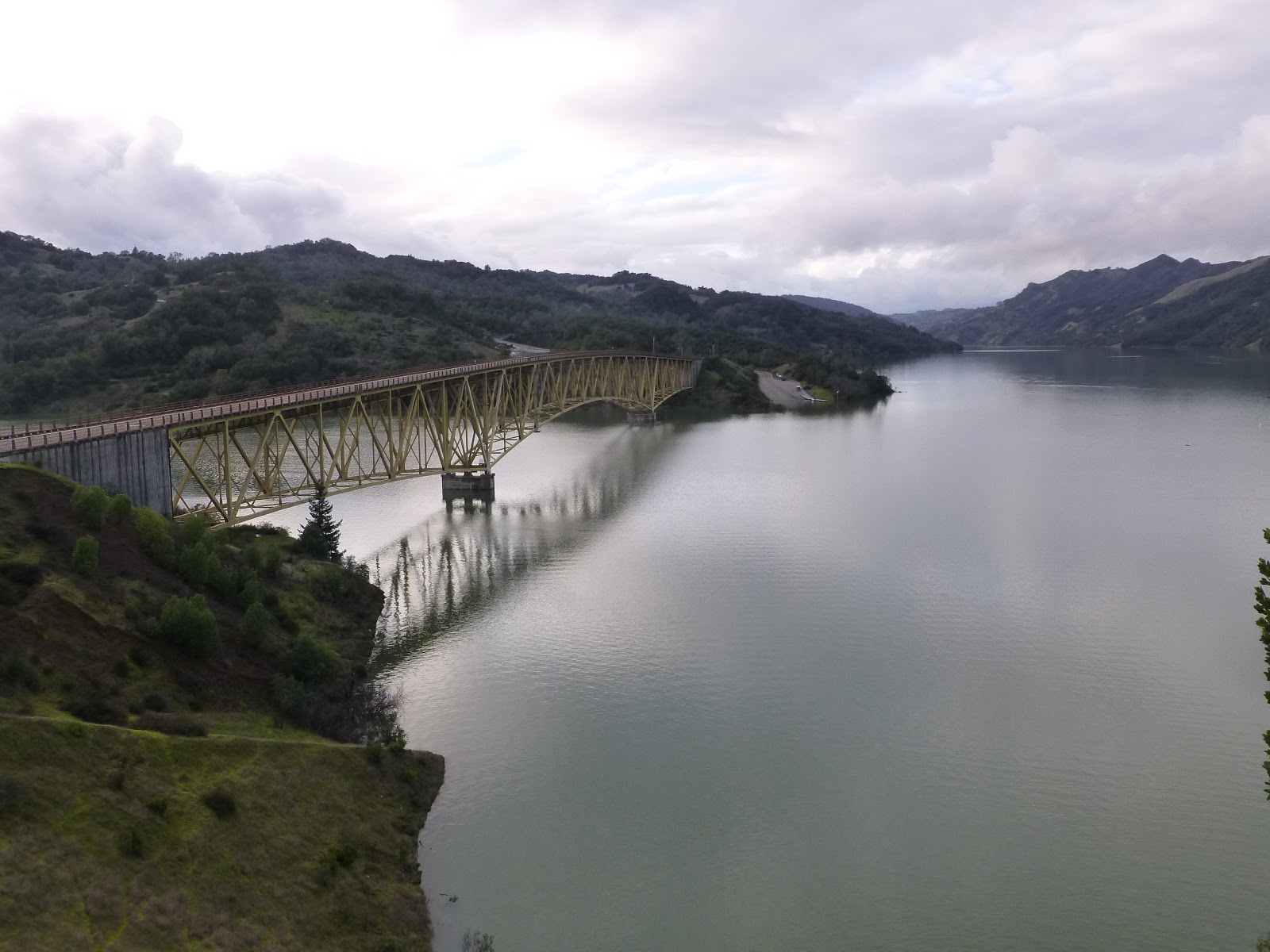
Dry Creek is dammed at the west end of the valley.  Lake Sonoma provides irrigation and domestic water as well as miles of hiking trails and a little used 14-mile dead end called Rockpile Road, a route that crosses the reservoir on a massive bridge.


Rockpile Road threads the ridge that separates the two arms of Lake Sonoma, passing through the Army Corps of Engineers administered recreation area and into a viticulture area identified as – surprise – Rockpile.

The road is little used – it is gated about twenty minutes in – so traffic is generally limited to the ranchers and farmers who work out that way.  


The pavement is grand with sweeping curves and sections that arc over one summit, then the next, reminding me a bit of Montana’s Beartooth Pass, only more temperate, less traffic, and with better wine locally available.


But, with ample warning, it ends.


Abruptly.


I pedal the Big Blue backwards on the pavement, arranging for myself enough space to hoist the thing around.  This is when I discover that one knee works and the other knee works not so well.


Using the guardrail to flex and relax said knee, I view the green hills – St. Patrick’s Day green hills – that lie beyond the pavement’s end.  Credited to Luther Burbank is the statement, "I firmly believe, from what I have seen, that this is the chosen spot of all this earth as far as Nature is concerned."  


Today’s ride out and back on Rockpile Road supports his contention.


It’s been an hour and a half on and off the Thunderbird and the bum knee feels not so bum.  I’m torn between making a longer day of it, risking fatigue, and just heading back to the barn.

What could I do to enhance this already glorious day?  Then, at US 101 and Lytton Springs Road, a solution presents itself.


Tacos al pastor and a beverage perched on the seat of the bike. Just like lunch on a real road trip.  What could be better?


A Modelo Especial sounded particularly good; if only I’d not been on the bike.


Catching the freeway north, I settle in for a ten-minute blast toward home. I’d been out of the saddle too long, but the big Triumph remains as comfortable and forgiving as I’d remembered it.  I was glad for today’s glorious weather and thankful that the Biblical rains we received happened while I was under in-house confinement orders. 

o0o

Note:  Upon returning home, I reviewed notes from the doc who worked over my knee and discovered that when he said “bike,” he meant:


not:


o0o

Today’s Route:  Exit US 101 at South Cloverdale Blvd, head west.  At the first intersection (landmark Starbucks, Sinclair Gas, liquor store, abandoned antique store across S Cloverdale) turn left heading away from town.  Somewhere along in here, the road becomes Dutcher Creek. Pass the Fritz Winery two miles southwest (stop in if you have a moment) and continue for a total of about six to Dry Creek Road.  Right on Dry Creek to the end of the valley.  At the spillway, turn left – your only choice – on Stewart’s Point Skaggs Springs passing Lake Sonoma the Visitor Center (stop in if you have a moment).  Continue up the hill about three miles.  Stewart’s Point Skaggs Springs will exit left, but you’ll want to continue on what is now Rockpile Road, over the big bridge and west for another dozen miles or so.  Return?  Retrace.  Consider following Dry Creek Road six or seven miles east into Healdsburg where you can hang out at the town’s square like the area glitterati.

© 2017
Church of the Open Road Press

Tuesday, March 7, 2017

HAP’S CLIPPINGS AND PIX


A journey into early aviation, art
and a little-known grandfather

Minor knee repair and poor weather has me off the motorcycle for a few weeks, and boxes of Mom’s memories have been stacked in the corner of my den for too long.  No time like the present, I suppose…

Sifting through her stuff, I find an ancient box designed to once hold a ream of typing paper.  Scrawled on the end of the rapidly deteriorating lid are the words: “Hap’s Clippings + pix.” 

E W Bagnell was my mother’s father.  Known as Hap to me, but others referred to him as Cap or Bobby, I knew very little about him other than that he was designated an Early Bird, wrenched on Lindbergh’s Spirit of St Louis, and later took up oil painting.  And he smoked Lucky Strikes.  We moved to Chico in 1957, he followed, lived with us for a year and then departed for Oakland’s Veteran’s Hospital where he died at about age 68.

Opening that ragged box of “clippings and pix” revealed some hidden history…

This from the Glendale Independent, Sunday, August 2, 1953:

NEW ART GALLERY OPEN IN OFFICE OF INDEPENDENT

Works of prominent Glendale artists will be exhibited beginning tomorrow in the city’s newest gallery, the large modern office of the Glendale Independent, 122 S. Maryland Avenue…

…Chosen to be the first exhibiting artist is E W Bagnell of 510 California Avenue, an artist member of the Art Association and a member of the Business Men’s Art Club of Los Angeles…

…The Bagnell exhibit, hung for the month of August, includes 18 oil paintings, the featured canvas being a portrait of the artist’s mother, Mrs. Elizabeth Bagnell, 93 [which currently hangs in Mom’s bedroom in Chico, CA]; and “Kings Ranch Rodeo,” from the private collection of Mr. and Mrs. M O Johnson, and loaned for the opening of the gallery…

…he had professional studios in Houston, Tex. And in Pasadena…

[Bagnell] is a pioneer in aviation and is among the early flyers that enjoy the distinction of the title “Early Birds.”* He was a captain in the Army engineers during World War I.

In his pioneering he helped build one of the earliest airplanes, sponsored by the Nebraska National Guard, and laid out Kelly Field, now Kelly Air Force Base in a cotton and mesquite field on the old Frio City Road just outside San Antonio, Tex.

Other early air ventures were test piloting for Curtis Airplane Co., and commercial flying in Mexico.  Then he and Capt. Ralph Taylor were sent by the Aero Club of America to Washington DC, with an airplane, which was set up on the Polo Field behind the White House to stimulate interest of Congressmen in airplanes, then a novelty.

Through those early years in aviation and in the Army he had little time for painting.  But he is now making up for lost time and his paintings on display in the Independent gallery are evidence of his talent and accomplishment…

Other clippings tell more of his story…


Among the other artifacts uncovered searching through Mom’s memorabilia is a model of and the patent application for a devise that when dropped into the steel pipe casing of a spent oil well, with a mechanical twist the unit can expand to press against the casing’s interior so the pipe can be craned out of the well for re-use.  Early recycler?


Also discovered: two prototype electric toothbrushes – he didn’t get the patent application on these – the works of which were encased in Bakelite.**


I pour through this trove and think of the man I barely knew.  His Army adventures began a century ago this year. 

His work in the aviation industry saw him piloting an exotic Italian tri-motor…


…and flying folks hither and yon.


Clearly, he had other adventures, however…


…and a bit of a reputation…


Hanging over the piano in my den is one of his oils called “Splitting Headache…”


…the last oil he created before he went to Oakland.

o0o
Notes:

*Early Birds Membership was limited to those who piloted a glider, gas balloon, or airplane, prior to December 17, 1916. The cutoff date was set at December 17 to correspond to the first flights of Wilbur and Orville Wright. 1916 was chosen as a cutoff because a large number of people were trained in 1917 as pilots for World War I.[2] Twelve of the aviators were women.

Hap’s name is embossed on a plaque in the Smithsonian’s Air and Space Museum along with the Wrights, de Havilland, Sikorsky, Glenn Curtis and others.

** Bakelite is one of the first plastics made from synthetic components.  Bakelite was used for its electrical nonconductivity and heat-resistant properties in electrical insulators, radio and telephone casings and such diverse products as kitchenware, jewelry, pipe stems, children's toys, and firearms.

© 2017
Church of the Open Road Press

Saturday, March 4, 2017

“On the Road with Janis Joplin” – a review


by John Byrne Cooke
Berkeley Press (division of Random House/Penguin)
© 2014 - $17.00

Rock music leapfrogged over me.  Mom wouldn’t let it in the house and I was loath to defy Mom.  So all the great groups, the Stones, the Dead, Jefferson Airplane – you know ‘em, I don’t – I missed out on, although I could give you most any lyric from “Oklahoma” or “Guys and Dolls” and know Sinatra’s songbook pretty well.

Fast forward to about 1992 and I’m attending the Jackson Hole Western Writers Conference in hopes of becoming a something I didn’t have the tenacity to become.  It’s Fourth of July Weekend and I find myself sitting on a hillside at the Snow King resort, drinking a beer, eating a burger, watching fireworks and hearing them boom and echo off the darkened mountainsides; and chatting one-on-one with one of the presenters:  John Byrne Cooke.

John is a talkative guy – perhaps a bit more so than other authors – but with good reason.  He researches and writes on interesting topics.  His trilogy “Snowblind Moon” (Tor 1986) tells the remarkable saga of Native American life on the plains during the time between the Fetterman Massacre and the events at Little Big Horn.  “South of the Border (Bantam, 1989) posits Butch Cassidy’s return from Bolivia.  “The Committee of Vigilance” (Bantam, 1994) is a novel centered on the raucous quest for law and order in gold rush San Francisco.  In 2007, Cooke published, “Reporting the War” (Palgrave MacMillan) a treatise on press freedom during American conflicts from the Revolution to our current War on Terror.  All interesting stuff.

The only concert I believe my wife ever attended, as a teen growing up in “the City,” was one featuring, perhaps, Big Brother and the Holding Company fronted by Janis Joplin.  Oh Lord!  Come to find out, John Byrne Cooke served as a roadie for that group.  He didn’t mention this to me at the Snow King.

Rather, I had to wait until I found his memoir, a loving tribute to an immense talent, that I realized his interests were even more varied – his life much more interesting – than simply researching the west and the press.  Reading through his work, I find myself transported back to the 60s, enjoying those bands that I’d never heard, traveling roads decades before I actually traveled them, and witnessing the love, the weed, the passion and the camaraderie of those young people whose generation I was both a part and not a part of.

John is a fine storyteller and Janis’s life was a fascinating, if tragic story.  I’m thankful that Cooke was there to see it and has decided to share it in his fast-paced, page-turning, readable style.  I now feel as if a little piece that had been missing as been put into place.

See your local, independent bookseller.

Monday, February 20, 2017

“The Theft of Memory” – A Review


subtitled:  “Losing My Father, One Day at a Time”
Jonathan Kozol
Signal Press (imprint of McClelland and Stewart)
© 2105

Jonathan Kozol is a highly regarded author of books on education and the underprivileged.  As a school curriculum superintendent, I recommended many of his works to colleagues and staff.  He writes with clarity, passion and conviction and his authorial wheelhouse is the realm of the mismatch between educational opportunity and educational need.

Long out of the profession, I picked up “Theft” in order to revisit the wisdom of this extraordinary thinker.  Never mind that it wasn’t about schools, but his dying father.  On page 2, Kozol writes about “Daddy” smoking his pipe: “The aroma of the smoke as it rose up about him remains in my memory, comfortably intertwined…” My Dad smoked a pipe.  And his favorite leather chair and the maple ashtray stand Dad used to use is at my elbow as I type.  Kozol had me hooked.


Harry Kozol, a renowned psychiatrist of the 20th century, would succumb to Alzheimer’s at age 102.  My dad only made it to 76.  Jonathan Kozol writes about the journey he takes with his father.  Along the way, he shares the contents of some of Daddy’s musings and reports found amongst the boxes of memorabilia left for Kozol to store.  Included were thoughts about professional contacts his father had with, among others, Eugene O’Neill with his gnawing creative self-doubt and Patricia Hurst and her turbulent path toward captive revolutionary.  The passages make you somehow feel as if some aspect of HIPPA is being ignored.  It’s all fascinating. 

But more intriguing is the thread of Kozol’s personal history with a driven father – attending on Saturdays, as a youngster, father’s examination of patients as a “guest consultant,” fishing with Daddy and losing fancy lures in the thicket across the creek, the aching fatherly disappointment when the son foregoes an Rhodes scholarship, and the resolution of this – and how son’s relationship with that father evolves, turning 180 degrees as son the cares for an aging parent.  The memoir is poignant and compelling, concluding: “Some blessings our parents give us, I need to believe, outlive the death of memory.”

I lived several hours from Dad as he progressed through his illness. In his last year, my career brought me to within 90 minutes.  That change meant I could hold his hand and read to him just a little bit more than before – and I did until the end.  It’s been seventeen years since Dad died.  A dozen or so boxes of knickknacks and writings remain sealed somewhere here in the house.

Kozol has convinced me to open them up and explore.

Sunday, February 12, 2017

OROVILLE DAM


A Personal History

I watched ‘em build Oroville Dam.  Yep.  That Oroville Dam. 

Department of Water Resources
In the 1960s, we lived In Chico, California about a half hour from Oroville Dam’s construction site on the Feather River.  With the foresight that only a few wise parents possess, Mom and Dad thought it would be a good idea if their boys could witness the construction of what would become an Eighth Wonder of the World.

Courtesy: Dad
As kids, our folks ensured that we rooted around historic places in the general vicinity of Chico.  One was Bidwell’s Bar on the Feather.  It was the place where Chico’s founder, John Bidwell, did a little prospecting and placer mining.  Located on a stream course that would be crossed by what would become the Oroville – Quincy Highway, California’s first suspension bridge was built to span the gully.  With the filling of the reservoir, the bridge would be lost, so efforts were made to relocate the historic structure, but I remember it in its original location.

(c) Bill Talbitzer
Many tidbits of history were to be Lost Beneath the Feather, so local newspaper reporter Bill Talbitzer collected stories of both the mining camps along the Feather and of old Oroville, put these together with some historic photographs and published an entertaining volume of lore by the same name.  I have three copies.


Encyclopaedia Brittanica
Construction of the dam began with the installation of a concrete core way down in the bottom of the river canyon.  An observation point had been leveled out so the curious could see this process a great distance up the side of the canyon.  To my nine-year-old eye, the gigantic earthmovers and concrete pumpers looked no bigger than the Tootsie Toys we played with in the pile of dirt out behind the house. 

We would return to this overlook many times to watch the progress.  Being only nine, and then ten, it seemed like it took forever for any of that progress to be noted.  But the observation area proved to be popular – so much so that some entrepreneurial type threw together a snack bar with a large sign advertising “Best Hot Dogs by a Dam Site.”  I thought it was odd that they’d use a cuss word on their billboard, but that was long before I really grasped (and embraced) cussing.


Petersen Tractor
At 770 feet in height and over a half mile in length at the top, Oroville Dam is the world’s largest earth fill dam.  Materials for the endeavor linked Oroville’s 1860s past with its 1960s present.  Where the Feather River tumbles out of the Sierra/Cascade and into the broad, flat Sacramento Valley, the velocity of the falling water slows and it’s load of gravel and silt and gold was deposited along the river’s bottom.  Massive dredges were employed to scoop up this rocky sludge so that gold would be extracted from the goop.  The tailing left behind covered square miles of valley floor, sitting there, undisturbed, until folks realized they were a dandy source of earth-fill for an earth-fill dam.

A twelve-mile long railroad was devised to transport these historic cobbles from the valley floor to the construction site.  Trains of forty car lengths hauled the burden and were ingeniously unloaded using a machine that tipped the load out of the gondolas without unhooking them from the train.


One day, probably a couple of years into our visits, we were surprised to find that the observation area had been fenced off and the hot dog stand removed.  Following detour signs, we soon found ourselves several hundred feet above the old vantage point at a new one.  There would still be a lot of work to do.

Not the least of which was the removal of a concrete arch bridge that was filled around with tailings and protruding out face of the construction.  In order to ensure the integrity of the dam the bridge would need to be blasted away – and the blast would be spectacular.  With multitudes of others, we gathered at the upper observation point to witness the scheduled explosion.  Noon would be the appointed hour and at high noon – with the gathered holding their collective breaths – a plunger was pushed and, outside of what looked like a minor puff of dust, nothing happened.  It would be weeks before the old bridge was taken out.


Completed in 1967 or 68, Oroville Dam would corral the second largest reservoir in the state.  The route of the Western Pacific would be moved, and a new suspension bridge crossed over a now inundated Bidwell’s Bar.  It was predicted that in three year’s time, the lake would be full. 

But an unusually wet rainy season turned that three-year timetable into mere months.  We drove over to Oroville to watch the dam spill for the first time.  Water raced down the chute, crashing into bolsters at the bottom designed to keep the current from washing out the opposite bank of the Feather.  It worked perfectly.

Six or eight years later, when I was living in nearby Paradise, California, a large and rather disconcerting earthquake rattled Butte County causing many broken windows and some structural damage to buildings in downtown Oroville.  Speculation held that the weight of the water behind the dam might have caused movement along a minor fault or fissure with ripple effects across the immediate area.  I recall my brand new VW bus sitting under a wildly swinging carport and wondering what insurance might cover.


NBC
In January and February of 2017, California’s five-year drought was interrupted by a series of atmospheric river storms.  Funneling up the river courses of the American, the Yuba and the Feather, area reservoirs filled to capacity way too early in the wet season.  Engineers and hydrologists knew that to reserve capacity for future unknowns, releases from Oroville would be necessary and the spillway was again activated.   

San Francisco Chronicle
This time, however, the unforeseen occurred.  A fault in the huge concrete slip-n-slide allowed water to drain through the surface rather than over it.  In a short time, the boil of water washed out some strata or fill beneath the spillway and a hole developed.  Water rushed beneath the structure and began eroding the hillside.  Operators halted the spill to assess the situation while an incredible volume of water poured into the lake from upstream.

Sacramento Bee
Fortunately, an emergency spillway – one never used before – worked as it had been engineered, allowing inches of water to outflow over its 179-foot length.  In anticipation of this event, a little clearing of the overgrown emergency route ensure that trees, brush and debris would not wash down to the Feather’s course clogging it at the Table Mountain Boulevard Bridge and possibly wiping it out.

When the waters came, everything worked as designed.


Still, “experts” from around the country predicted that the dam was on the brink of failure, raising concerns that were generally unfounded.  Through this I’ve concluded, yet again, that the following is true:

OPINION + KEYBOARD does not = EXPERT

Department of Water Resources
We live in an age where too many believe that nothing the government does is done well.  Oroville Dam stands in stark contrast to that belief.  It is a masterpiece that has lived up to its billing as an “Eighth Wonder of the World.”

o0o

Notes:  Here’s a DWR video that tells the real story of the dam’s construction.  It is worth six minutes of your time: https://www.youtube.com/watch?v=p_5udzKfLQM

Please forgive any uncredited images found in this post.

UPDATE!!!  Two and a half hours after posting this the Department of Water Resources (DWR) called for an evacuation of low lying areas of Oroville as the soil/topcover in the emergency spillway began to show unexpected signs of erosion. It appears that lake inflow has slowed and that releases down the damaged main spillway have been increased to, hopefully accommodate the circumstance. That said, perhaps the Church of the Open Road was a bit premature in suggesting that "everything worked as designed."

Still, reports of a dam failure are still in the "too early to tell" category.

© 2017
Church of the Open Road Press